
Build an assessment evidence trail by giving each material finding a stable reference to the evidence, reasoning and decision it supports. A client should be able to follow a conclusion back to its basis without searching through an unstructured folder or asking the original assessor to reconstruct the work.
Start with the findings that could change a decision. They need enough provenance to show what was examined, under which conditions and with what limitations. Not every minor observation needs an elaborate evidence package.
The aim is traceability, not the largest possible archive. A well-organised record helps a reviewer distinguish source material from the assessor's interpretation and makes later updates more reliable.
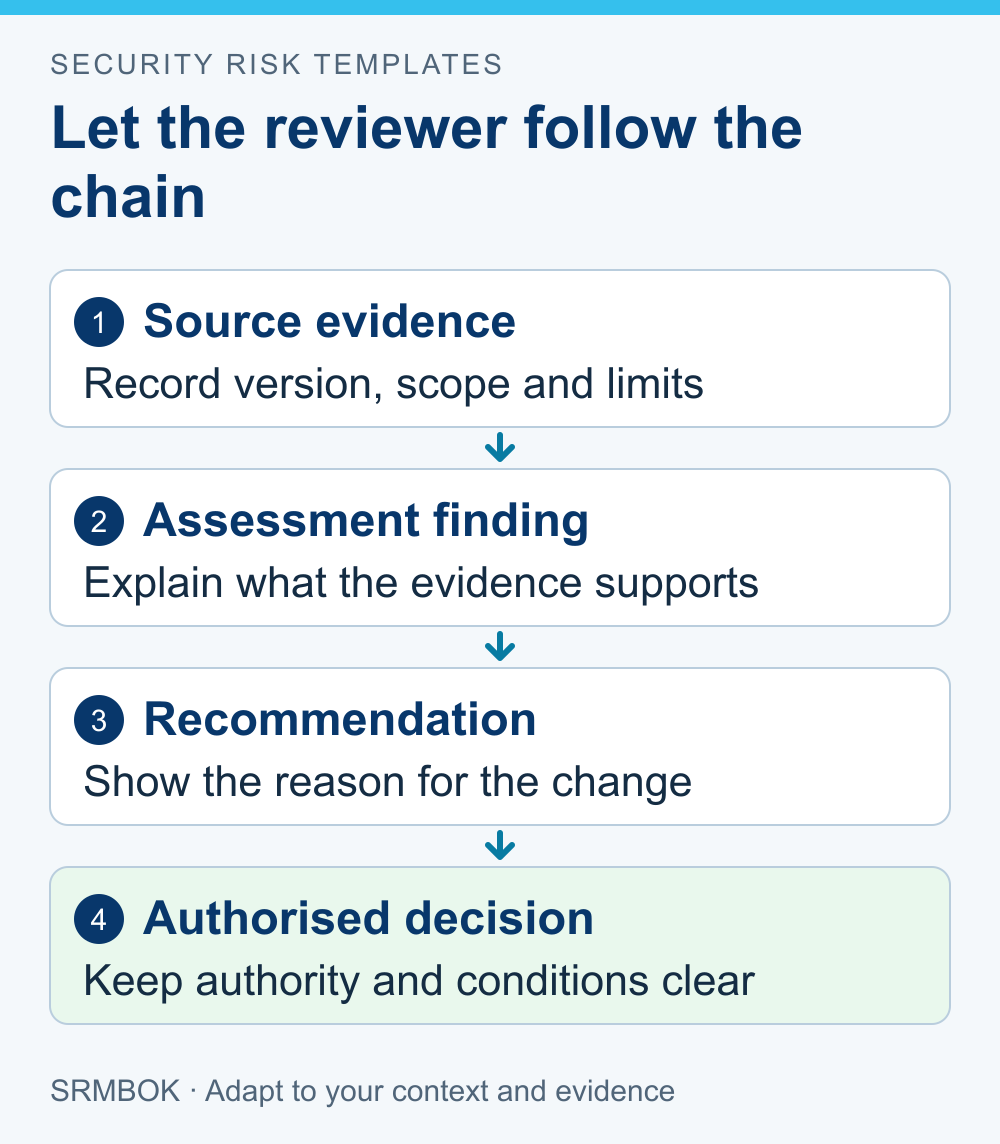
Keep the evidence separate from the conclusion
An evidence item might be an approved document, a dated observation, a relevant operating record or an attributed account. The finding explains what that evidence supports in the assessment.
A treatment recommendation adds another step: it proposes what should change and why. Keep these layers visible so a reviewer can challenge the reasoning without having to dispute the existence of the source.
The UK Government's 2025 AQuA Book distinguishes documentation of inputs, assumptions, decisions and assurance. That analytical discipline is useful for an assessment record, without making your security report a government analytical product.
Do not label an interview note as a test result or a design document as proof of current operation. The record type should reflect how the information was obtained.
Use stable identifiers and clear references
Assign a short evidence identifier that remains unchanged when the filename or storage location changes. Link findings and actions to that identifier rather than relying only on a descriptive folder name.
Record the title, source owner, version or date, scope, access conditions and the relevant location within a long document. If the source changes, retain an appropriate snapshot or version reference through the authorised document process, so a later reviewer can identify the version actually used.
A link alone may be fragile. The report should still tell an authorised reviewer what the source was and why it mattered if the original link later breaks.
Do not copy restricted material into a broadly shared report to make the link convenient. A controlled evidence register can identify who is authorised to inspect the source and how access is arranged.
Show the reasoning between evidence and finding
Write a short explanation of how the evidence supports the conclusion. Include conflicting information and material assumptions rather than only the records that support the preferred recommendation.
For example, a current procedure may allocate a task to a role. That supports a conclusion about documented responsibility. It does not, by itself, establish whether the role is staffed during the relevant period or whether the task is performed.
If several items are combined, explain their contribution. A reviewer should be able to tell whether the conclusion relies on one decisive result or on several limited observations considered together.
Keep the scope of the conclusion aligned with the evidence. A sample from one site, shift or supplier should not become an organisation-wide assertion without a reasoned basis for extending it.
Worked example: tracing an after-hours finding
A fictional assessment examines whether after-hours support responsibilities are clear. The assessor creates a small evidence chain:
| Reference | Record and scope | Contribution to the finding |
|---|---|---|
| E-014 | Approved contact instruction, current version | Identifies the nominated receiving role |
| E-015 | Interview with the relevant operations supervisor | Explains how the role is covered in the assessed period |
| E-016 | Agreed contact demonstration record | Shows the nominated route worked under the recorded conditions |
| F-006 | Assessor's finding with links to E-014–E-016 | States the supported conclusion and the untested fallback condition |
| A-003 | Follow-up action linked to F-006 | Assigns verification of the fallback arrangement |
The assessment can now say that the ordinary route was supported by the examined evidence. It cannot claim that the fallback was demonstrated.
If the client later supplies fallback evidence, the assessor can update F-006 and close or revise A-003 while preserving the original record. The new evidence does not need to be buried in an email that only one person can find.
Make review and correction visible
Record who checked a material finding, what they reviewed and the outcome. Factual verification by an operations manager is different from technical validation by an engineer or formal acceptance by a delegated risk owner.
Avoid ambiguous labels such as “approved” where the scope of approval matters. State whether the reviewer confirmed a fact, accepted a recommendation or authorised an operating decision.
When a correction changes the conclusion, record the reason and the affected references. Do not silently replace the evidence while leaving the old report in circulation without a clear version change.
Where the client disagrees, retain the disputed point and the basis of the disagreement. A requested wording change may improve accuracy, but it should not conceal a material unresolved concern.
Test the trail with a fresh reader
Ask an authorised colleague to choose one significant finding and follow the references without assistance. Can they locate the evidence, identify its period and understand why the conclusion follows?
Check whether the record makes its limits visible. A reviewer should not need to infer that an observed demonstration excluded an important condition.
Use the feedback to remove friction: ambiguous filenames, inaccessible folders, missing page references or duplicated versions. Do not add more fields unless they help answer a real review question.
This check assesses traceability. It is not a substitute for specialist review of the underlying method or technical conclusion where that is required.
Preserve the record at handover
Agree who will own the evidence register, where it will be kept and how authorised users can retrieve it. Confirm applicable retention and information-handling requirements through the organisation's responsible owners rather than inventing a universal retention period.
Use clear risk-register fields to retain finding references and connect recommendations to the treatment plan.
Your next action is to choose the most consequential recommendation in a draft report and follow it backwards to the source. Repair the first broken link before adding more narrative.
The paid SRMBOK Risk Assessment Template provides a report structure for context, analysis and treatment decisions. Add stable evidence references and an appropriately controlled register so its findings remain inspectable after the assessment team has moved on.