
Compare security risk consequences using explicit criteria for each relevant dimension, then retain the differences that matter to the decision. Do not average unlike harms into a single number merely because the register has one consequence column.
Start with the organisation's objectives and approved criteria. Identify who can explain effects on people, service continuity, information, finances and other relevant interests. The assessment team should not invent those thresholds without the appropriate authority and expertise.
The output should show both the overall judgement and its basis. Two scenarios can receive the same headline rating while requiring very different treatment, escalation and specialist input.
Describe the consequence before choosing its category
Trace the event to an effect on an objective. Equipment loss may lead to replacement cost, service interruption or a loss of information. Those effects depend on how the equipment is used and what alternatives exist.
Include the time dimension where it matters. A brief interruption and a sustained loss can have different consequences even though the initiating event is the same.
Ask which consequences are credible under the scenario being assessed. Avoid combining every imaginable extreme into a single narrative without explaining how those effects could occur together.
The UK Government's Orange Book recognises multiple consequence dimensions and the need for defined criteria. Its public-sector framework is a reference point; your organisation must establish the criteria and decision rules appropriate to its context.
Agree how multiple dimensions are combined
Some organisations use the highest relevant category; others retain a profile or apply a defined decision method. State the adopted rule and its rationale before using it, and retain the underlying dimensions even when the rule produces one headline category.
Do not assume that ordinal labels can be averaged as though they were measured quantities. A category labelled four in one dimension is not automatically twice a category labelled two in another.
Keep non-negotiable requirements and specialist decisions visible. A favourable financial result does not automatically offset a safety or legal requirement. Refer those questions to the responsible owners instead of resolving them through arithmetic.
If the organisation has no agreed combination rule, record that governance gap and seek an authorised decision. The assessor can propose a method, but should not quietly create organisational risk appetite in a spreadsheet formula.
Avoid counting the same effect twice
Trace the causal relationship between consequences. Lost revenue, compensation costs and reputational damage may be connected rather than independent amounts that can simply be added.
Where financial estimates are used, identify the basis, period and exclusions. Keep uncertain secondary effects separate from direct costs that can be supported more readily.
Reputation needs an explanation. State whose confidence could change, why that matters and how the effect could influence an objective. “Reputational damage” alone is too vague to guide a treatment decision.
For effects on people or specialist services, obtain competent input. Do not turn a general security workshop into an unsupported clinical, engineering or safety assessment.
Worked example: two losses with different consequences
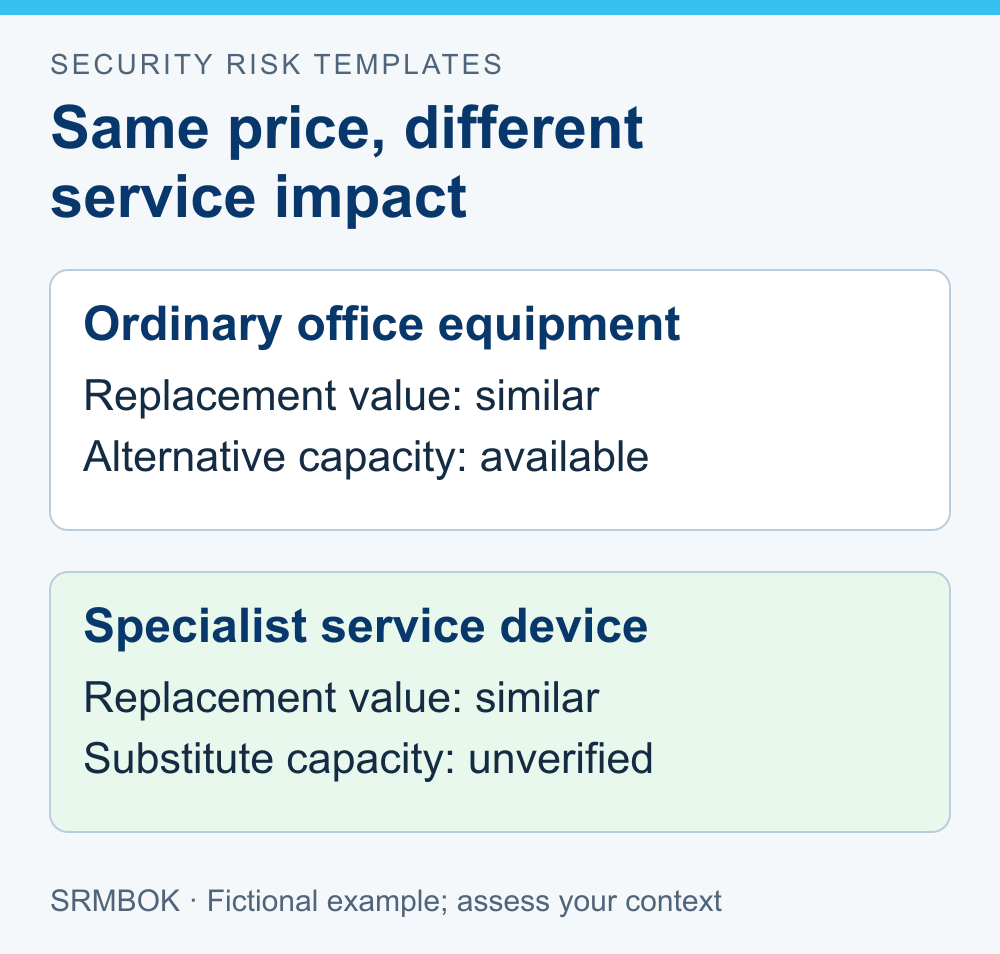
A fictional service business considers two equipment-loss scenarios. One involves readily replaceable office equipment; the other involves a specialised device needed for an important service.
The purchase values are similar. However, the second device has a longer replacement lead time and a more limited substitute. The assessment therefore needs more than an asset-value comparison.
| Dimension | Ordinary office equipment | Specialist service device |
|---|---|---|
| Direct replacement | Supported estimate available | Supported estimate available |
| Service effect | Alternative equipment is available within the assessed operation | Service owner must verify substitute capacity and lead time |
| Information effect | Depends on the actual data and protection on the equipment | Requires separate confirmation; cannot be inferred from the device's purpose |
| Confidence effect | Assess any relevant customer commitment | Explain how prolonged service loss could affect customer confidence |
The example does not assign universal ratings. It shows why similar purchase costs can lead to different assessment questions and priorities.
Once the service owner confirms the relevant impact and alternatives, the team applies its agreed criteria. It retains the consequence profile so a manager can understand what the overall rating means.
Keep scenario and consequence assumptions aligned
Check that the likelihood judgement refers to the same outcome you have described. The likelihood of equipment being unavailable is not automatically the likelihood of the most severe downstream consequence.
State the assumptions about duration, affected users and alternative capacity. If the scenario changes from one device loss to a wider disruption, revisit the consequence instead of keeping the old rating for convenience.
Where several credible outcomes matter, consider separate scenarios or a clearly described range. The aim is to support the decision without hiding materially different cases inside one overloaded row.
Record uncertainty beside the affected dimension. A known replacement cost should not make an unverified service-loss estimate appear equally certain.
Use the profile to choose treatment priorities
Ask which control or treatment addresses the important consequence. An action that reduces replacement cost may not restore the service any faster. A better substitute arrangement may reduce service impact without preventing the original loss.
Compare treatment options against the dimensions they are expected to change. Identify who can verify those changes and when the organisation may reasonably claim the benefit.
Do not use the overall rating as a substitute for explaining why one action comes first. Time to implement, dependencies, available interim protection and applicable obligations may affect the sequence.
Where dimensions create a trade-off, show it explicitly for the authorised decision maker. The report should help them understand the choice, not conceal it in a single score.
Record a short, reviewable rationale
For each material scenario, retain the consequence description, relevant dimensions, criteria applied, aggregation rule and key evidence. Include the owner of any unresolved specialist assumption.
A bow-tie analysis can help trace different consequences. Retain the reasoning behind each conclusion in an actionable register.
Your next action is to choose two risks with the same headline consequence rating and compare their underlying profiles. If they need different decisions, make those differences visible in the report.
The paid SRMBOK Risk Assessment Template provides a report structure for scenario analysis and treatment decisions. Adapt its consequence discussion to your approved criteria and preserve the important dimensions rather than forcing every judgement into a single unexplained cell.