
If alarm response is unclear, check the chain from detection to assessment, notification and authorised response. The fault may be an unclear responsibility or an outdated contact arrangement rather than the alarm device itself.
This article concerns intruder and building-security alarms at ordinary business premises. Fire, medical, process-safety and other specialist alarms need their own competent design and response arrangements. Do not alter or test a life-safety system through a general security exercise.
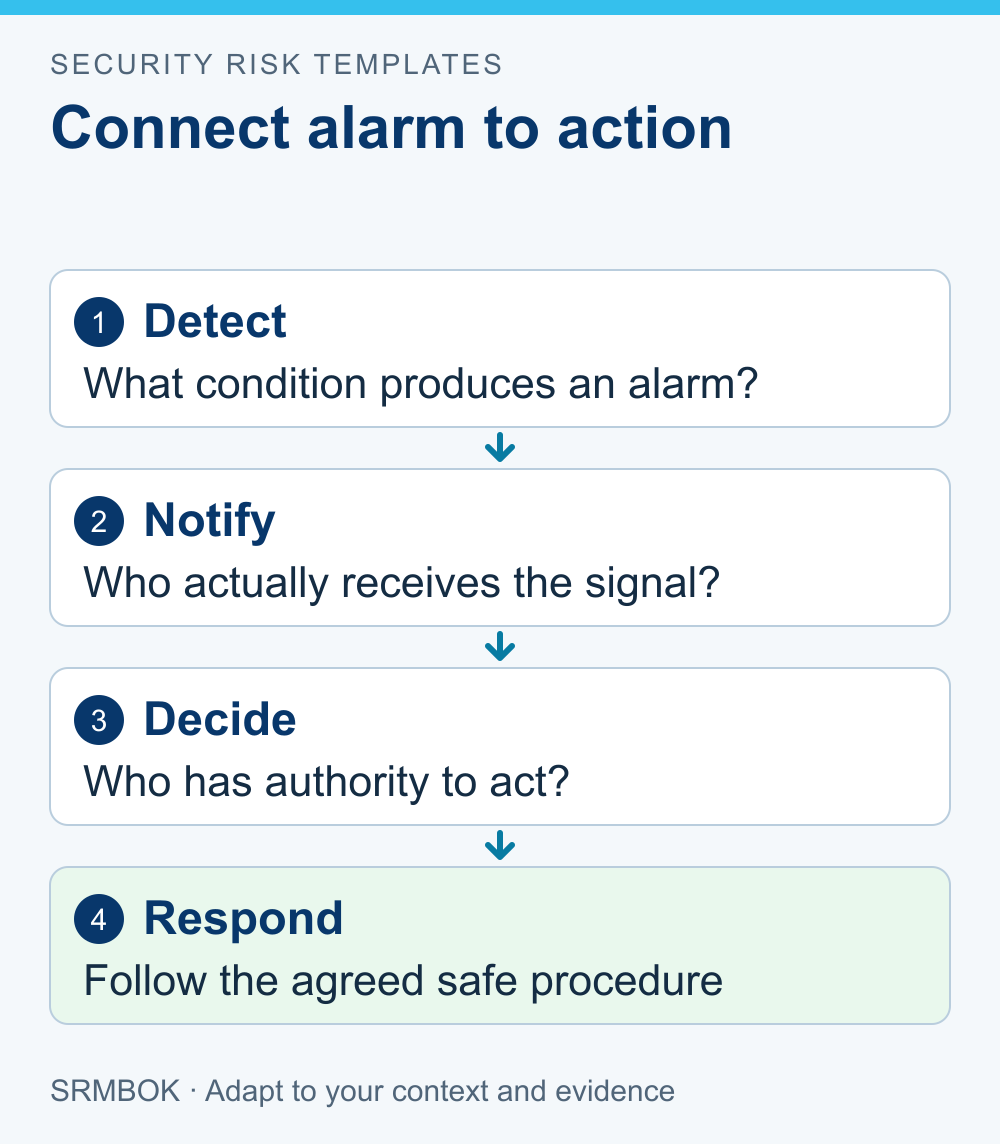
Separate the functions in the chain
Start by identifying what the system detects and where the signal goes. Then establish who interprets it, who decides on the response and who has the capability to carry out that decision safely.
An audible alarm, a message on a phone and a monitored service are different arrangements. Do not infer the response from the presence of an alarm sticker or a mobile application. Read the current service description and confirm the procedure with the responsible provider.
Queensland Police guidance on electronic security alarms distinguishes monitoring choices and states that Queensland Police does not monitor these alarm systems. For a site elsewhere, verify the local arrangements rather than assuming the same service model or a guaranteed police response.
Find the first point where the evidence stops
Take a recent activation and trace it through the records. Did the device detect an event? Did the monitoring point receive it? Was the correct person contacted? Did that person acknowledge it? Was a decision made and recorded?
Keep clock differences and incomplete records in mind. Two timestamps may not be directly comparable if the systems use different time settings. Record uncertainty instead of inventing a precise response interval.
The first missing record is a useful lead, but it is not automatically the root cause. A notification may have been sent to the agreed number while the duty roster failed to assign someone to carry the phone. The investigation should follow the operational arrangement as well as the technology.
Agree who can make the decision
Name a role with authority to assess the information and initiate the approved response. Provide an escalation route when that role cannot be reached or when the incident exceeds its authority.
“Call the manager” is insufficient if there are several managers or if the named person is on leave. Specify how the current duty contact is maintained and how a temporary replacement is confirmed. Protect personal contact details through the approved systems.
Do not make a lone employee the default person who goes to a potentially occupied premises. The response must account for the possibility of an intruder and the person's training, authority and available support. Immediate danger requires the appropriate emergency response.
Build a response record that exposes gaps
The fictional example below concerns a small office with an external monitoring provider. It describes management questions and omits operational details that would identify a real site.
| Step | Question to settle | Evidence of a working arrangement |
|---|---|---|
| Receipt | Which monitoring point receives the security signal? | The provider confirms the current routing and records an agreed test event. |
| Assessment | What information is available to interpret the event? | The responsible role can access the approved information and explains the decision route. |
| Notification | Who is the current authorised duty contact? | A maintained contact record matches the duty arrangement. |
| Escalation | What happens if the first contact does not answer? | The agreed exercise demonstrates the approved fallback route. |
| Closure | Who records the outcome and any fault? | The event record includes the decision, follow-up owner and unresolved issues. |
The table does not prescribe attendance times. Set performance requirements from your risk assessment, service arrangements and local conditions, then verify that the proposed response can meet them.
Investigate repeated unwanted alarms
Repeated activations can overload operators and encourage workarounds. Record their causes where known: equipment faults, environmental conditions, configuration problems or ordinary activities that the design did not accommodate.
Use those records to identify a correction with the installer or service provider. Do not solve the inconvenience by quietly disabling detection, ignoring a zone or silencing notifications without an authorised risk decision and suitable interim protection.
Check whether staff understand what an activation means. A device fault and a suspected intrusion may call for different actions, but the distinction must be clear to the people receiving the information. Ambiguous messages can undermine an otherwise sound response process.
Exercise the whole chain safely
Agree the test with the provider, the relevant site owner and anyone who could receive or act on the notification. Use the approved test mode or procedure. Establish how the exercise will be identified, who can stop it and how normal operation will be restored and confirmed.
Define the exercise objectives around the unanswered questions: whether the notification reaches the correct role, whether that person can make the required decision and whether the approved escalation occurs. A successful siren test would leave those questions unresolved.
Start with a normal contact path and then an agreed exception, such as an unanswered first contact. Do not involve emergency services in a test without the required prior arrangements. Record the observed result and any limitation that prevented a complete check.
Resolve gaps before declaring the system effective
If the exercise fails, identify whether the problem concerns detection, communication, decision authority or response capability. Assign a correction to the owner of that part of the chain. Retest the affected sequence after the change.
Keep an interim decision visible if the control remains unreliable. For example, the responsible manager may need to change operations or arrange suitable additional protection while a provider corrects the fault. The right measure depends on the site and the consequences of failure.
The receiving and response roles should match the security plan. Use a bow-tie if the team needs to see how detection and response affect the scenario.
Your next action is to ask the alarm provider and duty manager to describe the same activation from receipt to closure. Compare their answers. Any unexplained difference is a useful starting point for an agreed test or correction.
The paid SRMBOK Guide to Physical Security Specifications covers alarms, sensors and monitoring as part of physical protection. Use it to structure the required result and supporting arrangements, then confirm the technical specification and response procedure with the appropriate specialists.