
Before a staff member travels, agree what they will do if transport fails, communication is lost or they need urgent help. A business travel safety plan puts the essential arrangements and contacts somewhere they can use them under pressure.
Duty of care is a personnel security problem, not a paperwork problem
Business travel creates workplace safety responsibilities whose legal scope depends on the circumstances and jurisdiction. Confirm the applicable duties with your organisation’s safety and legal advisers. The difference is that a factory floor is a controlled environment and a departure lounge in an unfamiliar city is not. Treating business travel safety as a compliance box — "insurance purchased, ticket booked, form signed" — misses the actual risk, which is personal: the traveller's exposure to crime, civil unrest, medical emergency, or a targeted approach if they are carrying anything of value to someone else. This sits squarely in personnel security, alongside insider threat and pre-employment screening, because the person is the asset you are protecting and the person is also the one who has to execute the plan under stress.
Use current destination advice and confirm local contacts close to departure. Smartraveller’s preparation guidance is a useful Australian starting point; it does not replace an assessment of the particular work and traveller.
Categorise the trip before you plan the detail
Not every trip needs the same level of preparation. A day trip between two capital cities is a different risk profile to two weeks in a region with weak infrastructure, unstable governance or an elevated crime rate. Before filling in any checklist, make a judgement call on the trip's risk tier based on the destination's political stability, crime and security environment, the quality of medical and emergency infrastructure, and how easily the traveller can be reached and extracted if something goes wrong. This is a judgement, not a formula — government travel advisories are a useful input, but they are written for the general public rather than for your specific traveller doing your specific work, so they inform the tier rather than set it automatically.
Who makes that tier call also matters. Leaving it to the traveller alone invites optimism bias — the person going is usually the person least inclined to rate their own trip as high risk. A better arrangement is a short conversation between the traveller and whoever holds duty-of-care responsibility for the business unit, using the destination, the purpose of the trip and the traveller's own experience with the region as the inputs, and a defined escalation route to an authorised decision-maker when they disagree.
The business travel safety plan template itself: two pages, not a wiki
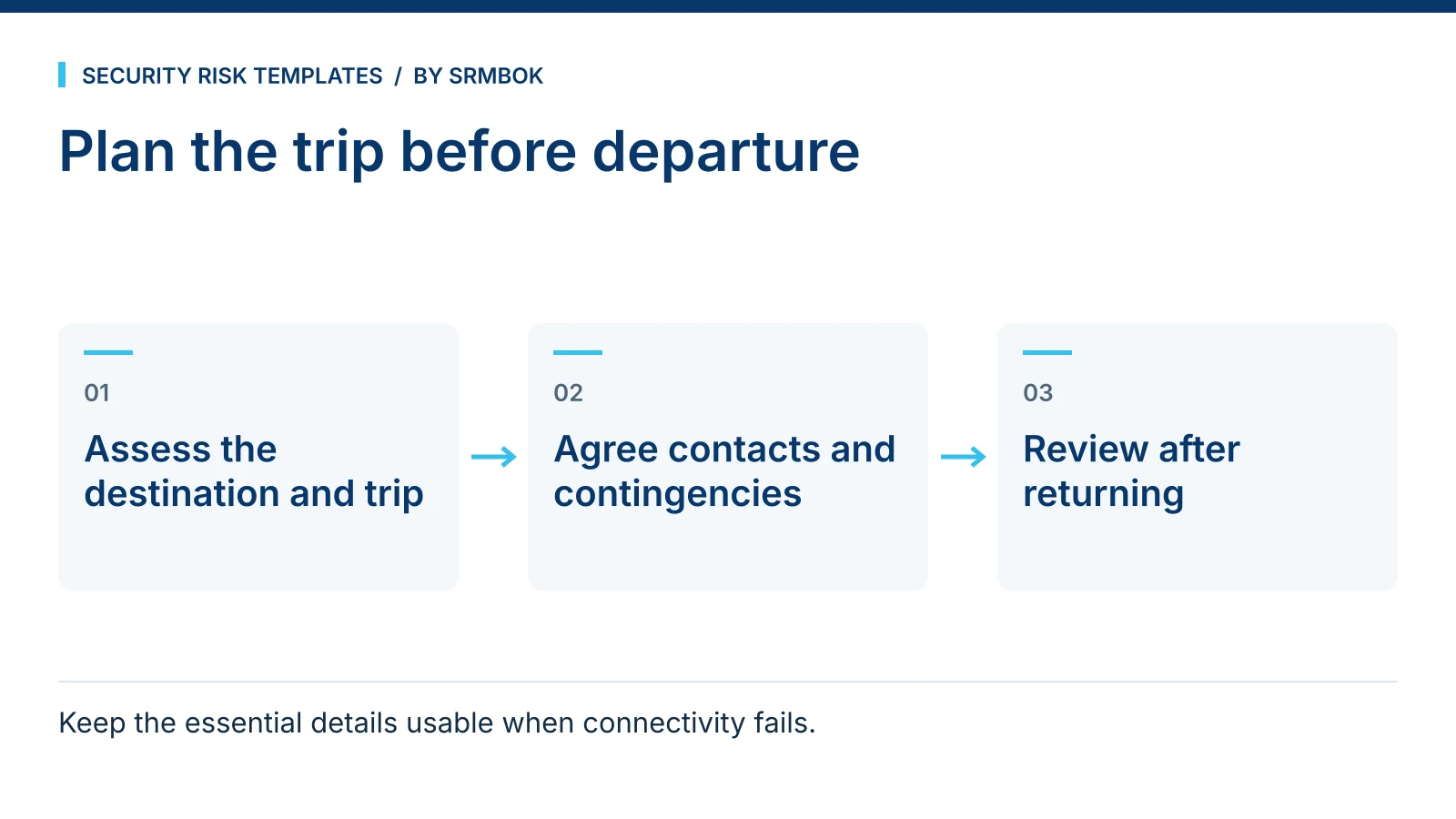
A travel safety plan that works under pressure is short. If it takes longer to read than the emergency it is meant to help with, nobody will open it when they need it. A practical structure has two parts.
Page one — before you go. A checklist covering pre-travel preparation (visas, vaccinations, insurance confirmed, itinerary shared with a nominated contact), emergency contacts, the critical information the traveller needs on hand, transport arrangements at both ends, what to do about their digital footprint, and — the part most plans skip — what they do if there is no internet access at all when something goes wrong.
Page two — if something goes wrong. Emergency contacts specific to the destination, not head office generalities: the nearest consulate or embassy, local emergency numbers, the organisation's after-hours contact, and passport and travel document details recorded somewhere other than the passport itself.
Digital footprint and the no-internet problem
Two things get missed in travel plans built by people who have not had to use one. The first is digital footprint: a traveller with location sharing on, a public calendar showing a hotel and dates, and a laptop full of client data is carrying more exposure than the trip itself. Before departure, decide what device the traveller actually needs — a loaner laptop with minimal data on it is a reasonable control for higher-tier trips, the same logic that applies to deciding what information should ever leave the building, worth thinking through with Bow-Tie Analysis Explained in 15 Minutes if you want to model exactly what could go wrong with a device compromise mid-trip.
The second is the assumption that the plan can live entirely in an app. If the traveller's phone is lost, stolen, flat or simply has no signal, an emergency contact list that only exists in the cloud is useless. The plan needs a printed or offline copy of the critical information: emergency numbers, document reference details and any essential medical information the traveller chooses to carry securely, and the nominated contact's number written down, not just saved in a phone.
Worked example: before and after
In this fictional example, a program manager, Priya, is sent from Melbourne to spend two weeks auditing a supplier's facility in a region flagged as medium-to-high risk. Compare what she was given against what a proper plan would contain.
| Element | Before (typical) | After (with a plan) |
|---|---|---|
| Itinerary | In her own inbox only | Shared with a nominated contact and manager, with check-in points scheduled |
| Emergency contacts | Head office switchboard number | Local emergency number, nearest consulate, after-hours company contact, all on a printed card |
| Devices | Personal laptop with full client access | Loaner laptop, minimal data, VPN access only, personal accounts logged out |
| No-signal contingency | None | Printed copy of contacts and critical information kept separately from the phone |
| Return trigger | Not defined | A pre-agreed condition that triggers an immediate return, decided before departure, not negotiated under pressure |
The last row matters more than it looks. Deciding in advance what would trigger cutting the trip short removes that decision from a moment when the traveller is stressed, has incomplete information, and may feel pressure not to be seen as overreacting.
Review the plan after the trip, not just before it
A travel safety plan is easy to treat as a one-off form filled in before departure and forgotten once the traveller is home. The more useful habit is a short debrief after any medium or high-tier trip: did the emergency contacts turn out to be correct, did the loaner device cause any problems getting work done, was there a moment where the plan did not cover something that actually came up. Feed that back into the template rather than into an email nobody reads again. A travel safety plan that has been updated by three actual trips is worth more than one written once by someone who has never had to use it under pressure.
Common mistakes
- Treating the travel policy as the travel plan. A reimbursement policy tells you what class of flight is approved. It says nothing about what the traveller does if their bag is stolen on day three.
- Sending a checklist with no destination-specific contacts. A generic emergency contacts list that does not name the actual nearest consulate is not much better than none.
- No pre-agreed return trigger. Without one, the decision to cut a trip short gets made in the middle of the event that should have triggered it.
- Assuming connectivity. Plans that live only in an app fail exactly when they are needed most.
- Skipping lower-risk trips entirely. A short domestic trip does not need the full plan, but "no plan for anything under a week" is how the one exception becomes the incident.
Get the template
The SRMBOK Personal Travel Safety Plan is a free two-page template built around this structure: page one covers pre-travel preparation, emergency contacts, critical information, transport, digital footprint and no-internet contingencies, and page two holds emergency contacts, passport and consulate details ready to use under pressure. Once travel is covered, the same personnel-security lens is worth applying upstream — to the suppliers your travelling staff are visiting, using Foreign Ownership, Control or Influence: Screening Suppliers for FOCI — and to the board-level risk questions this kind of exposure eventually raises, covered in Five Cybersecurity Questions Every Board Should Be Asking.