
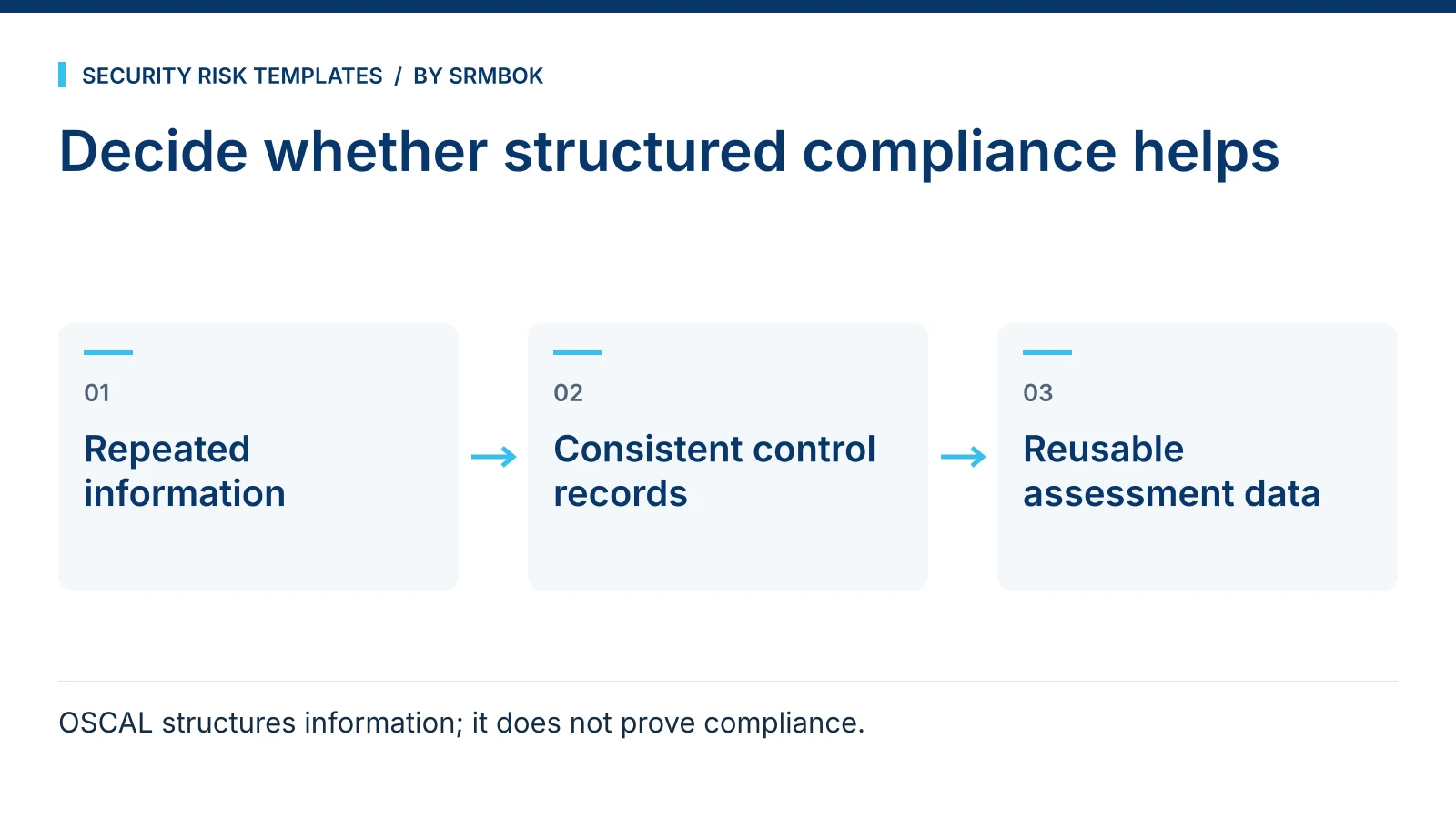
If a supplier has told you to become OSCAL-ready, first identify the compliance information you need to exchange and with whom. OSCAL may help structure that information, but its value depends on a real reporting or automation need.
What is OSCAL, actually?
OSCAL — the Open Security Controls Assessment Language — is a set of data formats developed by the US National Institute of Standards and Technology (NIST) for describing security controls, how they are implemented, and how they were assessed, in a structured, machine-readable way rather than as free text in a Word document or PDF.
Think about what a control looks like today in most organisations. The control itself lives in a framework document. Your implementation of it lives in a system security plan, described in prose. Your evidence that it works lives in a spreadsheet, an audit report, or a screenshot folder. Three different formats, written by three different people, at three different times, none of them able to talk to each other or be checked by software. OSCAL's purpose is to let all three be expressed as structured data that tools can read, compare and validate automatically.
The problem it solves
If you have ever had to answer the same control question for three different frameworks — because a client's contract cites one standard, your regulator cites another, and your own risk framework cites a third — you already understand the underlying problem. The control is conceptually the same. The paperwork is not, because each framework encodes it in different words, at a different level of detail, updated on a different schedule.
OSCAL does not solve this by inventing a single universal control set. It solves it by giving every framework, every implementation and every assessment result a common structural format. Once your control data is structured this way, it becomes possible to map one framework's controls to another's, generate an implementation record automatically from your actual system configuration, and produce an assessment result that a customer's tooling can ingest directly instead of a human having to read your PDF.
Who needs to care now, and who can wait
Government agencies and contractors dealing with US federal frameworks are furthest along, because OSCAL originated from that ecosystem and continues to be developed by NIST for that purpose. If you sell into that supply chain, or your compliance obligations are increasingly expressed through frameworks that are themselves moving toward machine-readable formats, this is not a future problem — vendors and assessors are already asking for it.
For most other organisations, OSCAL is not yet an obligation. It is a direction of travel. The practical question is not "do we need OSCAL today" but "how much of our current control documentation would survive being converted into a structured format without a rewrite." If your system security plans, control mappings and assessment evidence are already reasonably structured and consistent, adopting OSCAL later will be straightforward. If they are inconsistent free text scattered across shared drives, that is a risk worth knowing about regardless of what you decide about OSCAL specifically.
This is a judgement call, not a compliance deadline, and it is one every board should make deliberately rather than by default. Delaying a decision is a legitimate choice if you make it with your eyes open to what your control documentation actually looks like today. Delaying it because nobody has looked is not.
A worked example: one control, three views
Take a control most organisations have in some form: encryption of data at rest for a customer database. Below is the same control shown as it typically exists today, against how it would be represented once expressed in OSCAL's structure.
| Aspect | Typical current state | OSCAL-structured state |
|---|---|---|
| Control definition | A paragraph in a policy document, phrased slightly differently across three frameworks you comply with | A single structured control definition that each framework's profile can reference and tailor |
| Implementation record | A sentence in a Word-based system security plan: "Database encryption is enabled" | A structured implementation statement tied to the specific control, system component and responsible party |
| Assessment evidence | A screenshot and an auditor's sign-off in a PDF, filed by year | A structured assessment result recording what was tested, when, and the outcome, in a format a validation tool can check |
Nothing about the underlying control changes. What changes is whether a machine — or a person using the right tool — can find, compare and verify that record without manually reading three different documents.
Common mistakes
- Treating OSCAL as a new compliance framework. It is not a framework and does not replace ISO 27001, the ASD Essential Eight or any other control set. It is a format for expressing whichever framework you already use.
- Assuming it is purely a technical, tooling-team problem. The decision to adopt it, and the discipline to keep control documentation consistent enough to convert, is a governance question before it is an engineering one.
- Waiting for a mandate before doing any preparation. The organisations that struggle most when a framework does require OSCAL are the ones whose underlying control documentation was never consistent to begin with. That groundwork — consistent control naming, clear ownership, current implementation records — pays off regardless.
- Buying a tool before understanding the models. OSCAL vendors will happily sell a platform. Understanding what a catalog, a profile, a system security plan and an assessment result actually represent, before you buy anything, avoids paying for a capability you do not yet need.
- Assuming this is only relevant to large enterprises. Supply chain pressure moves downward. A mid-size supplier to a government prime contractor can find this requirement arriving well before their own risk maturity would suggest.
Where this fits in your existing program
OSCAL only has something to structure if your underlying risk and control information is already sound. That starts with knowing what you are protecting and how sensitive it is — our A Fully Worked Information Classification Example (Free) shows what that looks like in practice — and extends to having a risk register with fields disciplined enough to survive being machine-readable one day; see Risk Register Fields: The Minimum Set That Actually Works if yours has grown unwieldy. None of this requires abandoning your existing risk methodology. ISO 31000:2018 remains the right process framework for how you identify, assess and treat risk; OSCAL, if and when you need it, is a downstream question of how you document and exchange the control evidence that process produces. If you have not looked at ISO 31000 in a while, ISO 31000 Explained on One Page (Free Download) is a useful refresher before this conversation goes any further with your board.
Get the guide
Deciding whether OSCAL matters to your organisation requires both governance and technical judgement, and it deserves a clear brief rather than a vendor's pitch. The SRMBOK Guide to OSCAL is a non-technical explanation written for directors, CISOs and risk heads, covering the eight models, how a control moves through them end to end, ten board-level questions to ask, a twelve-question vendor checklist, a ninety-day pilot framework and a readiness self-assessment. Download the SRMBOK Guide to OSCAL before your next vendor conversation.