
For a visitor host handover, have the receiving host explicitly accept responsibility and update the visitor record before the handover is complete. A calendar invitation or an assumption that “someone upstairs knows them” is not a reliable transfer of responsibility.
This procedure suits an ordinary workplace where visitors are hosted or escorted. Adapt it for the site's access rules, accessibility needs and emergency arrangements. Visitors to public areas, patients and customers may be subject to different processes; do not impose an escort requirement where none is justified.
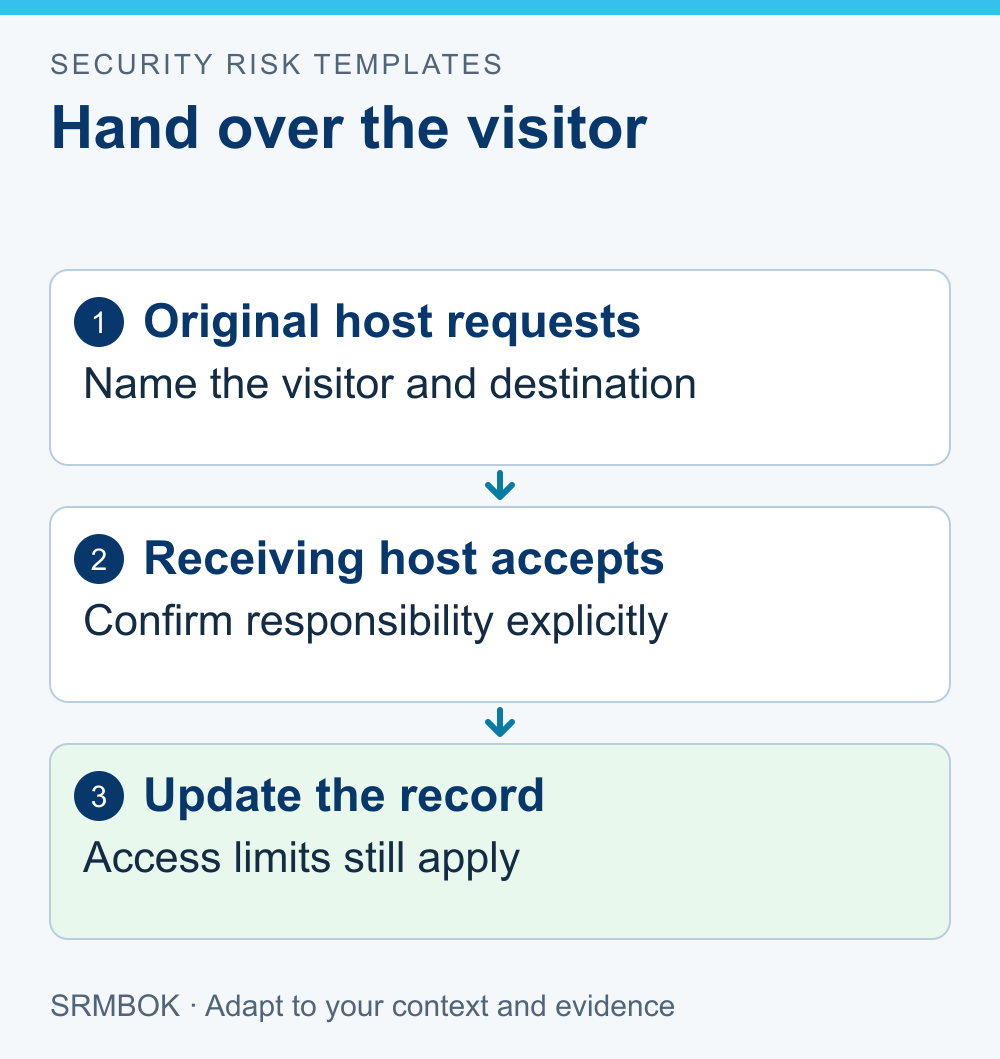
Define what responsibility the host accepts
Specify the host's role in plain language. Depending on the visit, it may include confirming the purpose, receiving the visitor, explaining relevant arrangements, staying with them in designated areas and arranging departure or another authorised handover.
Distinguish hosting from escorting. A person who organised the meeting may not be the person accompanying the visitor. Where an escort is required, name that role and its boundaries separately so neither person assumes the other is doing it.
NPSA's security-awareness guidance for staff includes taking responsibility for visitors on site. The practical handover below is a suggested way to make that responsibility visible; it is not a universal legal requirement.
Identify the handover points
Walk through a typical visit from arrival to departure. Look for places where responsibility changes: reception to host, one meeting to another, a host leaving unexpectedly, or a visitor continuing work after reception closes.
Ask the staff involved what actually happens. A written process may assume the original host remains available for the whole visit, while normal work involves several meetings and locations. Designing around the real sequence is more useful than repeating an instruction that cannot be followed.
Also define what happens if the receiving host is unavailable. The visitor should have a clear, safe place to wait and a known contact. Do not leave reception or a departing host to improvise access to restricted areas simply to keep a meeting on time.
Use a short handover with confirmation
A workable handover answers four questions: who is the visitor, who is accepting responsibility, what activity and area are authorised, and what must happen at the end? Share only the information the receiving host needs.
Confirmation should be affirmative. A message sent is not the same as a responsibility accepted. The method may be an in-person exchange or an approved communication route, provided staff can establish that the correct authorised person has accepted.
Update the record used by reception or security. That record does not need to become a detailed account of every conversation. It needs enough current information for staff to identify the responsible host and act during an exception.
Try the process with a fictional visit
In this example, a supplier representative attends an office demonstration followed by a meeting with a different team. Names and circumstances are invented.
| Stage | Required action | Useful record |
|---|---|---|
| Arrival | Reception confirms the visit and the original host receives the visitor. | Visitor identifier, original host and arrival confirmation. |
| Change of meeting | The original host contacts the approved receiving host and explains the agreed next activity. | Proposed receiving host and any relevant access limit. |
| Acceptance | The receiving host confirms and takes responsibility through the agreed handover. | Current host and handover time. |
| Departure | The current host follows the departure process and confirms closure. | Departure or pass-return confirmation required by site rules. |
Suppose the second host is delayed. Under this proposed procedure, the original host remains responsible until an authorised alternative accepts or the visit is brought to an appropriate end. The process should not silently transfer responsibility to reception because a meeting has finished.
Keep the access decision separate
A change of host does not automatically authorise entry to every area used by the new host. Check the visit's purpose and the access rules before movement. If the activity changes materially, use the site's authorisation process for that change.
For example, moving from a meeting room to a controlled work area may require a separate approval or briefing. Do not infer permission from a visitor's seniority, familiarity or possession of a general visitor pass.
Make the boundary easy to understand. The host should know whom to contact when a request exceeds the agreed visit. The visitor should receive a courteous explanation and an appropriate alternative while the request is resolved.
Handle exceptions without losing people
Plan for a host becoming unavailable, a meeting running late or a visitor needing assistance. Keep the alternative process proportionate and respectful. It should preserve safety and access boundaries without making staff invent a new rule under pressure.
Explain what to do if a visitor cannot be located or is observed without an escort where one is required. Use the site's reporting and response process. Do not direct staff to confront someone aggressively or make assumptions about intent from appearance.
Emergency arrangements take priority over routine sign-out. A visitor record can support accountability, but it should not be presented as proof that everyone is safe or that nobody remains in a building. Coordinate it with the established emergency procedure.
Test the handover, not just the sign-in screen
Use an announced exercise with staff acting as the visitor and hosts. Include a simple exception such as the receiving host being temporarily unavailable. Observe whether responsibility remains clear and whether the current record matches the actual handover.
Ask reception and both hosts to explain who is responsible at each point. If their answers differ, the procedure needs clarification. If the procedure is clear but the record cannot be updated, address the system or access problem.
Avoid testing with real visitors who have not agreed to participate. The purpose is to verify a process, not to embarrass staff or create a confusing security incident.
Keep the record proportionate
Collect and retain visitor information under the organisation's approved privacy and records arrangements. A handover process is not a reason to collect excessive identity information or retain movement details indefinitely. Make the current operational record accessible to the people who need it and protect it from wider disclosure.
Keep the handover consistent with the security plan and the authority established by the security risk policy.
Your next action is to walk through one multi-host visit with reception and the teams involved. Write down the acceptance step, backup route and record update. Then run a short exercise to check that all three work together.
The paid SRMBOK Procedure Template provides a structure for documenting a repeatable operational procedure. Use it to record your visitor-handover roles, steps, exceptions and review arrangements, then tailor the detail to the workplace.