
Assess university building security after hours by comparing the activities that continue with the people, services and response arrangements that remain available. A building can be authorised for evening use while a particular room, activity or support arrangement is unsuitable for that period.
Start with actual use: scheduled teaching, individual study, research, public events, cleaning and maintenance. These activities can overlap without sharing the same permissions or supervision.
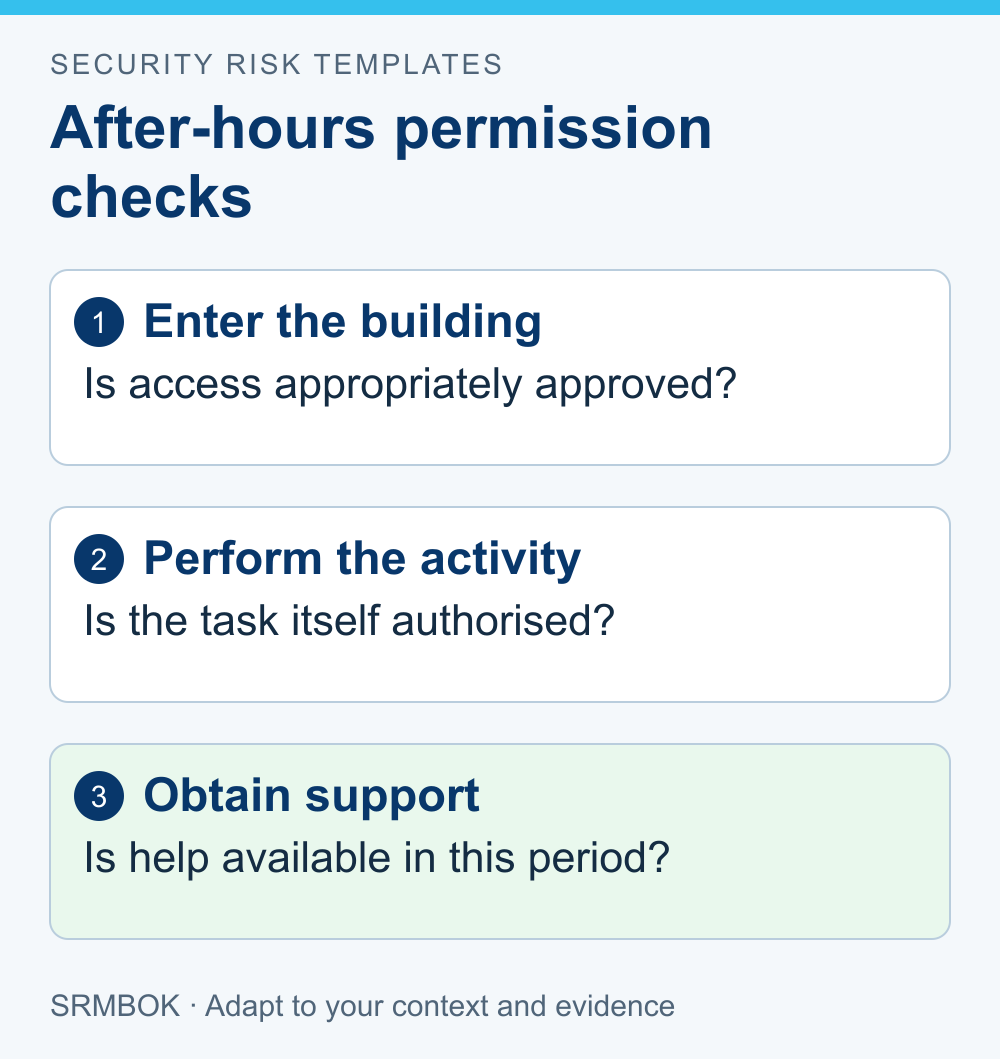
The assessment should produce clear operating conditions for each relevant pattern of use. Its value lies in explaining the gaps between permission to enter, permission to perform a task and the support available when that task takes place.
Describe occupancy as a pattern
List the main activities by location and period. Include people who are present without appearing in a teaching timetable, such as contractors, researchers or event staff.
Distinguish scheduled occupancy from occasional access. Ask how the university learns that an activity has changed, moved or extended beyond its booked time. Avoid treating an access record as a complete occupancy count unless its coverage and limitations have been established.
Record the services that change after hours: reception, local supervision, facilities support, campus security and emergency coordination. Verify the arrangement rather than inferring it from daytime experience or a telephone number on an old notice.
A compact occupancy profile should identify the activity, responsible role, permitted area, expected period and relevant support. Personal information should be limited to what the institution needs for the authorised purpose.
Separate three kinds of permission
Building access, activity approval and specialist authorisation are different decisions. A credential that opens a building does not establish competence to use a laboratory, workshop or other restricted facility.
Review how these permissions interact. Determine which role approves the activity, who sponsors the access entitlement and how changes reach the people responsible for the building.
Use the university's current policies and local arrangements. An assessor should not invent a lone-work rule or decide that every postgraduate student may use every space after hours.
Where the assessment identifies an unclear permission, record the decision that is missing. Avoid treating ambiguity as evidence that the individual has acted improperly. Often the organisation needs to clarify its own process.
Check support in the same operating period
The University of Melbourne's emergency-management guidance illustrates why occupancy changes matter: it calls for emergency arrangements to account for changes in the availability of relevant personnel when buildings remain in use. That is an institutional example, not a rule automatically applying to every university.
Apply the underlying question to your setting: are the arrangements assumed by the assessment actually available during the proposed activity?
Consult the responsible safety and emergency-planning staff. Security assessment should connect access and communication with those arrangements, while leaving specialist decisions under their proper authority.
Check how unfamiliar users obtain local information, report a problem and identify the assistance they need. Keep the distinction between routine support and emergency response clear. Do not replace official emergency instructions with an improvised article-based process.
Worked example: an evening course in a mixed-use building
A fictional university extends a professional-development course into the evening. The building also contains research rooms and offices. Daytime staff normally help visitors find the teaching area and resolve access problems.
The course organiser books the room and receives confirmation that the building can remain open. The assessment asks a different question: what supports the evening class once the daytime reception function ends?
| Assessment finding | Why it matters | Decision to resolve |
|---|---|---|
| The teaching booking has changed, but the local contact information has not | Participants may seek help through an unavailable service | Confirm the responsible evening contact and communicate it |
| Building access permissions are wider than the course's needs | Room booking and access sponsorship are disconnected | Review entitlements with the authorised access owner |
| Another activity continues elsewhere in the building | One organiser cannot account for every occupant | Coordinate shared-building arrangements without inventing a single attendance list |
| The class sometimes finishes late | The approved period may differ from actual use | Define how extensions are authorised and communicated |
The findings do not prove that evening teaching is unsafe. They show that the original booking decision omitted operating assumptions that need confirmation.
The team agrees a defined teaching period, an appropriate support arrangement and a change process. Separate research activity retains its own authorisation. The assessor records which evidence supports each condition and which matters still require a decision.
Include users who experience the building differently
Consult a representative range of users, including people working late, cleaners, reception staff, disability support and campus operations. A daytime walkthrough with managers alone may miss the practical difficulty of finding help in an unfamiliar building.
Ask about specific tasks and occasions rather than inviting broad claims that the building is always secure or always dangerous. Record the difference between an observed problem, a reported experience and an assumption needing verification.
Consider accessible communication, movement and assistance through the university's established processes. Do not make individuals disclose unnecessary health or personal information in a general security workshop.
Where a user describes a sensitive incident, direct the matter through the appropriate institutional reporting route. The assessment needs enough information to understand the control issue; it does not need to become an unrestricted case file.
Test a bounded scenario
Select one agreed after-hours scenario, such as an authorised class needing routine assistance when its usual organiser is unavailable. Ask participants to explain the expected handover and check the relevant records.
Use an authorised, non-disruptive demonstration if needed. Do not manufacture an emergency or trigger a response merely to see what happens.
Record the period, roles and conditions covered by the check. A successful demonstration during one activity does not validate every after-hours use of the building.
State the assessed activities and periods in the assessment scope, then update the relevant security plan through its authorised owner.
Your next action is to compare one evening activity with its daytime version and identify the first support assumption that changes. Resolve that point with the activity owner and campus operations.
The paid SRMBOK Risk Assessment Template provides a report structure for context, evidence, scenarios, controls and treatments. Use it to document the after-hours operating conditions and outstanding decisions, alongside the university's current permissions and specialist procedures.