
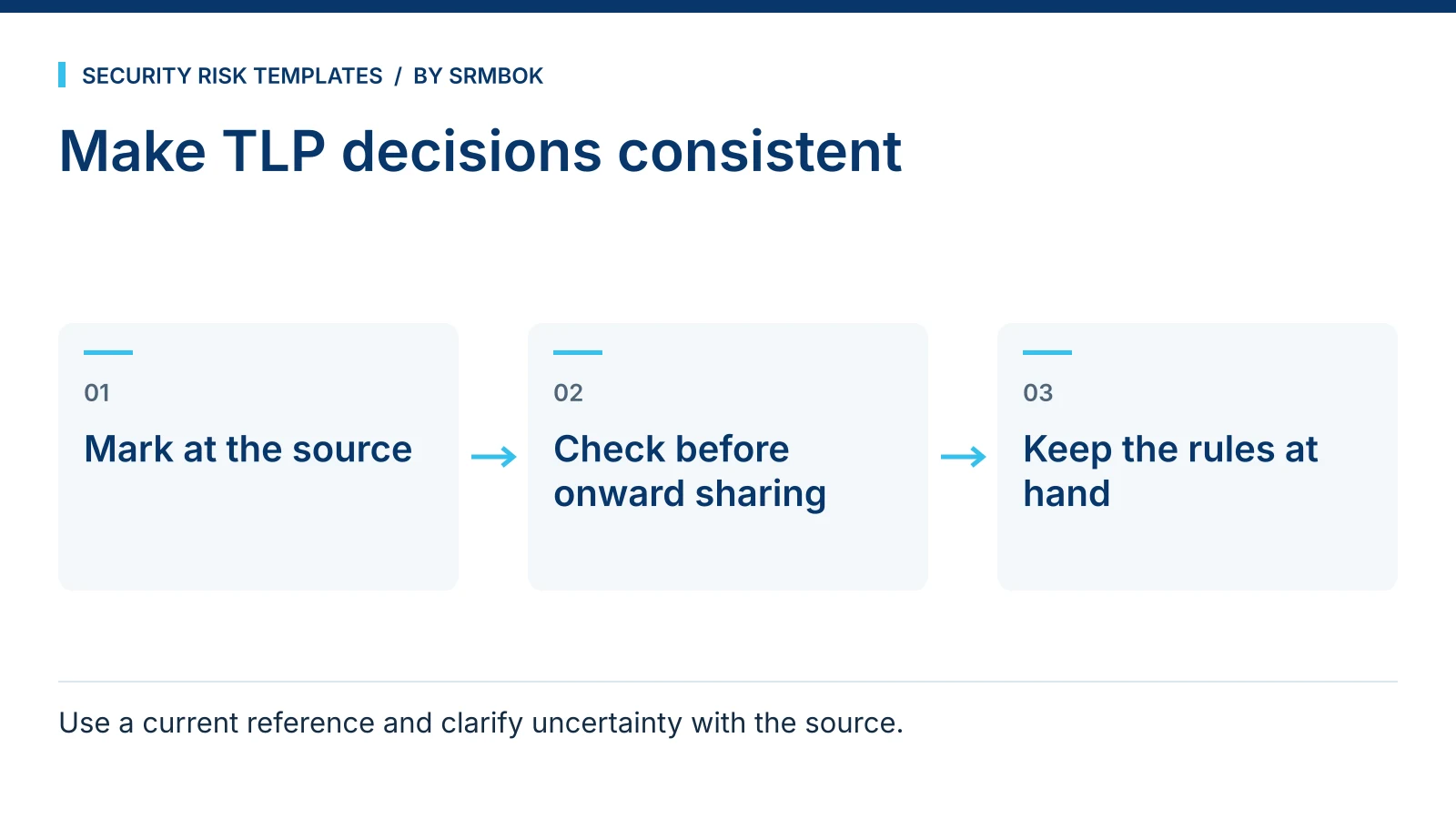
If analysts disagree about who can receive TLP-marked information, put the current sharing rules where they make those decisions. A clear desk or wall reference supports training and reduces reliance on memory during a busy shift.
What TLP is actually for
The Traffic Light Protocol is a labelling scheme for sharing sensitive information, telling the recipient how far they're allowed to pass it on. It doesn't classify how sensitive information is in some absolute sense — that's a separate classification question. TLP answers a narrower, more practical question: given this specific piece of information, who is the sender authorising you to share it with next.
The current scheme uses four labels: TLP:RED, restricted to the named recipients only, not to be shared further; TLP:AMBER, limited to the recipient's organisation and its clients on a need-to-know basis, with TLP:AMBER+STRICT limiting that further to the recipient's own organisation only; TLP:GREEN, shareable within the recipient's community but not published openly; and TLP:CLEAR, shareable without restriction. TLP:CLEAR replaced the older TLP:WHITE label, and AMBER+STRICT was added to give senders a tighter option between AMBER and RED — a distinction worth knowing if you're working alongside partners who still reference the older four-label version.
Why a TLP wall chart beats a wiki page
Every SOC has TLP documented somewhere — a wiki page, a policy document, an onboarding slide. None of that helps an analyst who's mid-triage and needs to decide, in the next ten seconds, what label to put on an email forwarding a partner's threat intelligence. A wall chart works because it's visible at the point of decision, not filed somewhere that requires stopping what you're doing to go and find it.
The practical failure mode isn't ignorance of what TLP is — it's the ten-second decision made under time pressure without a quick reference in the eyeline. A chart on the wall next to the analyst desks, plus a desk-sized version for anyone working from a smaller station, closes that gap far more reliably than an intranet page ever will.
There's also a training argument for a physical chart that a wiki page doesn't cover. New analysts absorb the scheme faster from something they walk past twenty times a shift than from a document they read once during induction and never open again. And a shared physical reference gives a team a common point to gesture at during a disagreement about a label, rather than each person defending their own recollection of a rule they read months ago.
Reading and applying a label correctly
The label on information you receive tells you what you're allowed to do with it — it's an instruction from the originator, not a suggestion. The label you apply when you send information forward is your own decision about how far you're comfortable letting it travel, made at the point of sharing, not retrofitted afterward when someone asks why it went further than intended.
A short worked sequence for handling an inbound TLP:AMBER threat report:
- Confirm the label on receipt — don't assume it matches what a similar report was labelled last time.
- Check who "the recipient's organisation and its clients, on a need-to-know basis" actually includes in your context before forwarding.
- If forwarding internally, mark the forward with the same label — don't strip it or leave it implied.
- If the information needs to go to a client or partner outside that circle, go back to the originator rather than deciding unilaterally that it's fine.
- If you're the originator of a new piece of information, choose the label based on what you're actually comfortable with the recipient doing next, not the label that's fastest to apply.
What the label doesn't tell you
TLP and formal information classification answer different questions, and a chart that conflates them causes as much confusion as having no chart at all. Classification describes sensitivity and associated handling requirements, with review rules set by the relevant scheme. TLP states the source’s sharing restrictions. A recipient cannot simply choose a less restrictive label when forwarding information. The same document can carry a classification marking and a TLP marking at the same time, doing two different jobs — one describes the information, the other governs what happens to it next.
Conflating the two shows up in practice as staff assuming a TLP:GREEN label means "not very sensitive," when it may simply mean the originator is comfortable with community-wide sharing of something that's still operationally significant. The wall chart should make that distinction explicit, not just list the four labels and their colours.
Worked example: an email that goes wrong
A fictional water utility's SOC receives a TLP:AMBER indicator report from an information-sharing partner describing a vulnerability affecting a specific SCADA vendor. An analyst forwards it to the utility's engineering team, who — under pressure to get a patch scheduled — forward it again to the vendor's support line to ask about a fix timeline, without re-checking the label.
That second forward breaches TLP:AMBER, because the vendor is not "the recipient's organisation and its clients." The fix isn't punishing the engineer. It's making sure the label was visible on the forwarded email in the first place — a one-line reminder in the subject or body of what TLP:AMBER permits — so the decision to forward again is made with the restriction in view, not from memory of a rule seen once during onboarding.
| Step | What went wrong | What the wall chart would have surfaced |
|---|---|---|
| Receipt | Label noted, then dropped from internal forward | Chart: always restate the label when forwarding |
| Internal forward | Sent to engineering, correctly within scope | — |
| External forward | Sent to vendor support, outside AMBER's scope | Chart: AMBER = your organisation and clients only, not third-party vendors |
Common mistakes
- Dropping the label when forwarding. The original email had TLP:AMBER in the subject line; the forward doesn't, and the next person in the chain has no way to know.
- Treating AMBER and AMBER+STRICT as interchangeable. They're not — STRICT removes the "and its clients" allowance entirely.
- Applying TLP to a document's overall sensitivity rather than its sharing instruction. TLP is about who it can go to next, not how secret it is in the abstract.
- No consistent labelling on outbound intelligence. If your SOC produces its own reporting, failing to label it means recipients default to their own assumptions about how far it can travel.
- Relying on memory instead of a visible reference. The rules are simple until someone's handling their fortieth email of the day.
Get the reference where people will actually see it
TLP discipline sits alongside other information handling controls worth having visible in the same space — A Fully Worked Information Classification Example (Free) shows how TLP and classification work together rather than being confused for the same thing. If insider handling of shared intelligence is a concern in your environment, Insider Threat Self-Assessment for Senior Managers (Free Checklist) is a useful companion check. And for SOCs benchmarking their broader technical control maturity, Essential Eight Maturity Assessment: A Free Self-Scoring Tool covers the wider control set TLP discipline sits inside.
The Traffic Light Protocol (TLP) Toolkit gives you an A3 wall chart for the operations centre, an A4 desk version, and a practitioner one-page guide covering markings, label selection, email and document marking, and the common mistakes. Download the free TLP toolkit and put the wall chart where the ten-second decisions actually happen.
Check the current FIRST TLP definitions when teaching or updating your local handling procedure. TLP does not override legal, contractual or other applicable restrictions, and CLEAR remains subject to normal copyright rules.