
Request security workshop evidence that supports the important decisions, with a named owner, relevant period and handling arrangement for each item. Sending a large generic document checklist can bury the useful material and make preparation harder for everyone.
Begin with the workshop purpose. A session defining assessment scope needs different inputs from one evaluating controls or agreeing treatment priorities. State what participants should be able to decide by the end.
Your evidence request should make preparation manageable and gaps visible. It should not imply that the workshop can verify every document, settle every technical question or approve a control merely because its owner attends.
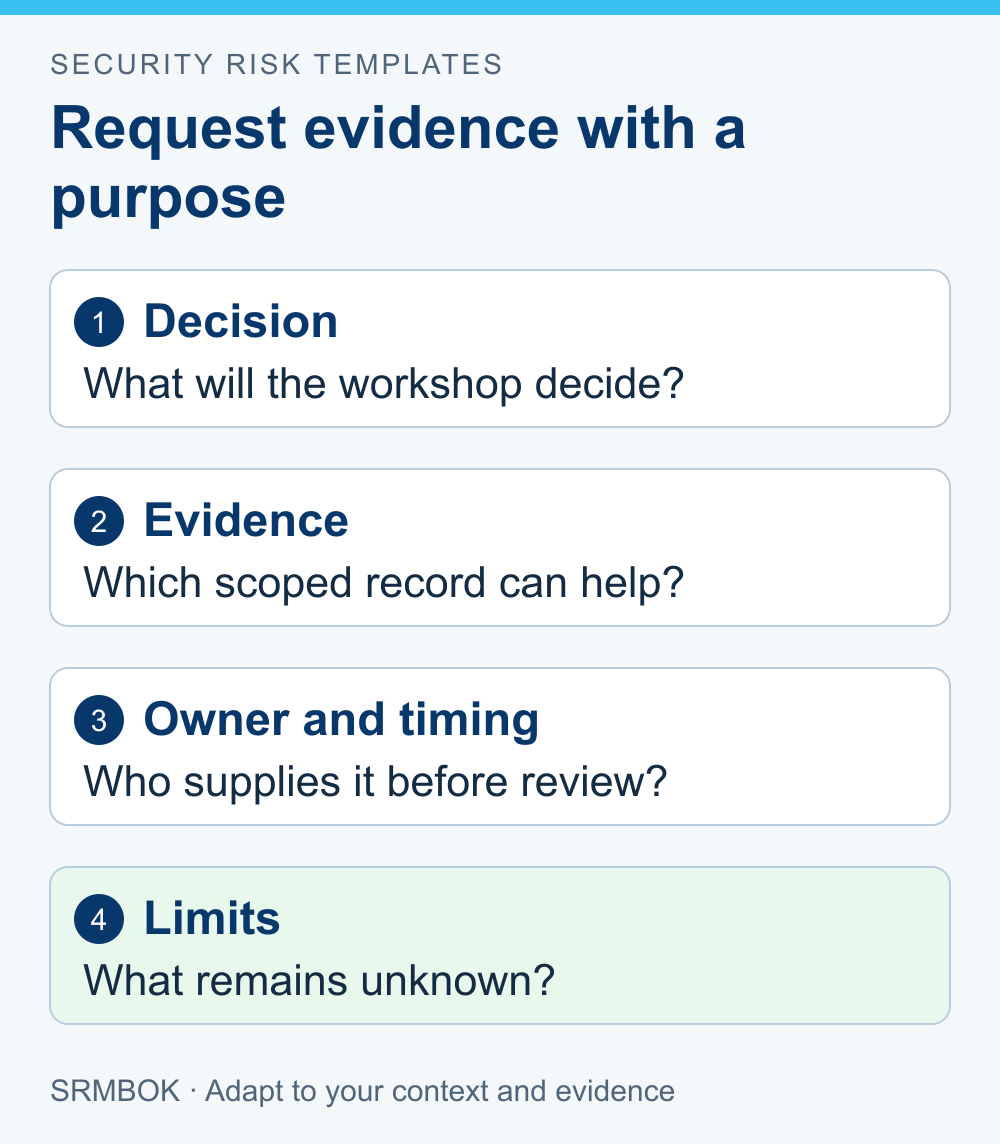
Turn the agenda into evidence questions
For each agenda decision, ask what information would change the answer. If the team is assessing a service interruption, it may need the service owner's impact explanation, current dependency information and evidence about the relevant recovery arrangement.
Distinguish information that establishes context from evidence supporting a control claim. An organisation chart may identify the responsible team; it does not demonstrate that the team performs a particular task.
Use the assessment approach to choose the evidence. NIST SP 800-53A Revision 5 distinguishes examination, interviews and tests in control assessment. That distinction helps explain why a policy file is only one possible input, even when your engagement is outside NIST's US information-system context.
Do not request every conceivable record in case it becomes useful. Start with material decisions and expand the request when a specific gap justifies the additional burden.
Specify scope, period and purpose
Name the part of the operation covered by each request. Ask for the current approved document or a relevant sample, rather than “all security procedures”. State the period needed and why it matters.
Describe the question the record should help answer. This allows the owner to suggest a more suitable source if your original request uses the wrong name or asks for a report the organisation does not produce.
Ask the owner to identify exclusions or known limitations, including whether an empty report means no events or incomplete collection. A maintenance summary might cover one contract but omit another system. A training report might record attendance without assessing capability.
Use a due date that permits review before the workshop. Material received as participants join the meeting has not been assessed merely because it appears in the shared folder.
Separate required preparation from useful background
Classify each request according to its effect on the workshop. Essential preparation supports a planned decision. Useful background helps interpretation. A later follow-up may be relevant without preventing the initial discussion.
Explain the consequence of missing an essential item. The workshop might proceed with a provisional finding, defer a particular decision or change its agenda. Avoid automatically cancelling all work because one document is unavailable.
Invite participants to flag unavailable evidence early. A record that does not exist needs a different response from one awaiting permission or retrieval.
Keep the request proportionate to the organisation. A small business may provide a current task record and responsible person's explanation where a large organisation has a formal reporting system. Assess the substance and limits of the evidence.
Worked example: preparing to assess after-hours support
A fictional facilities team plans a workshop on after-hours security support. The initial request asks for all incident, staffing and maintenance records. The assessor replaces it with a focused request:
| Workshop question | Evidence requested | Owner and limitation to confirm |
|---|---|---|
| Who receives a request for help? | Current approved contact and responsibility arrangement | Operations owner confirms the periods covered |
| Does the arrangement operate as described? | Relevant recent records or an authorised demonstration result | Control owner explains sampling and missing periods |
| What happens if the usual contact is unavailable? | Current fallback instruction and its verification evidence | Duty-management owner identifies untested assumptions |
| What service consequence could follow from delay? | Supported impact explanation for the assessed activity | Service owner states assumptions and unresolved questions |
The request is smaller, but its purpose is clearer. Participants can see which decision each item supports and which role needs to attend.
If fallback evidence is unavailable, the team can still map the arrangement. It must retain the limitation when discussing current control performance and any interim operating decision.
Protect information during collection
Agree a suitable repository and access permissions. Do not ask participants to email unrestricted copies of sensitive records merely because that is convenient for the facilitator.
Prefer a relevant extract or supervised inspection where the full record contains unnecessary personal, commercial or security information. Retain enough provenance to identify what was examined and the limits of the extract.
Confirm whether material can be shown to all workshop participants. A supplier representative or cross-functional attendee may not be authorised to receive every source document.
Where information cannot be shared in the group, arrange an authorised review and communicate the relevant conclusion with its limitations. Do not turn confidentiality into either an automatic pass or an assumption of failure.
Review the pack before the meeting
Check that the files open, their versions are clear and their scope matches the request. Look for contradictions, missing periods and references to arrangements that have changed.
Prepare a short evidence summary showing what is supported, what remains uncertain and which decisions need discussion. Keep lengthy source material available to authorised reviewers rather than reading it aloud in the meeting.
Avoid pre-assigning ratings simply because a document looks polished. The workshop should examine whether the evidence supports the relevant claim, under the conditions being assessed.
Send focused clarification requests where needed. Give participants a fair opportunity to explain an apparent gap before it becomes a headline finding.
Carry evidence gaps into actions
At the workshop, identify the basis of each material conclusion. Record additional evidence promised, its owner and the decision that remains provisional until it arrives.
The assessment scope helps determine which evidence is relevant. The assessment process shows which decisions that evidence needs to support.
Your next action is to take one workshop agenda and replace every generic document request with a question, scoped evidence item and accountable provider.
The paid SRMBOK 30-Day Risk Assessment Delivery Kit includes assessment guidance and workshop preparation material. Use its staged structure to organise the evidence request and review time, adapting the pack to the client's information permissions, decision needs and available capacity.