
Plan a security site walk-through around the work and control functions you need to understand, then record what you actually observe under the conditions present. A useful visit answers assessment questions; it does not merely produce photographs of doors and cameras.
Agree the purpose, route, participants and permissions with the site owner before arriving. Identify the operating periods that matter and which observations will require another visit or a different form of evidence.
The result should connect the site, its activities and its controls to specific findings. It should also show what the visit could not establish. A quiet daytime tour cannot demonstrate how an unfamiliar process works during a busy night shift.
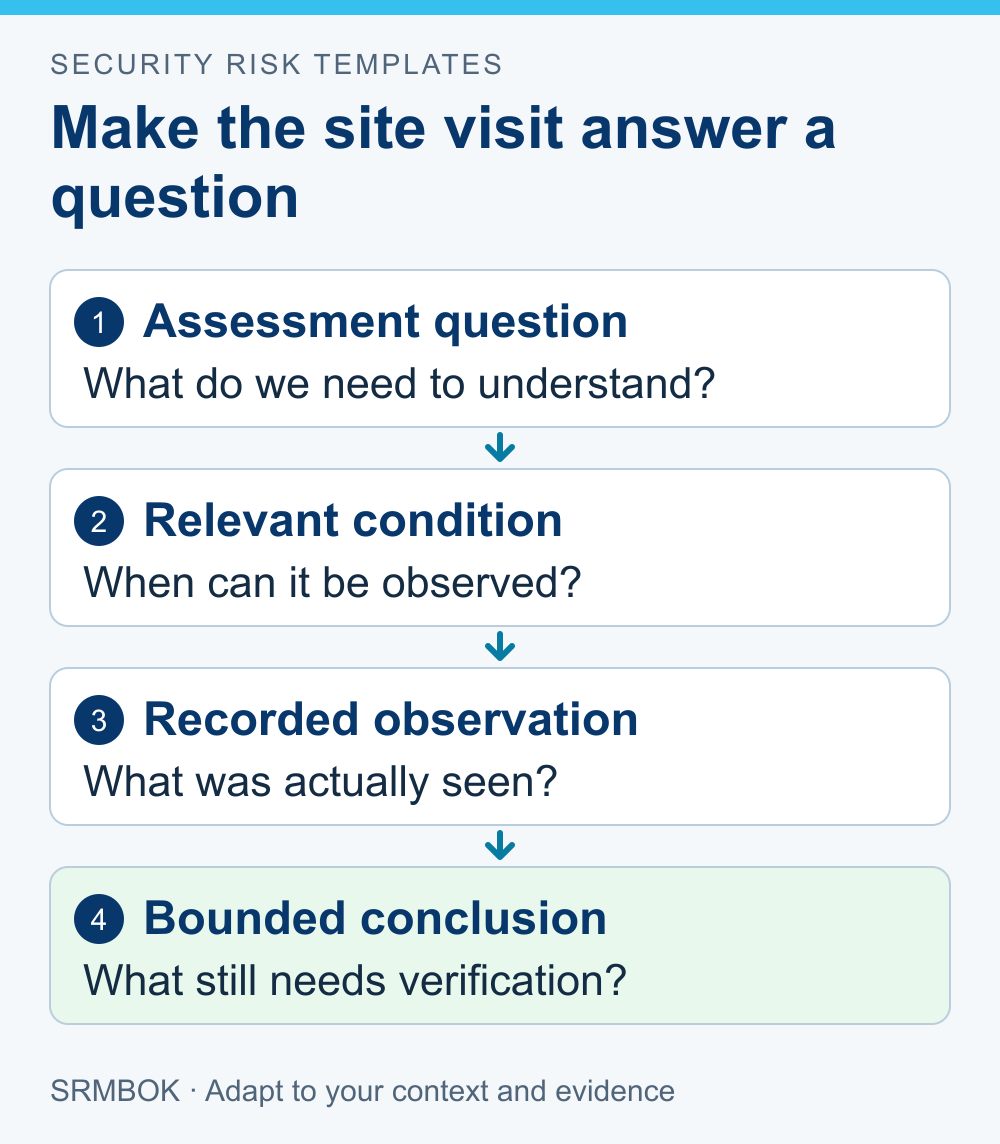
Choose the questions before the route
Start with the service or activity being assessed. Ask what must be protected, how people or goods move and which handovers could affect the outcome.
Select questions that observation can help answer. You might need to understand how visitors find reception, where a consignment changes custody or how a worker obtains assistance. Some technical control claims will require records or planned tests instead.
ProtectUK's risk-identification guidance, published in March 2024, includes walkthroughs, staff consultation and review of controls in their operating environment. Its context is UK counter-terrorism risk. The observation discipline can inform a broader site assessment without importing its threat assumptions into every business.
Keep your route connected to the questions. A tour determined entirely by the host's preferred sequence may miss a relevant boundary or operating condition. Discuss omissions openly rather than treating the escort as an obstacle.
Agree safe access and information handling
Confirm induction, escort, accessibility and protective-equipment arrangements with the site. Ask where photography, recording or document collection is permitted and how sensitive notes should be handled.
A walk-through is not authority to enter restricted areas, operate equipment, try credentials or activate alarms. If a question needs testing, record it and arrange the appropriate approval and competent support.
Avoid collecting identifiers, personal information or detailed configurations that the assessment does not need. A description linked to a controlled record may be more useful than a photograph copied into several presentations.
Agree how urgent findings will be raised. The assessor should know who can receive an immediate concern without having to finish the whole report first. That route should use the site's established arrangements.
Observe normal work before discussing improvements
Watch how the relevant task proceeds, where practical and authorised. Ask the person responsible to explain the task at a suitable pause, without distracting them during hazardous or time-critical activity.
Record the date, period, activity and conditions. Note whether you saw normal work, a demonstration or an explanation of what ordinarily happens. Record any special arrangements made for the visit that could limit how representative it is. Those observations support different conclusions.
Keep the current arrangement distinct from a planned improvement. A host pointing to where a new system will be installed is describing a proposal, not demonstrating an existing control.
Avoid diagnosing the whole problem at the first visible defect. A damaged item may matter, but its consequence depends on its purpose and the other controls involved. Establish the function before deciding the priority.
Worked example: a visitor-access observation
A fictional office assessment examines how visitors reach the correct host. During the visit, the assessor sees one ordinary arrival and discusses an exception with reception.
| Observation or account | Suitable record | Limit of the finding |
|---|---|---|
| One visitor is met by the expected host | Date, period and observed handover | Does not establish all arrivals are handled consistently |
| Reception explains the process when a host is unavailable | Attributed account and referenced instruction | Requires confirmation under the relevant condition |
| A revised visitor guide is awaiting approval | Current draft reference | Cannot be credited as an issued instruction |
| The route to a shared area is outside the agreed visit | Explicit observation exclusion | Refer to the responsible property representative for evidence |
The assessor now has a focused follow-up list. The visit has neither proved that the entire access process works nor demonstrated that every unobserved step is defective.
The next decision is proportionate: obtain the current instruction and verify the unavailable-host handover through an agreed method. A broader exercise is only justified if the evidence question requires it.
Use a short observation record
For each material finding, capture the location or controlled reference, activity, observation, source and relevance to the assessment question. Add the evidence still needed and the person who can help obtain it.
Write descriptions that another authorised reviewer can understand. “Poor security” is a conclusion without a basis. “The receiving role for the stated exception was not identified in the instruction provided” identifies something specific to resolve.
Keep photographs linked to their purpose and context. A picture of an open door does not establish why it was open, whether the area was supervised or whether the condition breached a requirement.
Do not fill the report with every minor observation. Group routine matters appropriately, while retaining significant findings and their evidence. The reader should be able to see which observations could change a risk decision.
Examine variation deliberately
Consider whether staffing, public access, work volume, weather or maintenance changes how the relevant control operates. Select follow-up observations according to the assessment purpose and the consequence of being wrong.
Where another visit is impractical, agree an alternative evidence source and state its limits. A current operating record may answer one question, while an authorised remote walkthrough may answer another.
Avoid describing a convenience sample as comprehensive coverage. Record which conditions were examined and why. This makes the assessment easier to update when a previously excluded condition becomes important.
Close the visit with a factual recap
Summarise material observations and outstanding evidence with the site representative. Separate immediate matters, questions requiring clarification and proposed improvements that still need analysis.
Confirm who will provide the missing information and by when. Give the host an opportunity to correct a factual misunderstanding without asking them to endorse conclusions that have not yet been developed.
Define the visit's boundary through the assessment scope, then connect observations to the wider assessment process.
Your next action is to choose five questions for your next site visit and specify which operating condition would let you observe each one meaningfully.
The paid SRMBOK 30-Day Risk Assessment Delivery Kit provides assessment planning and workshop material. Use it to place the walk-through within the wider evidence and review process, with the site's permissions, observation limits and follow-up decisions made explicit.