
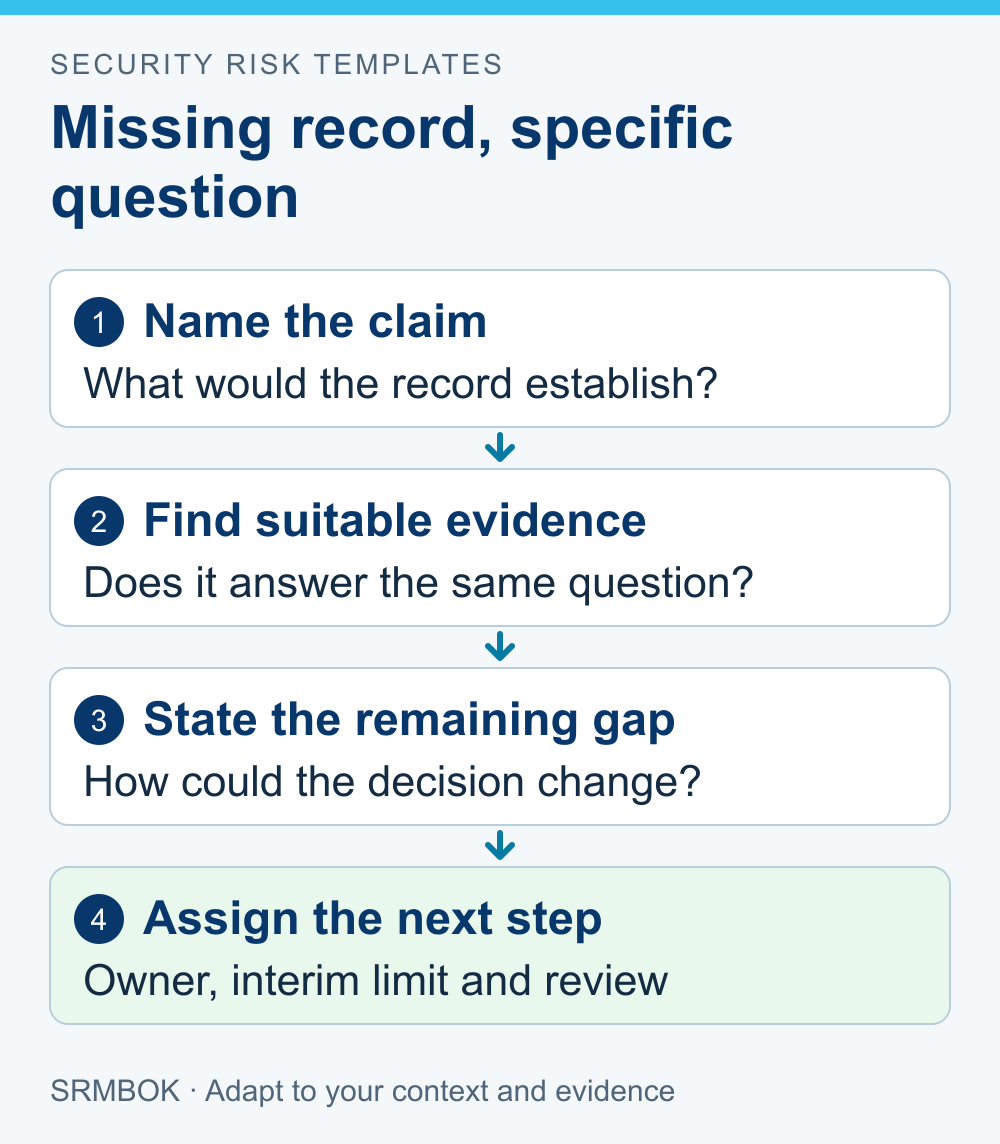
When security records are missing, identify exactly what they would establish. Then seek proportionate alternative evidence and state the remaining limits. Missing documentation is not proof that a control failed, but it can prevent you from making a defensible claim that the control works.
Start with the decision at risk. A missing drawing, training record and test result affect different questions. Treating them all as “poor documentation” hides the practical consequence of the gap.
The assessment should leave the manager with a clear choice: obtain better evidence, make a bounded interim decision or change the planned activity. It should not produce an apparently precise rating that conceals an unsupported assumption.
Establish what is actually missing
Distinguish records that never existed, records that cannot be located, records held by another party and records you are not authorised to inspect. These conditions may require different owners and actions.
Confirm that the request used the correct terminology and scope. Sometimes an assessor asks for a document title the organisation does not use, while the required evidence exists in another system.
Record the relevant period. A current instruction may establish today's intended process without demonstrating its operation or explaining past performance. An old test report may be genuine but no longer apply after a material change.
Do not infer deliberate concealment from an incomplete response. State the facts and follow the agreed escalation route if access to necessary evidence remains unresolved.
Explain which conclusion cannot yet be supported
Tie each gap to a specific question: what is installed, who is authorised, how a task was performed or whether the intended outcome was demonstrated.
NIST's Guide for Conducting Risk Assessments, SP 800-30 Revision 1, includes assumptions, constraints and information sources in assessment preparation. It is US information-security guidance, but the need to make evidence limits explicit applies usefully to a broader site assessment.
Write the limitation beside the affected conclusion. A generic disclaimer at the back of the report is easy to overlook when a manager reads the recommendation or rating.
Distinguish an evidence gap from a requirement breach. If an applicable requirement specifically calls for a record and that record is absent, the missing record may itself be a finding. Establish the requirement and facts before making that statement.
Seek alternatives that answer the same question
Ask the responsible owner what else can support the claim. Options may include controlled system records, supplier evidence, interviews, observation or an authorised demonstration.
Check equivalence carefully. A purchase invoice supports acquisition, not installation quality. A photograph can show a component was present, but may not establish current operation or the conditions under which it performs.
Use more than one source where the consequence justifies it. Agreement between a procedure, a responsible person's account and a relevant operating record can be useful, provided you understand whether those sources are genuinely independent.
Avoid unnecessary intrusive testing. If resolving the question requires technical work or could affect protection, arrange it through the site's authorised process with competent people and appropriate safeguards.
Worked example: unavailable commissioning evidence
A fictional business inherits an access-control system when taking over premises. The current team cannot locate the original commissioning record.
The assessor initially considers marking the system ineffective. On review, that would overstate the evidence: the absence of the record does not establish that the system fails. It does leave important claims unsupported.
| Question | Alternative evidence | Remaining limitation |
|---|---|---|
| What system is currently in service? | Current controlled inventory and competent inspection | Historical configuration may remain unknown |
| Who administers permissions? | Current authorisation and operating records | Past entitlement decisions are outside this evidence |
| Does a defined function meet the current requirement? | Approved, safely planned functional verification | The result covers the tested function and conditions only |
| Were all original contract requirements met? | Supplier archive or original acceptance evidence | Current testing may not establish historical contract completion |
The team can make a current operating decision without inventing a historical acceptance record. It may need new verification and a separate contractual or asset-record action.
The report states which questions have been answered and which remain open. That is more useful than applying one unsupported label to the entire system.
Assess how much the uncertainty matters
Consider plausible outcomes if the missing claim proves true or false. Would the treatment priority, operating limit or acceptance decision change?
If the decision is unchanged across the credible range, document that reasoning and avoid disproportionate evidence collection. If the decision changes materially, prioritise resolving the gap or refer the interim decision to the authorised owner.
Do not replace uncertainty with the worst imaginable scenario. Use credible conditions supported by the site context and obtain specialist input where the consequences require it.
Avoid invented numerical confidence percentages. You can explain that a conclusion relies on an unverified assumption without pretending to have measured the probability that the assumption is correct.
Agree a bounded interim arrangement
Where work must continue before evidence is complete, identify the responsible decision maker and the conditions they are being asked to accept. Include the current protection, unresolved question, interim measure and review trigger.
An interim decision should not silently become permanent. Name the owner responsible for obtaining evidence and the condition that ends or revises the arrangement.
The assessor should not grant themselves operating authority. Their role is to make the evidence and implications clear enough for the authorised person to decide.
If the evidence gap prevents the engagement from meeting its purpose, say so directly. A partially completed assessment can still be useful, but it should not be presented as a complete assurance result.
Close the gap without rewriting history
When new evidence arrives, record what changed and update the affected conclusion. Preserve the earlier limitation and decision record where required by the organisation's document controls.
Keep the evidence limitation attached to the assessment scope and put unresolved verification work into an accountable schedule.
Your next action is to choose one missing record and write the exact claim it would support. Seek an alternative that answers that claim, rather than collecting unrelated paperwork.
The paid SRMBOK Risk Assessment Template provides a report structure for context, findings and treatments. Use it to keep evidence limits, interim decisions and follow-up ownership beside the scenarios they affect, replacing its worked examples with the site's actual information.