
Resolve a risk rating disagreement by identifying which assumption, evidence item or criterion produces the different judgements. Do not begin by asking participants to compromise on a colour or vote for a score.
First confirm that everyone is assessing the same event, consequence, period and control state. A person rating the current operation and another rating a proposed future arrangement can reasonably reach different answers while using the same matrix.
The useful outcome is a better-supported decision, which may include a documented unresolved difference. Agreement is valuable when it reflects shared understanding; it is not evidence that the underlying risk has changed.
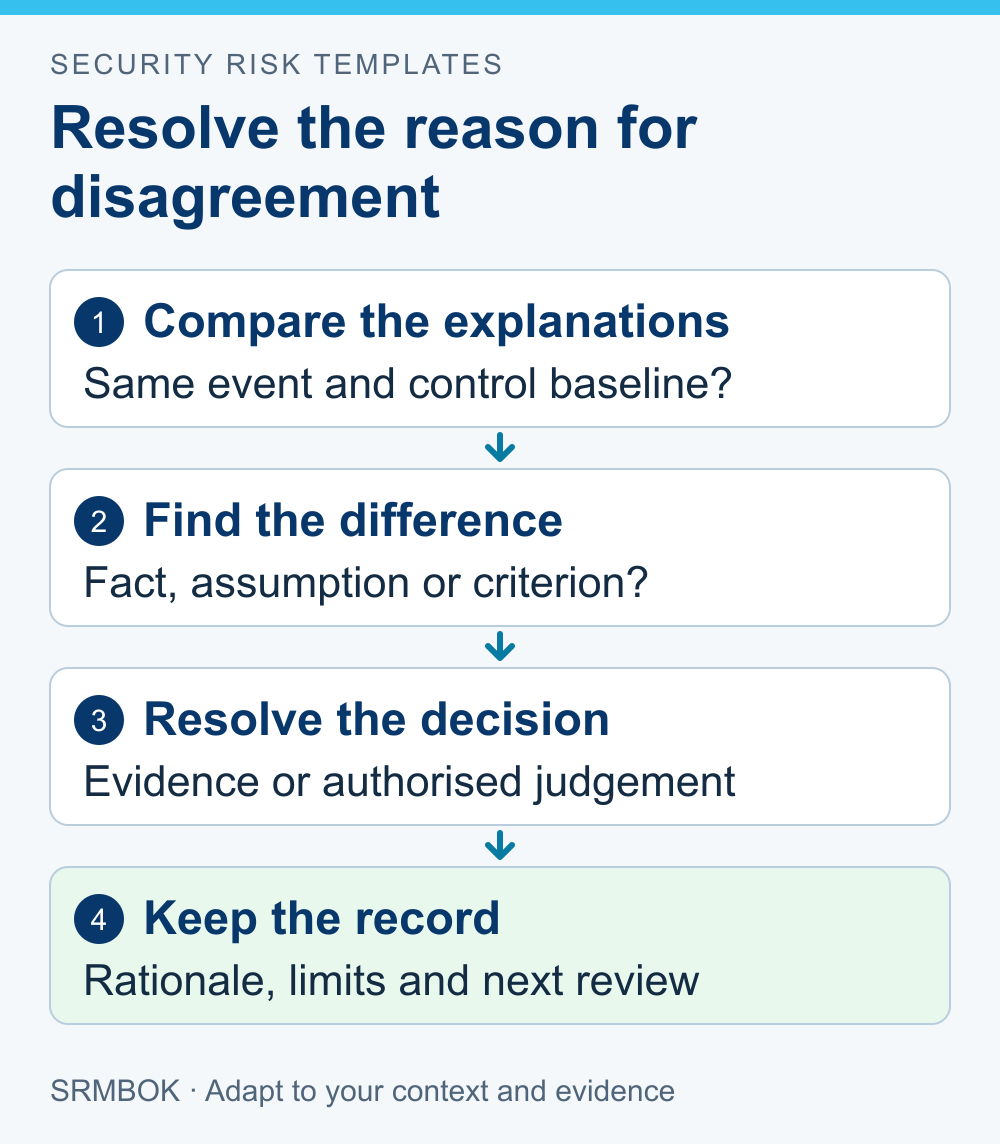
Put the two explanations beside each other
Ask each participant to state their conclusion and the main reasons for it. Keep the initial explanation short enough to compare, without allowing interruptions that turn the exchange into advocacy.
Record the scenario, evidence, assumptions and criteria each person used. Separate a disagreement about facts from a disagreement about how the organisation should respond.
The UK Government's 2025 AQuA Book emphasises communicating assumptions, uncertainty and analytical limits. Applying that discipline here makes a disagreement inspectable instead of leaving it as a contest between confident opinions.
Avoid attributing a view to bias or lack of competence without evidence. Different roles can have access to different information, and the apparent conflict may reveal a missing part of the assessment.
Check the event and baseline first
Read the risk statement aloud and ask what each person believes would happen. Clarify the event boundary and whether they are considering an attempt, a successful event or a particular harmful consequence.
Check which controls are included. A proposed treatment cannot be counted as an existing control simply because the project has been approved. An installed control should not be credited with unverified performance beyond the evidence available.
Confirm the period and operating conditions. A rating for a normal staffed period may differ from a rating during an unusual change or degraded operation.
Resolve these differences before debating the matrix category. If the participants are describing materially different scenarios, separate them and assess each on its own terms.
Classify the source of disagreement
A factual disagreement needs evidence. A criteria disagreement needs clarification of the adopted definitions. A consequence disagreement may need the service owner or a specialist. A disagreement about acceptability belongs with the authorised decision maker. Seniority may establish decision authority; it does not establish which factual account is correct.
Do not expect one workshop technique to resolve all four. More discussion cannot establish whether a test was completed if the relevant record has not been obtained.
Use a simple issue record: disputed point, competing interpretations, decision affected, evidence or authority needed, owner and next review. Keep it linked to the relevant scenario.
If participants agree on the evidence but value the trade-off differently, say so. That is a management decision about priorities or appetite, not necessarily a technical failure by either assessor.
Worked example: an assumed alternative service
A fictional team assesses loss of a support service. Operations rates the consequence lower because an alternative provider is available. Security rates it higher because that provider's capability has not been verified.
Both are using the same consequence criteria. Their disagreement rests on a specific assumption about the alternative.
| Point to compare | Operations view | Security view |
|---|---|---|
| Alternative provider | Named in the continuity plan | Named, but the relevant service scope is unclear |
| Availability during the scenario | Expected to respond | Concurrent demand has not been checked |
| Evidence | Existing contract | Contract does not answer all scenario conditions |
| Decision needed | Rely on the alternative | Verify or limit reliance before claiming the lower consequence |
The facilitator does not average the ratings. The team asks the supplier owner to establish the relevant capability and constraints, then considers an interim decision while the evidence is obtained.
If the evidence supports the assumption, the assessment can reflect that. If it does not, the consequence analysis or treatment needs revision. The disagreement has produced a useful evidence action rather than a negotiated score.
Use expertise for the question it can answer
Invite a specialist when the disputed assumption falls outside the team's competence. Ask a precise question and provide the scenario and conditions they need to understand.
Record whether the specialist supplied a measured result, a professional judgement or a conditional view. Do not turn “likely to be feasible, subject to design review” into “the solution is proven”.
Keep decision authority distinct from technical expertise. A specialist can explain performance or consequences without being the person authorised to accept the organisation's residual exposure.
Where experts reasonably disagree, identify the range and its implications. The decision maker may need further analysis, a reversible option or an interim limit rather than a single forced answer.
Decide whether the disagreement changes the action
Compare the management decision under each credible interpretation. If the same immediate action is justified either way, record that and proceed through the appropriate authority while resolving the remaining analytical issue.
If the interpretations lead to different investment or operating choices, make the unresolved assumption prominent. Explain what evidence would distinguish the choices and the consequence of waiting for it.
Avoid treating uncertainty as a reason to do nothing. Equally, do not use uncertainty alone to demand the most restrictive possible response. Show the credible alternatives and the basis for an authorised judgement.
Keep any interim action time-bounded or linked to a clear review condition. The workshop's inability to settle a rating should not become a permanent undocumented arrangement.
Record the resolution and what remains open
Document the agreed baseline, evidence considered, clarified criteria and resulting judgement. If a material difference remains, retain it with the reason and the person responsible for the decision.
Check the agreed assessment scope and risk baseline before trying to resolve a scoring disagreement.
Your next action is to take one contested rating and ask each participant to name the single assumption that most affects their view. Resolve that assumption before reopening the full scoring debate.
The paid SRMBOK Guide to Mental Models explores ways of examining problems, including systems thinking and the limits of expertise. Use it to broaden the questions you ask during disagreement; it does not supply a formula that makes every group reach the same risk rating.