
For an event security assessment involving several organisers, establish one agreed picture of the site, activities and decision responsibilities before combining their risk assessments. Start with the interfaces that no single organiser fully controls, such as shared entrances, communications and changes to the event programme.
Separate organisations may each have competent teams and still leave a shared decision unowned. A venue plan, promoter plan and contractor plan do not automatically form a coherent operating arrangement.
This article is for organisers and security advisers coordinating an Australian public event. Specialist crowd, medical, fire, accessibility and emergency planning remain necessary where relevant. A security assessment is not an event permit or proof that every required approval has been obtained.
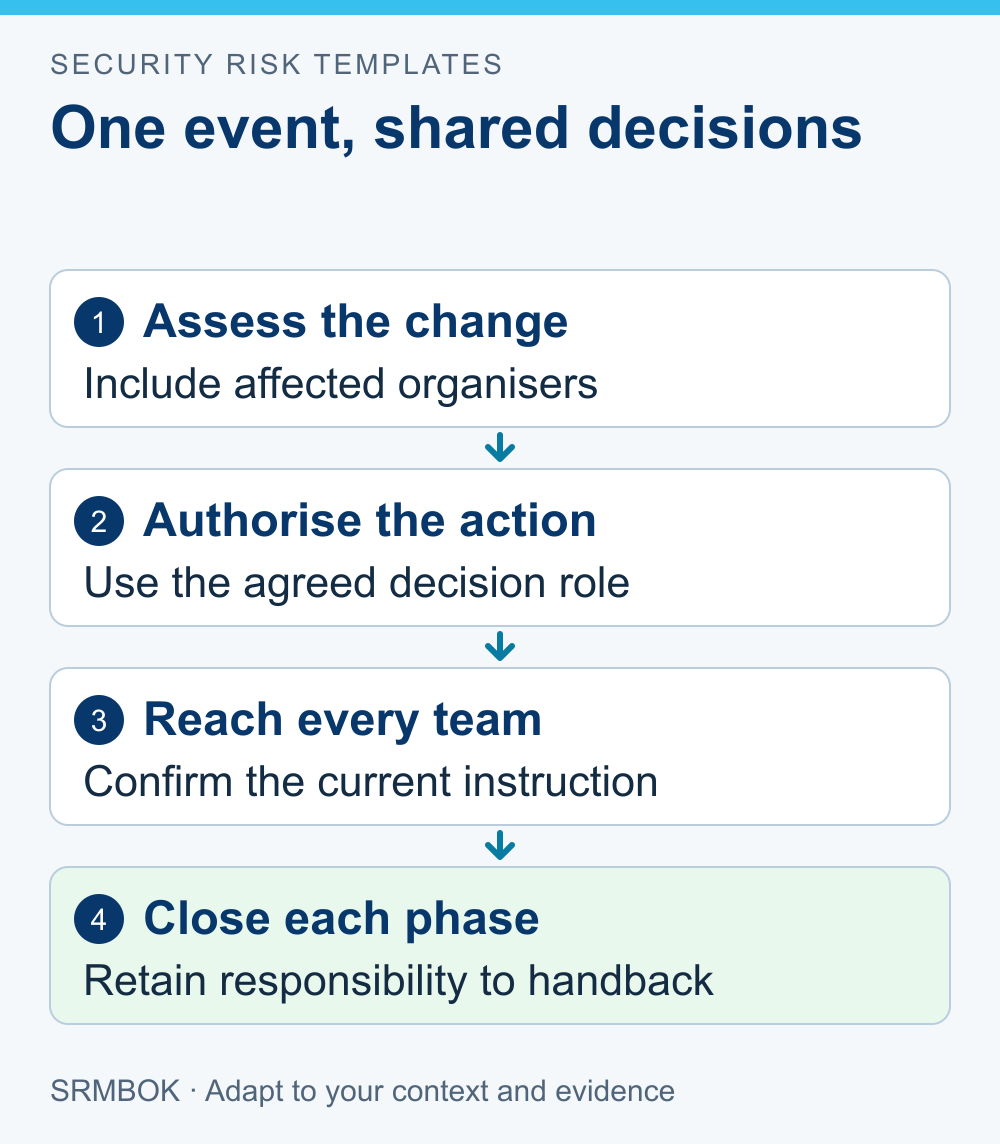
Define the event across its whole period
Include construction or setup, public arrival, event operation, departure and pack-down. The people present, boundaries and responsible organisations can change between these phases.
Describe the activities, expected patterns of use and relevant uncertainties without inventing crowd estimates. Use the organiser's supported planning information and identify who will update it when conditions change.
Map shared spaces and neighbouring operations. An event boundary on a drawing may not match the area affected by queues, deliveries or departing attendees. Agree which interfaces require coordination with the venue, local authorities or other operators.
The Australian Institute for Disaster Resilience's Safe and Healthy Crowded Places Handbook, published in 2018 and listed as current when checked, provides a multidisciplinary planning framework. It is guidance, not a substitute for the applicable local requirements or competent event design.
Assign decisions as well as tasks
List who can approve a material programme change, alter an operating arrangement, pause an activity and authorise its restart. Keep commercial authority and operational safety or security authority clear.
For each shared control, name the person coordinating the interface and the parties responsible for performing their own steps. Coordination should not be confused with transferring another party's obligations.
Record escalation when organisers disagree, including who has authority to decide the affected operation under the event arrangements. A shared radio channel does not resolve competing authority, and a committee that meets after the event cannot make a time-critical operating decision.
Confirm that named roles will actually be staffed during the relevant phase. Pack-down may continue after senior organisers leave, while contractors and valuable equipment remain on site.
Build scenarios from the combined operation
Examine conditions created by interaction: a changed performance time affecting arrivals, a closed shared route, conflicting delivery schedules or loss of a common communications service.
Identify the control purpose before choosing a measure. If the problem is that a changed instruction fails to reach stewards, adding a physical barrier does not fix the communication gap.
Use credible scenarios grounded in the event and its environment. Avoid copying a long catalogue of threats without showing why each is relevant or what decision the assessment supports.
Keep detailed vulnerabilities and operational configurations in controlled records. Wider briefings should provide clear actions and contact routes without unnecessary sensitive detail.
Worked example: an event programme changes
A fictional community event has separate organisers for performances, market stalls and venue operations. A late programme change affects shared areas. Their assessment records the following decisions.
| Interface | Question to resolve | Evidence of readiness |
|---|---|---|
| Revised programme | Who evaluates the effect on shared movement and staffing? | Relevant operations and specialist owners review the change |
| Instruction issue | Who sends the approved version to each team? | Receiving supervisors acknowledge the current instruction |
| Public communication | Who approves consistent information for attendees? | One agreed message and distribution route |
| Pause and restart | Who can make the decision for the affected activity? | Authority and consultation route confirmed before operation |
| Pack-down | Who retains responsibility after the public programme ends? | Named receiving role and contractor handover |
The example deliberately avoids specifying crowd densities, barrier designs or staffing ratios. Those require event-specific evidence and competent assessment.
Test the shared communications arrangement
Use a clearly labelled exercise to follow a fictional change from the decision-maker to the people expected to act. Confirm that they receive the same instruction and can ask for clarification.
Include an unavailable contact or failed ordinary channel if it is material to the event. The exercise should reveal whether the fallback is staffed and usable, not merely whether a second device exists.
Coordinate exercises with venue and emergency arrangements so nobody mistakes them for a real incident. Agree the stop condition and how genuine incidents take priority.
Record failed handovers and conflicting interpretations. Revise the plan, staffing or authority allocation as needed; repeating the same briefing louder will not solve an unowned decision.
Review changes against clear conditions
Set triggers for reassessment, such as material changes to activities, layout, participant numbers, staffing, suppliers or available routes. Name who can determine whether a change requires specialist input or a revised approval.
Do not treat the event risk register as frozen once the first version is signed. Equally, do not allow informal changes to overwrite the approved operating arrangement without a decision record.
Keep a concise current-state briefing for each phase. It should identify the active plan version, material limitations, decision roles and outstanding actions affecting readiness.
Close the event deliberately
Retain responsibility through departure and pack-down, then hand the site back against the agreed conditions. Resolve temporary access, equipment custody and remaining defects.
Afterwards, compare the planned interfaces with what actually happened. Record improvements with owners and evidence requirements so the next event benefits from the review.
The shared decisions should feed the security plan, while material changes remain visible in an accountable treatment schedule.
Your next action is to put the organisers' plans side by side and identify three shared decisions. Confirm who makes, communicates and verifies each one before adding more rows to the risk register.
The paid SRMBOK Risk Assessment Template gives you an editable structure for boundaries, evidence, scenarios and treatments. Use it to document the combined event interfaces while keeping specialist plans, permits and approvals under their appropriate owners.