
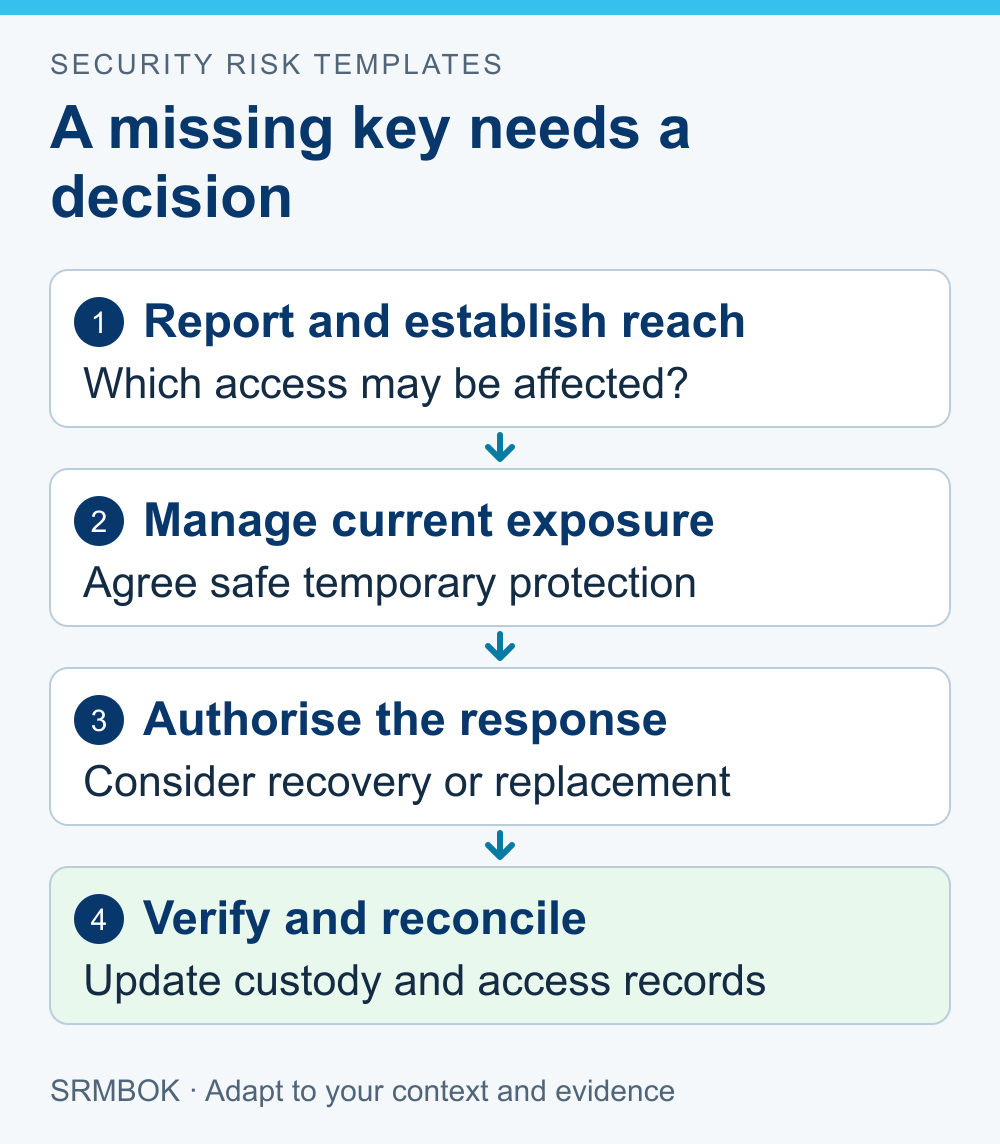
Report a lost master key through your security procedure immediately, establish what the key can open and put proportionate temporary protection in place while the authorised owner decides on replacement or rekeying. Searching for the key can continue, but it should not postpone a decision about exposed areas.
This is a management process for physical building keys. It does not cover cryptographic keys, provide lock-bypass instructions or determine who must pay for a loss. Use a competent locksmith and the relevant building specialists for technical changes.
Establish the facts without delaying the report
Record when the key was last known to be present, when its absence was discovered and who was responsible for its custody. Identify the key through the controlled register. Avoid broad emails containing photographs, key codes or a list of the areas it opens.
Make clear what is known and what remains uncertain. “Not in the issue cabinet at the handover check” is a fact. “A contractor must have taken it” is an allegation unless there is evidence supporting it. The immediate security decision does not require an accusation.
Give staff a reporting route they can use promptly. As an example of a named institutional process, the University of New England's Key and Lock Policy requires lost or stolen keys to be reported to specified university functions. Your organisation needs its own current contacts and responsibilities; the university policy does not govern another business.
Determine the extent of access
Have the authorised key-system custodian establish which areas and assets are affected. A key described casually as “the master” may serve one group of doors or a much wider system. The decision should use the actual keying records and advice from the system owner.
Consider whether information accompanying the key identifies the site or its purpose. Also consider where and how it was lost, whether theft is suspected, and the consequence of unauthorised access. These factors inform urgency without proving that someone has copied or used the key.
If the register is incomplete, record that limitation. Do not treat missing information as evidence that the key has limited reach. The system owner may need to investigate the extent of access while temporary measures address the potentially affected areas.
Choose temporary measures that people can operate safely
The aim is to manage exposure until a permanent decision is implemented. Depending on the circumstances, an authorised manager might restrict use of an affected area, relocate sensitive assets or arrange additional supervision through the existing security provider.
Do not improvise locks or barriers that interfere with safe exit, emergency access or accessibility. A change to a door can affect more than its resistance to unauthorised entry. Coordinate with facilities and the relevant safety specialists.
Give every temporary measure an owner, start time and review point. Explain its limits to the people relying on it. “Extra checks” is not a sufficient instruction unless someone knows which checks, under what conditions and how an exception will be escalated.
Make a documented replacement decision
The following fictional example concerns a key issued for a service area in a shared commercial building. It deliberately omits technical details and real access locations.
| Question | Fictional finding | Decision consequence |
|---|---|---|
| What can the key open? | The building manager confirms access to several service areas. | Include the building manager and affected service owners in the decision. |
| Is the key's location established? | The last recorded handover cannot be confirmed. | Treat recovery as uncertain and maintain interim protection. |
| What would unauthorised access affect? | Work areas include equipment needed for business operations. | Consider service interruption as well as theft. |
| Can a permanent change be implemented safely? | The locksmith needs a coordinated work window and an approved key-issue plan. | Assign the work, authorised recipients and verification before withdrawing interim measures. |
Record the decision maker, information used, remaining uncertainty and the reasons for the selected response. A limited response may be appropriate in one situation and inadequate in another. Avoid universal claims that every lost key requires exactly the same scope of work.
Treat a recovered key as new information
Finding the key may reduce uncertainty about its location, but it does not automatically establish that custody remained secure throughout the missing period. Report the recovery and let the authorised owner reassess the decision using the circumstances.
Do not quietly return it to circulation after a response has begun. It may already have been superseded, or other staff may be operating under changed arrangements. Update the register and tell the relevant people what has been decided.
If the key was found in a known controlled location and the custody gap can be explained, document that evidence. If its history remains uncertain, say so. The response should follow the evidence and consequences rather than embarrassment about the report.
Verify the change and restore normal operation
After authorised work, verify the affected keying arrangement through the responsible specialist's handover process. Reconcile issued keys, update controlled records and confirm that legitimate users have the access they require. Check that emergency and operational arrangements still work as intended.
Withdraw temporary measures only after the responsible manager confirms the conditions for doing so have been met. If some areas remain unresolved, identify them in the controlled action record and retain the appropriate interim protection.
The closure record should explain what was changed and checked, not just state that a replacement key was ordered. Keep sensitive key-system details separate from broad incident summaries.
Prevent recurrence through a workable custody process
Review how the key was issued, carried, handed over and returned. Look for system problems such as an unnamed custodian, a register that does not match actual practice or pressure to share a key informally. Address those conditions rather than relying only on a reminder to be careful.
Check whether the level of access issued was necessary for the role. A narrower authorised entitlement may reduce the consequences of a future loss. Technical changes should follow an assessed requirement, not a rushed attempt to buy certainty after an incident.
Put the authorised response into the security plan and track any replacement work through a treatment schedule.
Your next action is to confirm the current lost-key reporting contact and identify the person who can establish each key's authorised reach. If either answer is missing, resolve it before the next loss occurs.
The paid SRMBOK Guide to Physical Security Specifications covers locks, keys and related protective measures. Use it to structure the questions for your key custodian and specialist, then adapt the requirements to your building, risks and current local obligations.