
Assess rare incident likelihood by examining the defined event, exposure, relevant threat conditions and existing controls over a stated period. Treat a lack of recorded incidents as one piece of evidence, not proof that the event cannot occur.
Begin by agreeing what is being rated. The chance of an attempted incident, the chance of a successful event and the chance of a particular harmful outcome are different questions. Mixing them can create disagreement even when everyone accepts the same facts.
Use the organisation's approved criteria and make the reasoning visible. If the evidence cannot support a precise estimate, a qualified qualitative judgement is more honest than a percentage invented to fill a spreadsheet cell.
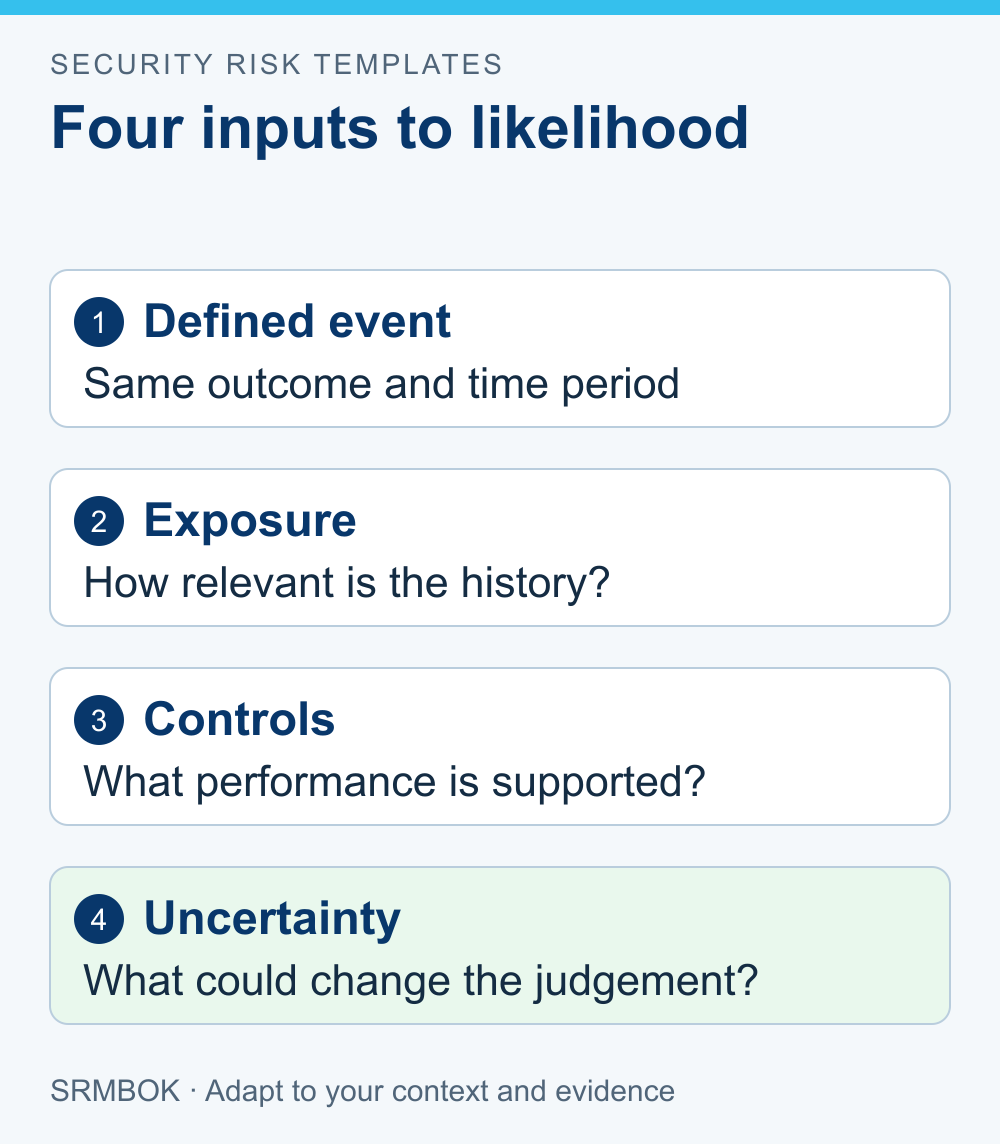
Define the event and time horizon
Write the event in sufficiently concrete terms that participants can discuss the same occurrence. Identify the asset or service, relevant conditions and consequence under consideration.
State the assessment period or exposure basis required by the criteria. “Unlikely during one authorised visit” is not the same proposition as “unlikely across every visit over several years”.
Check whether the criteria describe probability, frequency or a verbal judgement. Do not move between these forms without explaining the basis. A label such as rare is only useful when the organisation has defined how to apply it.
NIST SP 800-30 Revision 1 considers likelihood alongside threat events, vulnerabilities, predisposing conditions and impact. Its information-security context offers a useful reminder to examine the mechanism, rather than count past incidents alone.
Check the quality of the incident history
Ask what was recorded, how consistently and over which period. Determine whether the operation, exposure or reporting process changed during that time.
A clean log may reflect effective protection. It may also reflect limited exposure, incomplete reporting or an event that has not yet occurred. The record cannot distinguish these explanations by itself.
Look for relevant near misses, attempted events, control failures and service exceptions. Do not treat them as identical to the harmful event, but use them to understand the conditions that could lead to it.
Where external incidents inform the assessment, compare their context. Similar industry labels do not establish comparable exposure, controls or consequences. Record the differences before transferring a judgement from another organisation. Counts from organisations with very different exposure should not be treated as directly comparable rates.
Examine the route to the event
Identify the conditions needed for the scenario to occur and the controls intended to interrupt that route. Ask what is known about those controls under the conditions being assessed.
Avoid multiplying guessed probabilities for each step. A complicated calculation does not improve a judgement if its inputs are unsupported or the steps are dependent.
Identify shared dependencies. Several controls relying on the same person or service may not provide independent protection. Equally, an untested control should not automatically be assumed useless; state what its performance remains uncertain about.
Use relevant expertise for specialist assumptions. Record who provided the judgement and the limits of their knowledge. Confidence in a person's experience is not a substitute for understanding what their conclusion rests on.
Worked example: no recorded misdirected collections
A fictional distributor has no recorded cases of a consignment being released following an unauthorised collection change. Its team proposes the lowest likelihood category solely on that history.
The assessor asks about the current process. Collection volume has increased, a new shift uses the system and change approvals are not recorded consistently. These facts do not establish that an unauthorised release has happened. They do affect how much confidence the team can place in the historical record.
| Evidence | What it contributes | What it does not establish |
|---|---|---|
| No recorded unauthorised releases | Historical experience within the available records | A zero probability under changed conditions |
| Increased collection activity | A change in exposure to the decision | A numerical increase in incident probability without further analysis |
| Current approval procedure | Intended control design | Consistent operation across the new shift |
| Limited approval records | An evidence gap about performance | Proof that every unrecorded change was unauthorised |
The team assesses the scenario using its defined criteria, records the uncertainty and assigns a targeted check of the changed operating condition. It does not fabricate a percentage from the absence of incidents.
Compare credible interpretations
Where a rating depends on an uncertain assumption, consider how the judgement would change if that assumption were resolved differently. Keep the alternatives plausible and connected to evidence.
For example, consistent operation of the approval control may support one category, while a demonstrated recurring gap may support another. Explain which assumption distinguishes them and what evidence could resolve it.
This is a sensitivity discussion, not permission to choose whichever rating is most convenient. If the rating changes the operating or investment decision, make that dependence visible to the decision maker.
Avoid negotiating a middle rating simply to finish the workshop. A compromise label can conceal a factual disagreement that still needs investigation.
Match the precision to the decision
Use quantitative analysis when the data, model and decision justify it. Obtain suitable analytical expertise where estimation could materially affect a consequential decision.
When using qualitative criteria, document the main factors and evidence limits in a short rationale. A reviewer should be able to understand the judgement without guessing what the assessor meant by unlikely.
Do not let the pursuit of a perfect likelihood estimate delay an obvious required action. A mandatory requirement, an immediate concern or a low-cost correction may need attention regardless of which adjacent rating is chosen.
Keep the risk decision separate from the confidence in the assessment. A potentially consequential event can have uncertain likelihood; that uncertainty is information for management, not a reason to erase the scenario.
Record a reason to revisit the rating
Identify the evidence or change that would prompt reassessment: new operating conditions, verified control results, relevant incidents or a change in the assessed threat.
Check the likelihood judgement within the wider assessment process and keep the current and post-treatment baselines distinct.
Your next action is to take one rare-event rating and write its event, period, exposure and control assumptions in plain language. If those elements are unclear, improve them before debating the label.
The paid SRMBOK Risk Assessment Template provides a structure for recording scenarios, criteria, controls and treatments. Use its report format to retain the reasoning and uncertainty behind the rating rather than presenting the matrix colour as the whole assessment.