
Agree landlord security responsibilities by identifying the controls your business relies on and who operates, maintains and verifies them. Start at the boundary between shared building services and your tenancy, where assumptions most easily go untested.
A lease saying that a building has security does not tell a duty manager who responds when a shared door fails. A helpful property manager may coordinate the issue but lack authority to approve the tenant's proposed change.
This article concerns practical control ownership in shared premises. Have the appropriate adviser interpret lease rights and legal obligations. An operating agreement should reflect those requirements; it cannot replace or override them.
List the services your business actually relies on
Walk through an ordinary day and an after-hours period. Identify the shared entrance, reception, loading area, parking, lifts, alarm interfaces and other services relevant to your operation. Do not assume every building needs the same arrangements.
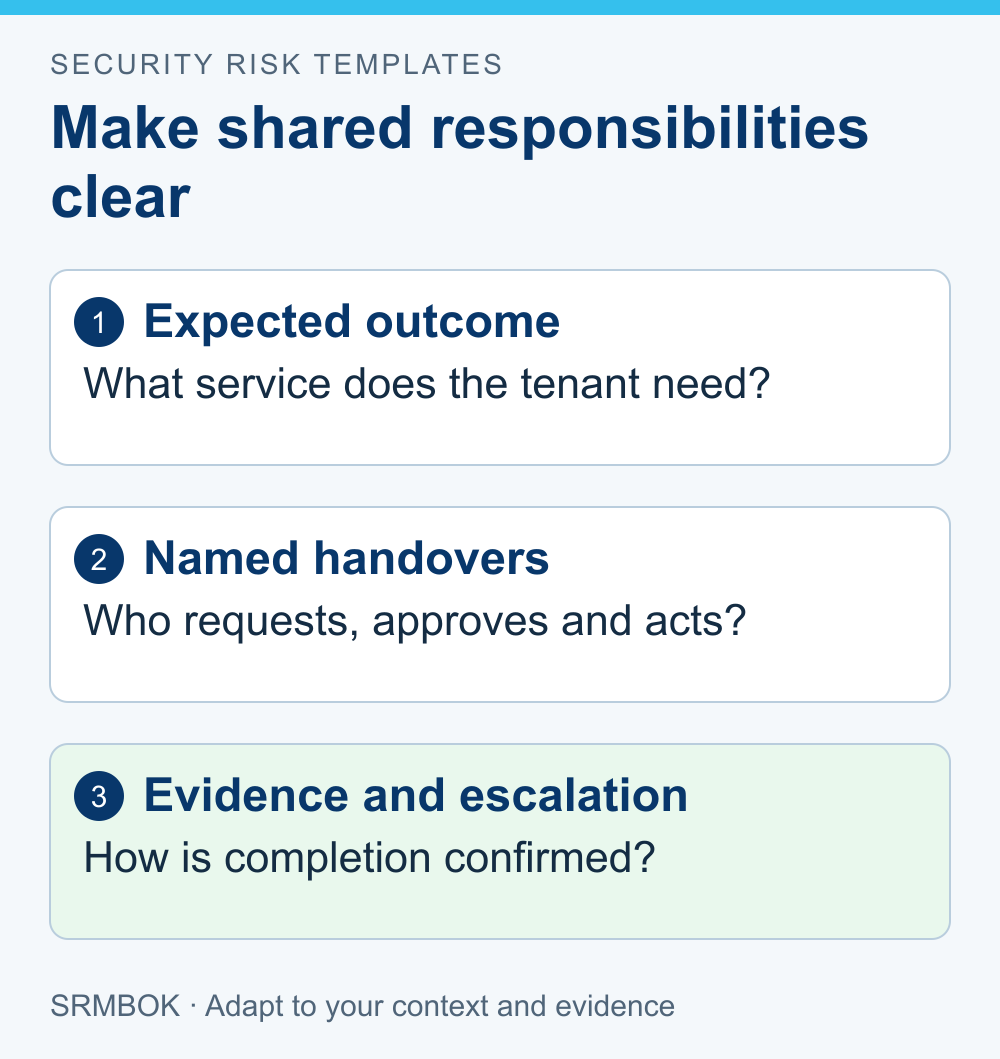
For each dependency, describe the outcome you expect. “Building security” is too broad. “A delivery outside reception hours is referred to the tenant's authorised contact before access to its floor” can be discussed and checked.
Include evidence access. If your incident review relies on a shared-system record, establish who holds it and the route for an authorised request. Do not assume the tenant can inspect other occupants' personal data or all building footage.
Australian business.gov.au guidance on choosing premises notes that a tenant's control depends on lease terms and recommends relevant professional advice. That is a reason to verify the agreement, not to assume a standard allocation of security responsibilities.
Separate ownership from operation
For each control, identify the party accountable for the required outcome, the people doing the work and the authority to approve a change. They may be different.
A landlord might own a shared access system, its contractor might administer it and the tenant might approve individual staff entitlements. In that arrangement, the tenant's departure notification is only the start of revocation. Someone must apply it and confirm completion.
Name a receiving role and fallback contact, rather than relying solely on a person's name. Staff and property managers change. The organisation needs a route that continues working through those changes.
Avoid assigning one shared responsibility to “landlord/tenant”. Split it into observable steps. One party supplies the request; another acts; the requester receives confirmation. This makes a missed handover discoverable.
Agree normal work, faults and changes
Normal service arrangements should cover operating hours, authorised users, planned maintenance and requests. Fault arrangements should cover notification, temporary protection, decision authority and escalation.
Change arrangements matter just as much. A landlord's reception-hours change may alter your delivery process. A tenant's move to late shifts may require a different after-hours arrangement. Agree which changes require consultation before they occur.
Ask what evidence the landlord can reasonably provide. Depending on the service, this might be a maintenance summary, a witnessed functional check or confirmation that a defect has been corrected. A commercial contract or privacy constraint may limit detail; identify another suitable assurance method rather than treating silence as proof of performance.
Worked example: a shared entrance
A fictional engineering consultancy occupies one floor of a multi-tenant building. Its staff work later than reception. The parties use this draft interface record for discussion.
| Interface | Tenant action | Building action | Completion evidence |
|---|---|---|---|
| Staff entitlement change | Authorised sponsor submits the approved change | Access administrator applies it | Confirmation identifying the entitlement changed |
| Shared entrance fault | Duty manager reports the observed condition | Building contact assesses and arranges repair or temporary measures | Fault reference, interim arrangement and verified closure |
| Out-of-hours delivery | Tenant confirms receiver and permitted destination | Building operator applies the agreed access process | Receiving decision recorded by the responsible role |
| Incident record request | Tenant provides purpose, relevant period and authorised requester | Record holder assesses and handles the request under applicable rules | Decision and any permitted release recorded |
The table is a proposed operating arrangement, not a statement of what every landlord must do. Both parties need to check it against their authority, contracts and actual capabilities.
Resolve gaps explicitly
When no party accepts a necessary task, record the unresolved gap and the exposure it creates. If the task may be performed but evidence is unavailable, record the uncertainty separately from a demonstrated failure. The response may be to change the service agreement, provide a tenant-controlled measure or reconsider reliance on that service.
Do not quietly assign extra duties to reception or guards without consulting their manager. The people asked to perform the work need instructions, training, time and a clear escalation route.
Set a deadline for resolving material gaps before the business relies on the arrangement. If an interim control is accepted, name its owner, operating limit and review date. “We will sort it out after moving in” is not a verified security service.
Where the disagreement concerns a lease interpretation or liability, refer it to the appropriate commercial or legal decision-maker. Keep the operational facts clear: what outcome is needed, what is currently happening and what remains unresolved.
Verify the agreement works on a real shift
Choose a low-risk scenario and walk it through with both parties. For example, submit an agreed test entitlement change and follow it to confirmation. Make the test clearly authorised; do not attempt an unannounced breach of another tenant's space.
Check the after-hours contact route. Confirm that the responder knows which decisions they may make and which require escalation. Record actual gaps without publishing sensitive response arrangements.
Review the record when contractors, occupancy, operating hours or relevant services change. A correct agreement can become inaccurate even when the lease itself has not changed.
Put the agreed interface into the security plan and align decision authority with the security risk policy.
Your next action
Choose the shared service whose failure would most affect your business. Write its expected outcome and ask the property manager to identify each handover needed to deliver it.
The paid SRMBOK Property Selection and Security Planning Checklist covers building, access, guarding and service questions. Use its comment fields to capture the evidence and responsibility decisions behind your reliance on shared controls; completing the checklist does not itself establish contractual rights or compliance.