Open the kitchen cupboard and choose tomorrow night’s dinner. Now take the fridge, the electric hob and the tap out of the picture. Can you still make it? A household with five kilos of rice might struggle. A household with a tin of chickpeas, a jar of roasted peppers, crackers and a working can opener can sit down to dinner.
That small experiment gets to the heart of the international push for household preparedness. Whether a storm cuts the power or deliveries stop for several days, the household decisions are much the same. What can we eat? What can we drink? Who might need a hand?
How many days are governments asking people to prepare for?
The European Commission’s Preparedness Union Strategy calls for guidance aimed at a minimum of 72 hours of self-sufficiency. Sweden advises households to be able to manage for at least a week. Norway gives that advice a physical dimension. It recommends storing about 20 litres of drinking water per person for a week. In the United States, the CDC recommends at least one US gallon per person per day for three days and suggests working towards two weeks of water where possible.
Those figures answer slightly different questions. Use your local emergency authority’s advice as a starting point. Then consider how long it might take to restore services where you live, who depends on you, how much you can carry and where you can put it. A ninety-day pantry is an optional planning exercise in the SRMBOK guide. Three days of familiar meals and safe water is a sound first achievement.
Count meals before you count tins
Start with a breakfast, lunch and dinner that everyone in the house already eats. A first day might include shelf-stable milk and cereal, crackers with tinned fish, and a chickpea and pepper salad dressed with oil. Choose portions you can finish if refrigeration is unavailable. For later days, rice with lentils and tinned tomatoes is economical if you have water, a suitable cooker and enough fuel. Make one of those meals this week. You will soon discover whether you have a can opener, whether anyone likes cold chickpeas, and how much washing-up water you use.
Think in ordinary shopping units. If you eat two tins of beans a week, twelve tins represent six weeks of beans. They tell you very little about how many complete dinners you have. Put new tins at the back, take dinner from the front and add what you used to the shopping list. Salt, oil, herbs, tea and coffee belong on that list if they make the food worth eating.
A fortnight for two adults, worked through
Take two adults who each use an illustrative planning allowance of 2,000 kcal a day. Together they need 4,000 kcal a day, or 56,000 kcal for fourteen days. If their cupboard holds 28,000 kcal, it covers seven days of energy. Now look at where those calories come from. If most come from rice and oil, the next grocery dollar might be better spent on beans, canned fish or another protein the household eats. Fruit and vegetables, dietary requirements and enough variety to finish the food still matter.
This is where the SRMBOK pantry calculator earns its place. On Household, enter the people and target days. On Pantry, enter the packs you actually own in the yellow column G. Check pack weights against your labels, especially if you buy in metric sizes. Summary gives you days of energy coverage and compares available protein with your household target. Use Shopping list to plan the next shop and Water for your supply of safe water. Someone living alone can use exactly the same method with one row and a smaller cupboard.
Water changes the arithmetic
At the guide’s illustrative allowance of four litres per person per day, two people need 24 litres for three days and 112 litres for a fortnight. That fortnight’s water weighs about 112 kilograms before containers. Six four-litre containers could meet the first target and are easier to carry individually than one large drum. Allow more for heat or additional needs, include pets separately, and identify where you could obtain safe replacement water.
Start with safe stored water. If authorities warn of fuel or toxic chemical contamination, use a safe alternative supply. For germs, CDC guidance is to strain cloudy water through a clean cloth or let sediment settle and draw off the clear water, then bring it to a rolling boil for one minute, or three minutes above 6,500 feet (about 2,000 metres). Let it cool and store it in a clean, sanitised, covered container. Cloth removes particles and leaves disinfection still to do. If using drinking-water tablets, match the dose, volume and contact time to the label. Check which organisms a filter is rated to remove.
Give the plan a ten-minute test
Tonight, set out one meal you can eat without cooking. Count your litres of safe water. Find the can opener and test the torch. Ask the person you live with, or a neighbour you check on, where they would look for each item. Put the first gap you find on your next shopping list. That is enough to make a start.
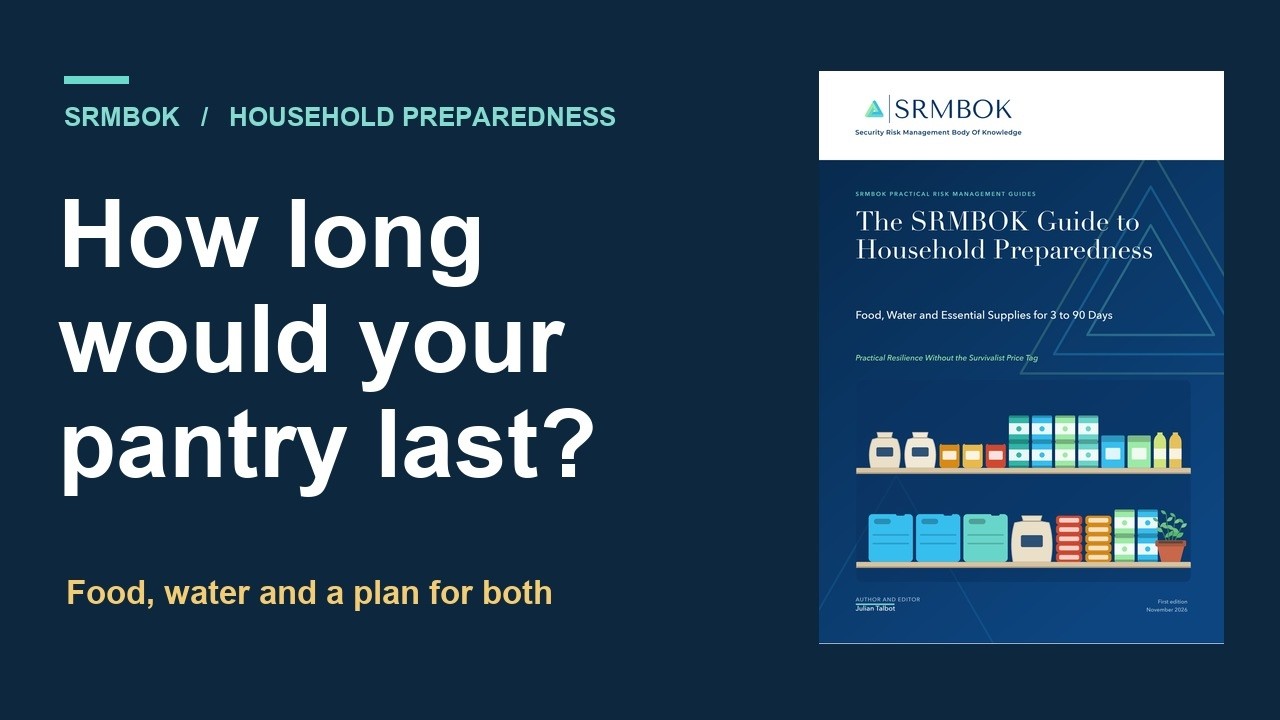
If you want to work through the rest, the SRMBOK Guide to Household Preparedness and editable pantry calculator bring the international guidance, worked menus, stock calculations and printable checklist together. Open the calculator with your cupboard in reach. The most useful number it will give you is how long your household can manage with what it owns today.
Official guidance
European Commission — Preparedness Union Strategy
Swedish Civil Defence and Resilience Agency — Basics of home preparedness
Norwegian Directorate for Civil Protection — How to store drinking water
US CDC — How to create an emergency water supply and How to make water safe in an emergency
Take the guide to your pantry
Scan the code or open the guide and editable pantry calculator on this device.