
For a data centre security assessment, examine physical support services by tracing the customer service back through the facilities, people and maintenance arrangements it depends on. Then examine whether the security controls protect those dependencies during normal work, change and recovery.
The useful starting point is a service outcome, such as the agreed availability of a hosted application. A list of equipment in the data hall does not explain every dependency that supports that outcome.
This assessment connects security with facilities engineering and service management. It does not certify a resilience rating, replace a cyber assessment or demonstrate that every possible failure has been eliminated.
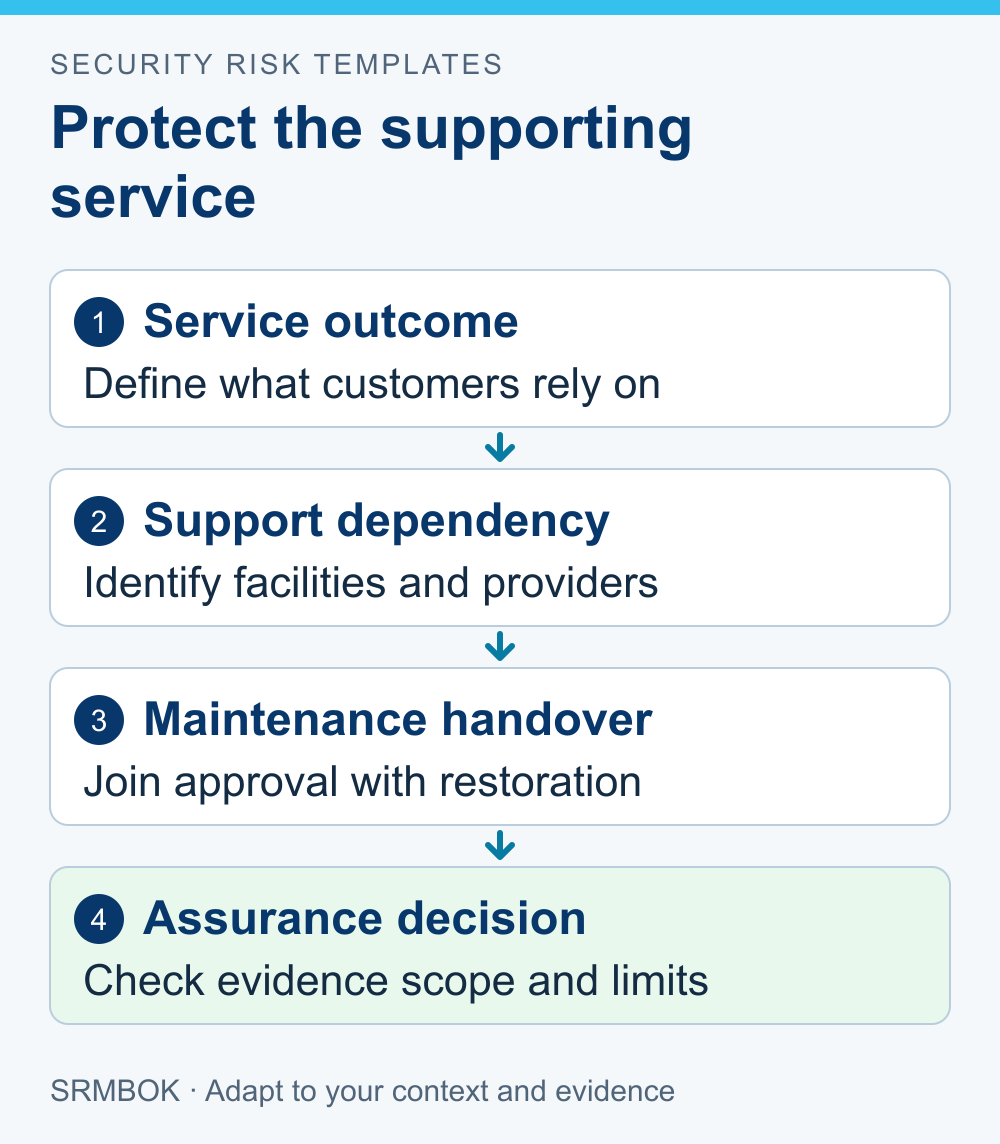
Begin with a defined service boundary
Ask the service owner to identify the service, users, operating conditions and tolerable effects of disruption. Record the basis for those expectations, including relevant agreements and continuity decisions.
Then identify the support functions needed to sustain it: power, environmental control, communications, facilities management and authorised technical intervention. Describe functions first, using controlled references for sensitive design detail.
Separate ownership from reliance. A tenant may depend on a building service it does not operate. A provider may rely on a maintenance supplier whose staff require authorised access. These interfaces belong in the assessment even when their detailed operation sits elsewhere.
Keep the boundary precise. An assessment of one facility does not automatically cover the customer's application design or alternative hosting arrangements. Record those dependencies and the owner who can assess them.
Join the facilities and security views
The UK's National Protective Security Authority discusses building management systems and their relationship to data-centre services in its guidance on physical perimeter and building risks for owners. It also promotes an approach that brings physical, personnel and cyber security together.
Use this as a reason to involve the right disciplines. A physical-security review may identify an access or maintenance interface, while an engineering or cyber specialist determines the technical implications and suitable test.
Avoid letting one discipline's assurance stand in for another's. A facilities component may be maintained correctly while its service-provider access process remains unclear. Conversely, a well-controlled room does not establish that the equipment inside it performs as required.
For each important function, ask what evidence shows that the necessary protection and support arrangements operate together.
Build a dependency record that leads to a decision
A practical record can include the service supported, dependency, responsible organisation, relevant security control, evidence and unresolved decision.
Add the conditions under which the dependency changes. Planned maintenance, provider substitution, an unusual work period or degraded operation may require different permissions or coordination.
Do not reproduce detailed layouts, configurations or credentials in a broadly circulated assessment. Use references to controlled records and identify who may inspect them. Decision makers need enough information to understand the exposure without receiving every operational detail.
Where evidence is unavailable, distinguish a confidentiality restriction from the absence of assurance. A provider may offer a supervised review or a suitable independent report. Check the scope, period and exclusions of that evidence before relying on it. Evaluate whether that alternative answers the question rather than accepting or rejecting it solely because it has a formal title.
Worked example: a maintenance interface changes
Consider a fictional data-centre operator that changes its facilities maintenance provider. The engineering scope is reviewed, but the assessment finds that responsibilities for approving attendance, supervising work and confirming service restoration are split across several teams.
No failure has been established. The concern is that each team is relying on another to complete a handover that has not been defined.
| Dependency question | Available evidence | Assessment action |
|---|---|---|
| Who authorises the maintenance task? | Approved work order identifies the responsible engineering role | Confirm how security receives the authorised attendance information |
| Who handles a personnel substitution? | Contract permits replacement staff but local approval steps are unclear | Agree a change process with the supplier and access owner |
| Who confirms the supported service is restored? | Equipment completion record exists | Link it to the service owner's required verification |
| Who retains unresolved issues? | Separate supplier and facilities action lists | Assign one accountable owner for the outstanding interface decision |
The treatment is not simply to add another access device. The operator first makes the work-authorisation and restoration handovers explicit, then determines whether existing controls can support them.
A later assurance check follows one authorised maintenance job through the complete process. Its result is limited to the conditions actually examined. The organisation does not claim that a single job proves the reliability of every support service.
Consider shared dependencies before counting redundancy
Ask the technical owners whether apparently separate arrangements rely on a common support function, provider or operating decision. Record their explanation and evidence at an appropriate level of detail.
The assessor should not infer independence from two equipment labels or two contract names. Equally, a shared dependency is not automatically an unacceptable risk. The consequence, available alternatives and agreed operating limits determine the decision.
Use a scenario that makes the dependency relevant to a service outcome. Describe the initiating condition, affected function, control response and consequence. Have the responsible specialists validate technical assumptions before the report treats them as facts.
Keep proposed improvements separate from existing controls. A planned service change can support a treatment decision, but it should not reduce the assessed exposure until the organisation has evidence that it is operating as intended.
Verify safely and close the right issue
Agree an assurance method with service operations, engineering, security and affected suppliers. Records review and interviews may answer some questions; others need a controlled technical demonstration within an approved change window.
Do not interrupt live support services as an informal security test. The test method, safeguards, acceptance evidence and recovery arrangements need approval through the organisation's established process.
Keep the service boundary explicit in the assessment scope and document support-service changes in the treatment plan.
Your next action is to select one important support function and follow its maintenance authorisation through to service confirmation. Record the first handover supported only by an assumption.
The paid SRMBOK Physical Security Risk Assessment Tool provides a workbook for documenting scenarios, controls, treatments and ownership. Use it to connect the physical-support findings to service consequences while keeping specialist technical evidence and sensitive configurations in their controlled records.