
Start a construction security assessment with the first authorised stage of work, including the boundaries, people and responsibilities that will change as the project progresses. Before mobilisation, agree what must be ready, who will verify it and who can authorise work when something remains incomplete.
A drawing of the finished development cannot establish that a temporary site is ready. Record the first stage separately so approval cannot be mistaken for permission to begin later work. The entrance used during early works may disappear later. Delivery activity, contractor numbers and storage needs can change before permanent systems are available.
The useful assessment therefore produces a stage-specific opening decision and a record of the next changes that require review. It should connect with the project's safety and construction planning rather than create a competing set of instructions.
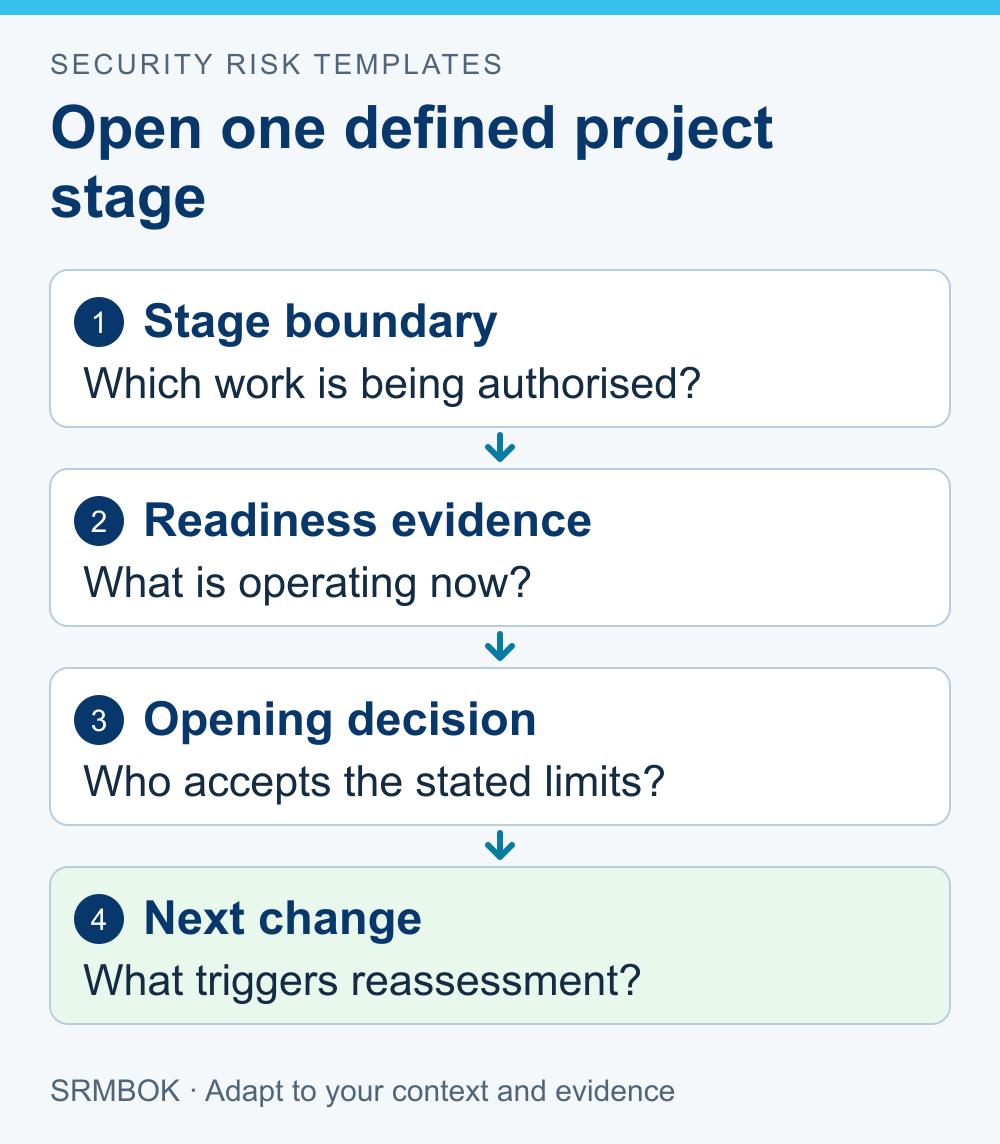
Define what opening actually means
Describe the work included in the first stage. Distinguish site establishment, demolition, excavation, material storage and public-facing activity where relevant. Record the hours, expected workforce, neighbouring uses and areas that remain occupied by others.
Ask the project manager to identify the drawing revision and programme on which these assumptions depend. An assessment of a superseded layout is not evidence for the new one.
Set a clear boundary around the decision. Permission for supervised establishment work does not automatically authorise unattended storage or unrestricted contractor access. Those activities may rely on different controls and responsibilities.
Write the opening condition in operational language: “Authorised establishment crews may work within the agreed area after the site supervisor verifies the listed arrangements.” Keep any limits and outstanding decisions beside that statement.
Bring the right responsibilities together
Identify the client representative, principal contractor or builder, site supervisor, security adviser, safety adviser and relevant property or facilities representative. Include the person responsible for any neighbouring operation affected by the works.
Safe Work Australia's November 2024 model Code of Practice for construction work discusses preventing unauthorised access and securing work areas, including coordination involving subcontractors. It is a model code: check its status and the applicable requirements with the regulator in the project's jurisdiction.
Use that guidance to raise the interface questions; do not treat a security checklist as a complete determination of construction duties. The assessment should identify who decides the site arrangements and who implements them at each stage.
Where a responsibility is shared, describe the handover. “Builder and tenant” is less useful than a named project role notifying the tenant's nominated representative before a boundary change, with both recording that the revised arrangement is ready.
Inspect the temporary operating arrangement
Walk the proposed first-stage layout with the people who will manage it. Review authorised entry, deliveries, temporary storage, public separation, communications and the arrangements at the end of a shift.
Check interfaces with safety, accessibility and emergency access. A proposed security measure should not introduce an unmanaged movement or evacuation problem. Technical design and safety acceptance belong with the relevant competent people.
Identify which arrangements exist, which are ordered and which are only proposed. A future gate or communications service cannot be credited as an operating control. Record the evidence required before reliance on it begins.
Also look for control tasks that lack an owner: accepting a late delivery, confirming a subcontractor has finished, checking a changed work area or reporting damage. Construction activity often changes the task faster than the document.
Worked example: opening an occupied-site extension
Consider a fictional office extension beside a building that remains in use. Early works begin with a small establishment team. The project plan later introduces regular deliveries and evening work.
The initial draft assessment says the site will have controlled access. A mobilisation review finds that the proposed reception arrangement only covers the occupied office. It does not establish who receives the construction workforce or closes the temporary work area.
The team converts the general statement into decisions:
| Stage or interface | Evidence needed | Opening decision |
|---|---|---|
| Establishment crews arrive | Supervisor has the authorised attendance list and briefing arrangement | Permit the defined establishment stage once verified |
| Office occupants pass the works | Agreed separation and information reviewed by responsible project and safety roles | Resolve the interface before affected work starts |
| Construction deliveries begin | Receiving responsibility and traffic arrangements confirmed | Review before adding routine deliveries |
| Work area becomes unattended | Closing responsibilities and reporting route demonstrated | Do not assume daytime supervision covers this state |
These are illustrative decisions, not a standard construction approval checklist. The important finding is that “the site is open” hides several different operating states.
The project manager can now authorise a bounded stage, defer an activity or require a change. The assessment makes the conditions visible without pretending that a security adviser can approve every construction risk.
Make changes trigger a review
List the foreseeable changes that affect the assessment: a relocated entrance, new subcontractor, changed work hours, additional storage, partial occupation or removal of a temporary boundary.
Assign a notification owner and a review decision. A change should reach the people who control access and site instructions before the old arrangement becomes misleading.
Use a simple change entry containing the proposed change, affected assumptions, required checks, decision maker and effective date. Refer to controlled drawings instead of duplicating sensitive or rapidly changing detail in several documents.
Not every change needs a new report. Some require an updated instruction and recorded verification. Others alter the scenario enough to need reassessment. Agree who makes that judgement and retain the reason.
Verify readiness and retain the limits
Before the relevant stage starts, check the important controls in the operating conditions they will face. Review records, ask staff to explain their tasks and arrange safe demonstrations through the responsible project team.
Record incomplete items honestly. State whether the work can proceed within a defined limit, requires an interim arrangement or must wait for an authorised decision. A signature on a generic checklist should not conceal an unresolved interface.
Define the stage in the assessment scope and make readiness actions accountable through the treatment schedule.
Your next action is to choose the first stage of the programme and write one page showing its boundary, readiness evidence, decision owner and next review trigger.
The paid SRMBOK Property Selection and Security Planning Checklist provides prompts for reviewing premises and security arrangements. Adapt those prompts to the temporary site and project stage; it does not replace construction planning, specialist design or jurisdiction-specific approvals.