
How can practitioners assess danger while accounts are disputed? Address immediate safety through the applicable family violence procedures, while clearly recording what is known, reported and uncertain. An unresolved account is not a reason to delay appropriate protective action or to assume either that an allegation is true or that it is false.
This article is for practitioners using an established domestic and family violence (DFV) response. It offers a supplementary way to organise records and follow-through. It is not a tool for deciding credibility, diagnosing a person, predicting violence or replacing specialist assessment.
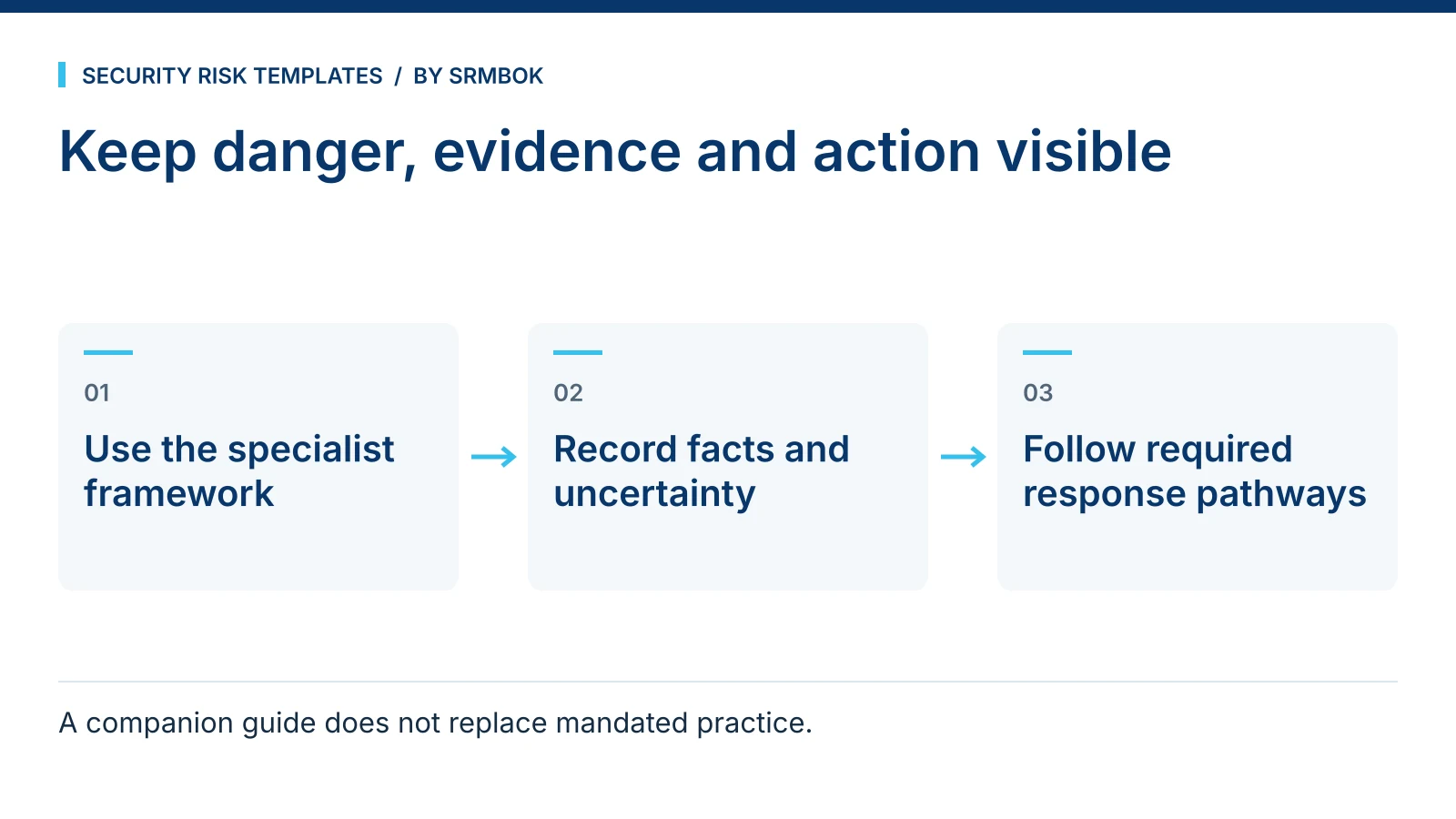
Use the relevant specialist framework
Work within the training, responsibilities and assessment tools required by your service and jurisdiction. For example, Victoria's MARAM comprehensive risk assessment guidance uses structured professional judgement, including the victim survivor's assessment of fear and safety, evidence-based risk factors and authorised information sharing. Comprehensive assessment under that framework requires specialist expertise.
These are not interchangeable with a generic likelihood-by-consequence matrix. A neat score cannot resolve uncertainty about an individual's safety. Nor should a person's fear be discounted because a separate investigation has not concluded.
Keep different questions visible
An assessment record can help the team distinguish three questions:
- What needs a safety response now? Record the concern and the response required under the service's procedures.
- What information supports the assessment? Distinguish a report, a direct observation, an existing record and a professional judgement. Note relevant gaps without treating an absence of records as proof that nothing happened.
- What further work is needed? Identify the appropriate specialist, information request or review process, including who will take responsibility.
This separation is a record-keeping aid. It does not remove the need to consider patterns, context, perpetrator behaviour, children or the possibility of misidentification within the relevant specialist framework.
Record uncertainty without freezing the response
Avoid turning an uncertain statement into an established fact as it passes between teams. Equally, avoid writing “unsubstantiated” as shorthand for “no action required”. State what is uncertain and how that uncertainty affects the next decision.
Where consultation or referral is needed, follow your organisation's process and confirm who owns the next step. Victoria's MARAM consultation and referral guidance is one jurisdiction-specific reference. Information sharing must follow the applicable authority and safeguards; a generic confidentiality label does not create permission to share a case file.
Worked illustration: a case review record
The following fictional example illustrates documentation, not a danger rating or a recommended safety plan. A practitioner receives a report of unwanted contact after separation. Some relevant records have not yet been obtained.
| Record entry | Useful distinction |
|---|---|
| Reported concern | Attribute the account accurately and record the person's stated safety concerns |
| Information available | Identify the records actually reviewed and their dates |
| Information outstanding | Specify what is missing and the authorised route for seeking it |
| Specialist input | Record who was consulted, their role and the advice received |
| Agreed response | Record actions within the applicable procedures, responsible people and follow-up arrangements |
| Review trigger | Record when the assessment should be revisited and who receives new information |
The table deliberately does not conclude that danger is low, high or unchanged. Those judgements require the appropriate assessment. Its purpose is to prevent a team from confusing an incomplete information request with a completed safety response.
Check implementation as well as paperwork
A recorded action and an implemented action are different states. Within the agreed response, confirm whether a referral was received, whether responsibility was accepted and whether the review occurred. Record obstacles so they can be addressed through the proper process.
A bow-tie diagram may help explain the difference between preventing an event and limiting its consequences in general risk work. It should not be presented as a validated DFV assessment instrument or used to score a particular person's danger. Keep supplementary diagrams subordinate to the specialist process.
Use the SRMBOK guide as a companion
Risk Thinking for Domestic and Family Violence Practice explores risk concepts that practitioners can consider alongside their existing training and procedures. Use it to support clearer questions and records, with specialist judgement governing decisions that affect safety.