
For an airport security assessment, examine the places where one participant's responsibility ends and another's begins, then verify how the shared security outcome is maintained across that handover. Start with the airport's actual operating boundaries and approved arrangements, not a generic site diagram.
An airport can contain public areas, controlled areas, airline operations, tenants, contractors and shared services. A control can look complete within one participant's records while the connecting decision is missing from everyone else's.
This article uses an Australian airport context. It provides an assessment method for authorised airport security and risk teams. It does not specify screening methods, restricted-area access procedures or operational details of a real airport, and it cannot establish regulatory compliance.
Establish which boundary you are assessing
Distinguish the airport's legal or declared boundary, the areas used for different operations, property or lease boundaries and control responsibilities. They may overlap without being identical.
CISC's airport-operator security guidance explains the role of security-controlled airport boundaries, security zones and operator security programmes. Verify the current instruments and approved programme for the actual airport with the responsible aviation-security specialists.
Do not infer a security requirement solely from a landlord's tenancy plan or a sign on a door. Use the authoritative controlled records and record their version. Where a planned works area changes the operating boundary, establish the approved arrangements for each stage.
State the assessment's purpose: perhaps a tenant interface, a works handover or a shared-service change. A focused assessment can be useful without claiming to reassess every airport operation.
Describe the outcome shared by the participants
Choose a concrete outcome that depends on more than one party. For example, an authorised maintenance visit should remain within its approved purpose and area, with any change referred to the appropriate decision-maker.
Identify the steps needed to deliver that outcome. Name the work sponsor and the role that confirms authorisation. Establish who manages the relevant access process. Then agree who receives notice of completion or changed conditions.
Avoid using “airport security” as the owner of every step. It may conceal responsibilities belonging to a tenant, airline, contractor manager or another service provider.
CISC's principles-based guidance for security plans and programmes stresses explaining scope, responsibilities and how measures apply in the operating environment. Apply that clarity to the interface record without substituting a general table for required controlled procedures.
Gather evidence from both sides
Obtain the relevant agreement, current instructions and evidence from the participants on each side of the handover. Interview the people who perform it under the conditions being assessed.
Ask each person to describe the same ordinary exception. Different answers can expose an assumption that has never been agreed. The aim is to resolve the decision, not to trap staff with a surprise test.
Record whether a control is documented, implemented and demonstrated. If a participant cannot share sensitive material directly, agree an appropriate assurance route through authorised representatives. Record the question that route answers and any limitation it leaves; confidentiality alone does not prove either adequacy or failure.
Protect the resulting assessment. Detailed maps, access configurations and control weaknesses belong in restricted operational records. Give wider stakeholders the decisions and actions they need without unnecessary sensitive detail.
Worked example: a tenant's maintenance activity
A fictional airport tenant plans maintenance affecting an interface with shared facilities. The assessment team prepares this decision record. It is illustrative and does not describe any real airport's access arrangements.
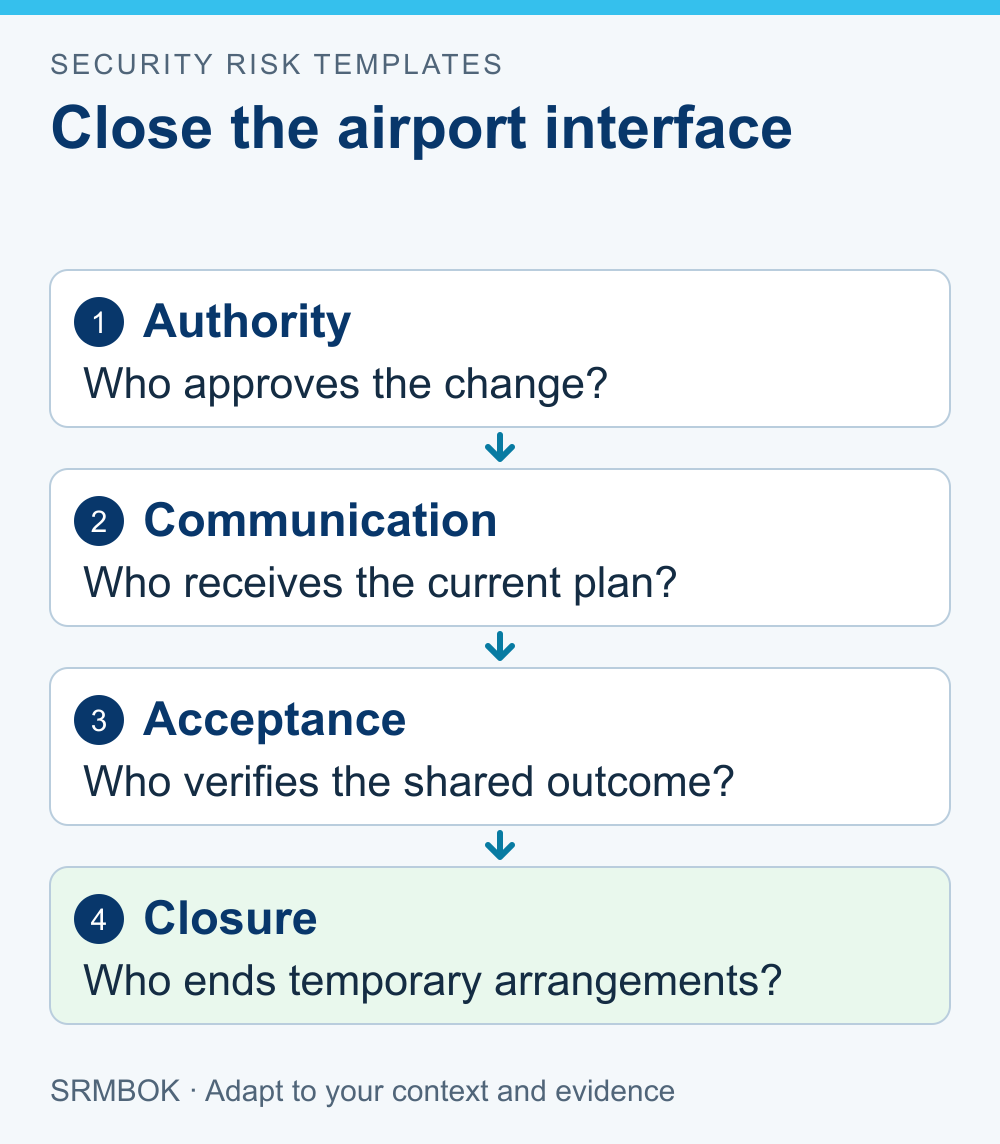
| Interface | Initial uncertainty | Required resolution |
|---|---|---|
| Approval of a changed work area | Tenant and facilities contractor each assume the other seeks airport approval | Confirm the authorised request and approval route |
| Communication of a changed work period | The revised schedule reaches the contractor but not all affected operators | Assign notification and acknowledgement responsibilities |
| Verification of reinstatement | Completion evidence covers the contractor's task only | Agree the relevant airport and tenant acceptance checks |
| Closure of temporary arrangements | No receiving role is named | Name the owner and record verified closure before stand-down |
The assessment does not conclude that the maintenance itself is unacceptable. It identifies the conditions that must be resolved before the relevant operating decision can be made.
Include public-area and service interactions
A measure intended to improve one boundary can affect queues, emergency movement, accessibility or adjoining operations. Bring the relevant operations, safety, facilities and service owners into the decision.
Consider when the interface changes. Peak movements, disrupted services, construction phases and out-of-hours work may involve different staffing or responsibilities. Select the conditions relevant to the particular assessment rather than listing every possible airport hazard.
Keep legitimate public and operational needs visible. The purpose is to make the required security outcome work in the airport environment, not to apply the most restrictive arrangement without examining its effects.
Where a decision requires specialist design or regulatory approval, record that dependency and who will obtain it. Do not treat a workshop's preferred option as authority to implement it.
Assess the risk of the handover failing
Write the scenario in terms of the affected operation and consequence. Identify the controls on each side and the connecting communication or decision that makes them work together.
Distinguish a demonstrated gap from missing evidence. Both can require action, but they support different statements. If an interface has never been tested under a relevant changed condition, say so instead of claiming it has failed in practice.
Avoid averaging away a material local problem in a whole-airport score. The action owner needs to know precisely which interface and condition require attention.
Close the interface through shared evidence
Agree the correction, owner, acceptance method and receiving parties. A contractor's completion report may need an airport-side functional check or a tenant's acknowledgement before the shared outcome is established.
Update the relevant controlled records through their authorised owners. Reconcile temporary arrangements and ensure the next shift receives the current state.
Record the interface boundary in the assessment scope and connect accepted responsibilities to the security plan.
Your next action is to choose one boundary affected by a recent change and ask both participants to explain the approval, performance and closure steps. Resolve the first conflicting assumption with a named decision owner.
The paid SRMBOK Risk Assessment Template provides a report structure for scope, evidence, scenarios, controls and treatments. Use it to document the interface assessment while retaining the airport's approved programme, current regulatory requirements and sensitive operating details in their designated controlled records.