
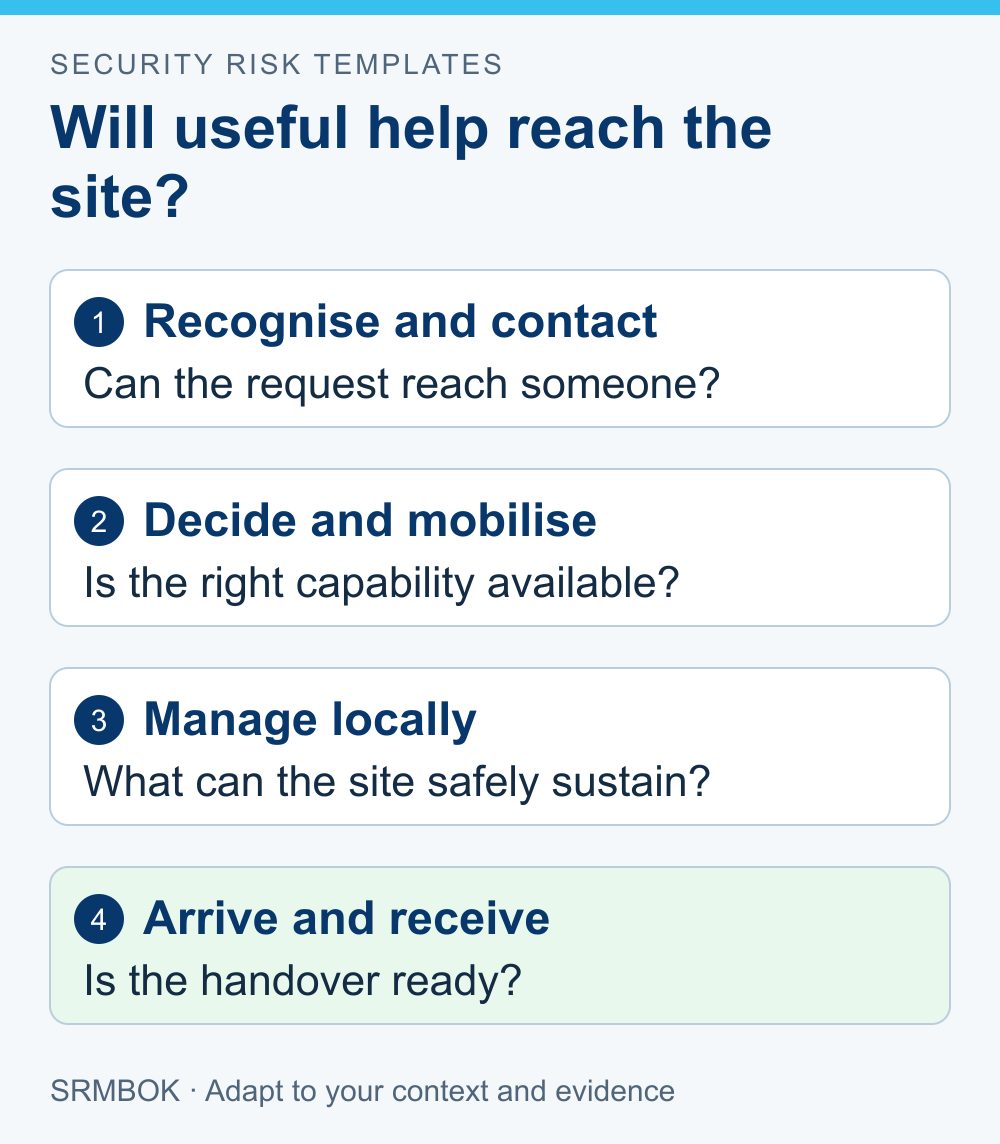
For remote site security, assess the time and conditions required to obtain useful assistance, then compare that with what the site can safely manage on its own. Start by tracing a request for help from detection through communication, decision, travel and access.
A phone number and a service contract do not establish that help can reach the right place with the necessary capability. Weather, communications, staffing, site access and competing demand may affect different parts of that chain.
This article is for managers assessing an ordinary remote operational site. Rescue, medical response, dangerous activities and technical emergency arrangements require the relevant qualified specialists. Do not use a general security assessment to authorise work that needs a separate safety decision.
Define what assistance means for the scenario
Identify the event being considered and the help needed. A security notification, an equipment repair and an emergency response are different services with different decision routes.
Describe the consequence of delay. The relevant question is not simply whether the site is far away, but whether the delay could exceed the site's safe or acceptable operating capacity.
Separate an ordinary response estimate, a contractual commitment and a demonstrated capability. They are different kinds of evidence. Record the source of any timing estimate and the conditions it assumes. If no reliable estimate exists, record the uncertainty rather than choosing a convenient number.
Safe Work Australia's remote and isolated work overview explains that isolation can arise from location, time or the nature of the work, including poor access to assistance. Use that wider view alongside the requirements applying in the site's jurisdiction.
Trace the assistance chain
Start with recognition: who notices the problem and how? Then examine whether they can communicate, whether someone receives the request and whether that receiver can authorise or mobilise useful help.
Continue to the arrival stage. The responder may need directions, access authority, suitable equipment or a receiving person. Resolve those requirements through controlled operational planning, without circulating sensitive site details widely.
Include the point at which local staff learn that assistance is delayed or unavailable. A plan can fail because the site continues relying on an expected response that is no longer coming.
Record each material dependency and its owner. Where several stages depend on the same communications or power service, identify the shared failure rather than counting the stages as independent protection.
Assess local capability honestly
Ask what trained people, equipment, information and safe working conditions are available locally. Confirm whether those resources remain available during the scenario being assessed.
Do not count one person for incompatible tasks. A worker assigned to maintain a safe operating state may not also be available to meet responders or investigate another problem.
Distinguish a documented workaround from a demonstrated one. If it has not been used or exercised under relevant conditions, explain what remains unknown and what verification is proportionate.
Identify the point at which work must pause, people must move to a safer arrangement or a higher authority must decide. The assessment should help define that decision through the proper operational and safety owners, not leave it to an unsupported worker.
Worked example: outside technical support
A fictional remote monitoring facility relies on an external provider to restore an important support service. The assessment team uses this table to examine the reliance.
| Link in the chain | Evidence question | If evidence is missing |
|---|---|---|
| Fault detected | Who notices the service loss during the relevant shift? | Assign detection and notification responsibility |
| Request transmitted | Has the approved contact route worked under relevant conditions? | Arrange a coordinated check and verify a suitable fallback |
| Support mobilised | What capability is available, with what constraints? | Obtain a supported provider statement and assess the limitation |
| Site remains operational | What local fallback has been demonstrated? | Set an authorised interim operating limit |
| Support arrives | Are access and receiving arrangements current? | Confirm the controlled handover before relying on attendance |
The example concerns technical support, not emergency-service response times. It illustrates how an apparently simple dependency contains several decisions and evidence gaps.
Examine concurrent disruption
Ask whether the event affecting your site could also affect the provider, the route or nearby sites seeking the same help. A regional disruption can make an ordinary service assumption inappropriate.
Do not automatically assume that a second provider is independent. Check the material resources and infrastructure on which both depend, at a level appropriate to your relationship and the consequence.
Consider the information required to make an alternative arrangement usable. A substitute service may need familiarisation, authorisation or compatible equipment before it can help.
Where independence or capacity cannot be established, retain that limitation in the assessment. It may justify a different local operating decision rather than another untested contract.
Exercise a bounded scenario
Begin with a tabletop exercise involving the site, the provider and the relevant operational owners. Use fictional details where appropriate and make the exercise status unmistakable.
Follow one request to the point needed to answer the assessment question. You may be able to verify contactability and authority without mobilising a vehicle or interrupting service.
For any practical test, agree authority, safety controls, notifications and recovery arrangements. Never create a real emergency or interrupt essential protection to make the exercise feel realistic.
Record what worked and what was not demonstrated. A successful phone call verifies less than arrival with the necessary capability, but it can still resolve a useful part of the uncertainty.
Turn the result into an operating decision
For each material gap, record the interim arrangement, owner, decision authority and evidence needed for closure. Keep local limits visible to the people on shift.
Review the dependency when staffing, communications, access conditions or provider arrangements change. An old response estimate should not silently become a permanent fact in the register.
Put assistance responsibilities in the security plan and retain unverified dependencies in an actionable register.
Your next action is to trace one consequential request for outside help and identify the first unsupported handover. Resolve that gap with the site and provider before treating the whole chain as reliable.
The paid SRMBOK Physical Security Risk Assessment Tool provides a workbook for recording the scenario, dependencies, controls and treatments. Use its owner and review fields to keep assistance assumptions and local operating decisions visible until they are supported by evidence.