
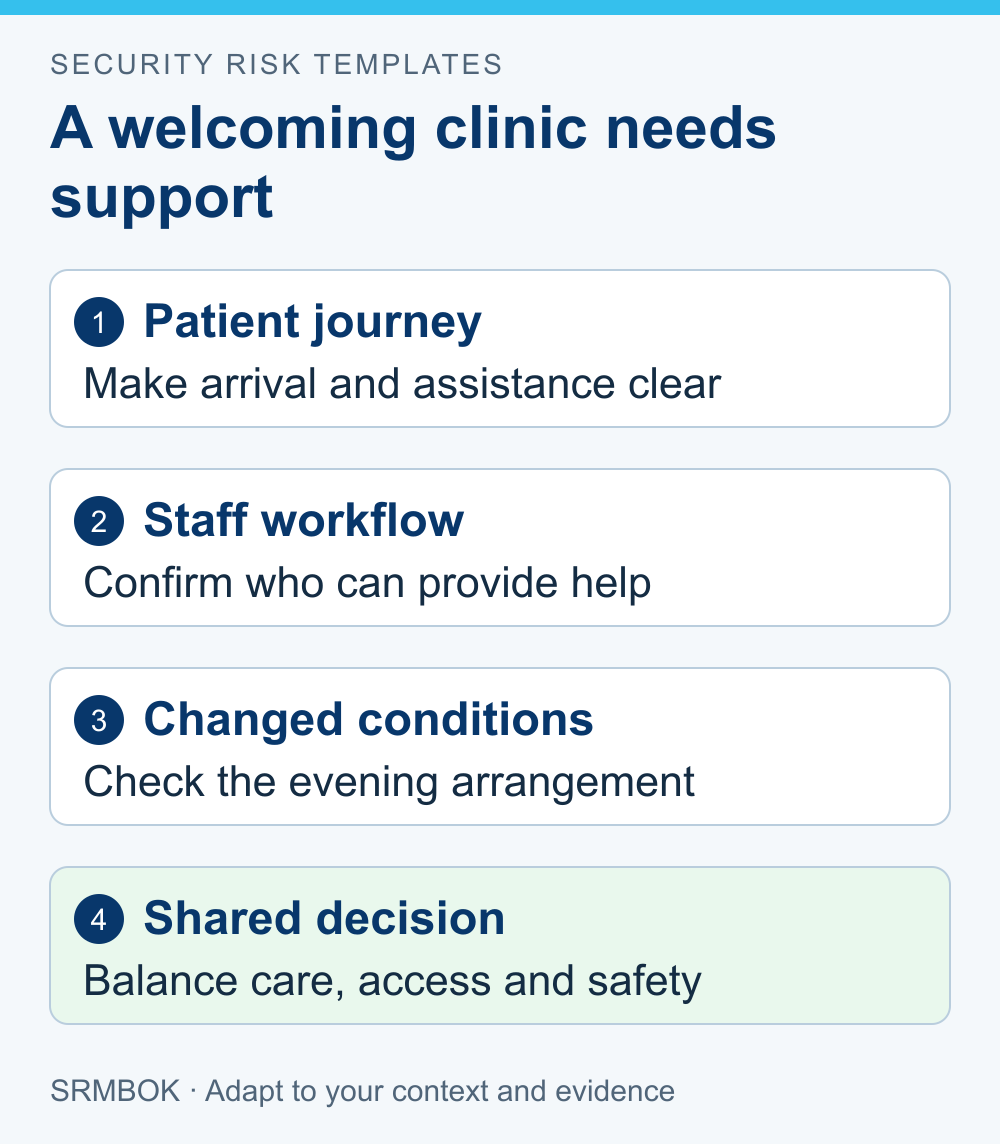
Start a clinic security assessment by following the patient journey and staff workflow together, then identify where access, communication or assistance arrangements fail to support both safe care and staff protection. Start with the decisions people face at reception and at the transition into clinical or staff-only areas.
A clinic needs legitimate public access. Making every interaction more difficult can create delay and confusion while leaving the most consequential gaps unresolved. The assessment should explain how a proposed measure supports the service as well as the security outcome.
This is a security-assessment method for clinic managers and advisers. Clinical decisions, patient-specific assessments, medicines controls and emergency-care protocols remain with qualified health professionals and the relevant governance arrangements.
Define the clinic's actual service
Record the type of service, appointment and walk-in arrangements, opening hours, staffing pattern and shared-building interfaces. A small consulting clinic and a hospital emergency department should not receive the same assessment with a different heading.
Identify who uses each area and why: patients, support people, delivery staff, cleaners, clinicians and other workers. Ask where someone unfamiliar with the building can obtain help without entering a staff-only space.
Include the period before opening and after the final appointment. Cleaning, administration and clinical work may continue when the usual reception or management support has ended.
Describe the assessed conditions and exclusions so the report does not imply it covers every clinical service or patient circumstance.
Gather observations without collecting unnecessary patient information
Consult workers across relevant roles and shifts. Review appropriately handled incident and near-miss information, focusing on conditions, decisions and control performance.
Observe ordinary movement and communication with permission. Avoid recording identifiable patient details in the security assessment unless they are necessary, authorised and handled through the clinic's applicable privacy arrangements.
Safe Work Australia's healthcare guidance on violence and aggression draws attention to work conditions, communication and access to assistance. It also recognises that different healthcare settings require different controls. Treat it as national guidance and verify the requirements applying in the clinic's jurisdiction.
Keep the evidence factual and use authorised, appropriately de-identified records when possible. Describe observed behaviour and operating conditions rather than using a diagnosis, appearance or background as a substitute for a risk assessment.
Separate public access from clinical and staff decisions
Define which areas are normally public and how movement beyond them is authorised. The process should be understandable to patients and workable for staff supporting people with different needs.
Ask who helps when a person arrives at the wrong place or cannot follow ordinary instructions. A locked door without an accessible assistance route may simply move the problem to another entrance.
Examine how staff obtain support when an interaction becomes difficult. Confirm the receiving role, available communication and escalation route under the staffing conditions being assessed.
Do not assume a duress device completes the response arrangement. Establish what its activation means, who receives it and how the approved response is coordinated. Any exercise needs clear authorisation and must not disrupt patient care or create a false emergency.
Worked example: the end of an evening clinic
A fictional clinic extends appointments into the evening. Its security assessment examines the changed operating condition rather than copying the daytime arrangements.
| Question | Finding to investigate | Decision needed |
|---|---|---|
| Who guides late arrivals? | Reception coverage ends before all appointments finish | Agree an accessible arrival and assistance arrangement |
| How do staff request help? | The usual support role is not always present | Confirm the evening receiving role and approved escalation |
| Who controls staff-only access? | A delivery sometimes arrives during closing | Assign receipt and movement decisions for that period |
| Who confirms the final state? | Clinical work and administrative closing finish at different times | Agree a closing handover that preserves care and safety needs |
The example does not prescribe patient exclusion, clinical restraint or a particular staffing ratio. It shows how a service change can invalidate assumptions behind existing controls.
Assess consequences beyond property loss
Consider harm to people, interrupted care, exposure of information and loss of essential equipment where relevant. Ask the clinical service owner to explain the operational consequences of a security incident.
Do not independently invent clinical impact thresholds. Where a scenario depends on the consequences of delayed care or equipment unavailability, obtain competent clinical input and record its limits.
Keep likelihood and consequence assumptions visible. Few recorded incidents may reflect limited reporting or changed conditions rather than evidence that a gap is harmless.
Distinguish an immediate safeguarding issue from a longer-term improvement. Refer urgent concerns through the clinic's established response process while documenting the assessment action separately.
Develop controls with the people who will use them
Compare options around the desired outcome. Improved reception communication, an altered workflow, suitable physical separation or a verified support arrangement may each address a different part of the problem.
Check accessibility, privacy, emergency movement and clinical effects with the relevant specialists. A security recommendation should not silently change how care is provided or who is eligible to receive it.
Ask staff to walk through ordinary and difficult-but-safe scenarios. Use fictional information and agreed exercise boundaries. Observe whether people can find help and make the required decision without abandoning another essential task.
Record unresolved conflicts for an authorised decision. Do not hide a disagreement between clinical and security priorities behind a generic “high risk” label.
Keep the assessment alive when services change
Review relevant controls when opening hours, services, layout, staffing arrangements or shared-building services change. Include feedback from workers and service users through suitable channels.
For each treatment, name an owner and define evidence of completion. Installing a device, issuing an instruction and demonstrating a functioning response are separate achievements.
Define the clinical and security boundaries in the assessment scope, and give each agreed improvement an owner in the treatment plan.
Your next action is to trace one patient journey during the least-supported operating period. Identify one unclear transition or assistance decision and resolve it with the clinical and operational owners.
The paid SRMBOK Risk Assessment Template provides an editable structure for scope, evidence, scenarios, controls and treatments. Adapt it to the clinic's service and retain specialist clinical, privacy and safety decisions with the people authorised to make them.