
Start a warehouse security assessment by following the custody of goods from receipt to dispatch, then focus on the exceptions where authorisation or accountability becomes unclear. Observe the operation with the warehouse team before proposing a control that slows work or creates a traffic hazard.
A warehouse is a moving system. Goods change location, quantities change, orders are amended and drivers arrive under time pressure. An office-style visitor checklist will not explain all the decisions that determine whether the right goods reach the right authorised carrier.
This method serves warehouse and security managers assessing ordinary goods operations. Dangerous goods, customs-controlled cargo and other regulated activities need their specific requirements and competent specialists included in the scope.
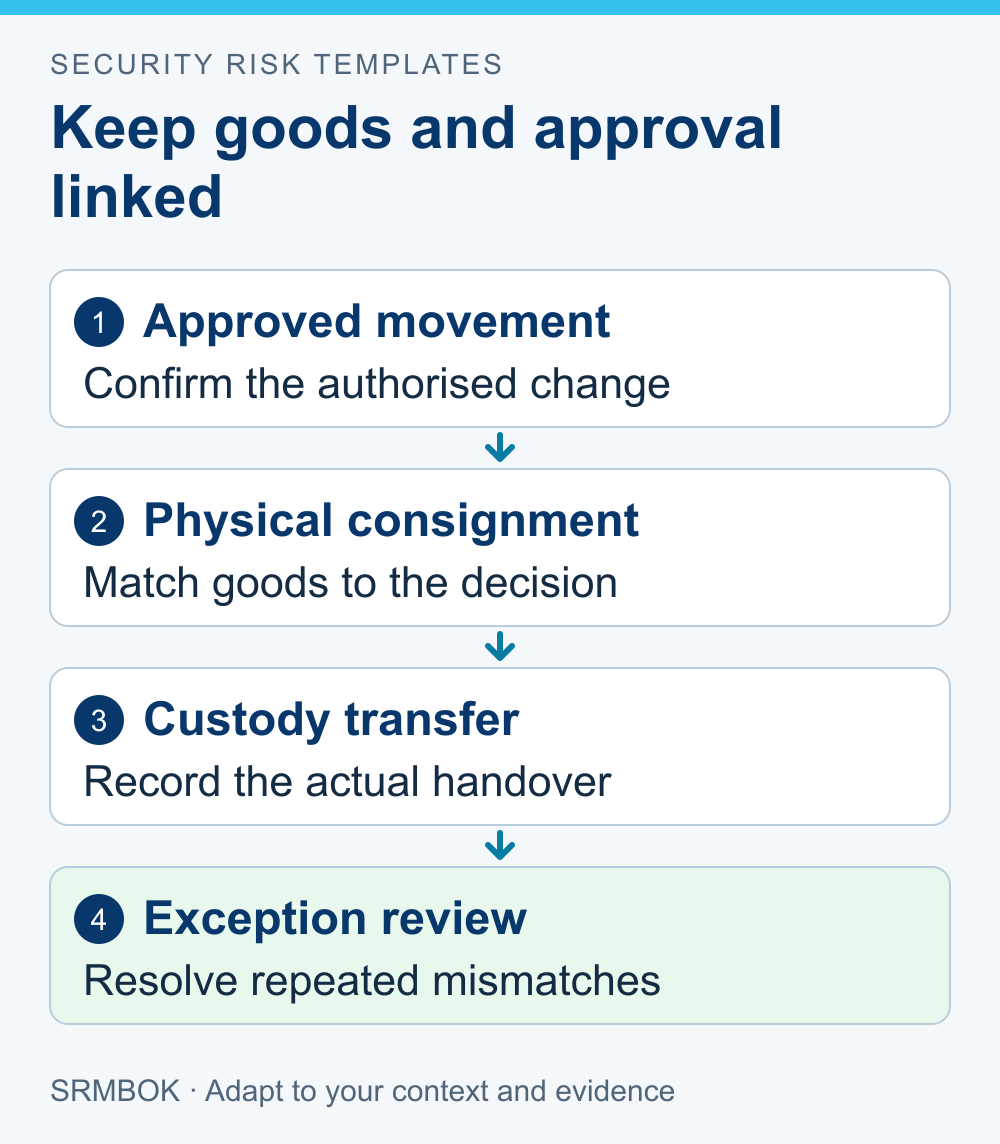
Draw the goods flow and its records
Map receipt, discrepancy handling, storage, picking, staging, loading and release. Add returns, damaged stock and urgent orders: exceptions often follow different routes from the normal process.
At each stage, identify the physical custodian and the record that authorises movement. Ask what the record proves and what it does not. A scanned label may show a transaction was entered without proving the correct item was loaded.
Choose a level of detail that supports decisions. You do not need to document every shelf movement to discover that nobody owns a disputed receipt or approves a changed collection request.
Compare the formal process with observation during relevant operating conditions. Arrange safe, authorised access for the assessor and avoid distracting workers engaged in vehicle or plant operations.
Assess security and safe movement together
A proposed checking point can change queues, reversing movements and pedestrian exposure. Involve the person responsible for traffic management before altering where drivers wait or where staff inspect paperwork.
Safe Work Australia's April 2021 traffic-management guide for warehousing addresses the interaction of vehicles, plant and pedestrians through warehouse activities. Use that guidance with current local requirements when designing the security interface; this article is not a traffic-management plan.
Do not send drivers through an operating area simply because the dispatch desk is there. Agree a safe communication and verification arrangement that fits the facility.
If a control creates repeated congestion, investigate the cause with operations. Removing the check entirely and forcing staff to work around an unsafe layout are not the only options.
Identify consequential exceptions
Review cases where a normal authorisation is changed: a different collection vehicle, amended destination, urgent release, unavailable supervisor or a system outage.
Establish who can approve each change and how the decision is verified through a trusted business channel. A request made at the loading point should not automatically replace the existing instruction.
Consider goods whose loss or misdirection would have an unusually serious consequence. The answer may depend on service commitments, replacement lead time or sensitive information as well as sale value.
Keep the scenario precise. “Theft from the warehouse” is too broad to guide every treatment. “An unverified collection change could result in goods being released to an unauthorised recipient” identifies a particular decision to examine.
Worked example: an amended collection
A fictional distributor finds that last-minute collection changes are managed inconsistently. The assessment follows the decision rather than proposing more cameras as the first response.
| Stage | Evidence question | Proposed improvement |
|---|---|---|
| Change requested | Can the request be linked to an authorised customer or carrier contact? | Confirm the change through the established contact route |
| Release approved | Is the approver authorised for this decision? | Define the approving role and fallback |
| Goods selected | Does the staged consignment match the approved release? | Use an appropriate reconciliation before loading |
| Custody transferred | Is the receiving party and actual handover recorded? | Keep a clear receipt and discrepancy route |
| Exception reviewed | Do repeated changes indicate a process problem? | Review causes with dispatch and customer service |
These are illustrative controls. The team would test whether they work within its actual systems, staffing and contractual arrangements before claiming the risk is treated.
Look beyond the loading door
Examine storage and staging periods in relation to the goods at risk. A controlled external boundary may coexist with unclear internal custody. Goods awaiting collection, returned items and items awaiting disposal can fall outside the normal stock flow.
Ask who can change inventory records and who reviews relevant exceptions. Coordinate with the system owner without turning the physical assessment into an unapproved technical audit.
Consider loss detection. If an item is missing, can the organisation identify when custody last changed and which records are reliable? A process that notices discrepancies only at a distant stocktake may need an earlier check for selected high-consequence goods.
Avoid assuming every discrepancy is malicious. Mis-picks, recording errors and incomplete receipts can resemble theft. Record facts and refer suspected wrongdoing through the authorised process.
Trial improvements under realistic conditions
Choose a limited, approved trial covering the relevant shift or dispatch condition. Explain the purpose to the people doing the work and agree what will be observed.
Check both the security outcome and operational effects against an agreed baseline. Measure delay or rework where useful instead of claiming that the change cannot affect dispatch. Did the authorised decision occur? Could staff complete it without leaving another essential task uncovered? Did the change introduce unsafe queues or confusion about custody?
Use the result to refine the process. If an approval route repeatedly fails, adding another signature box will not create an available decision-maker.
Document the limits of the trial. A successful ordinary collection does not establish that outage arrangements or all high-volume periods have been assessed.
Keep actions connected to the scenario
Each finding should identify the affected goods flow, evidence, consequence, owner and acceptance check. Distinguish an implemented change from a demonstrated improvement.
Review the assessment when the warehouse changes its layout, carrier arrangements, operating hours or order-management system. A route that was practical at one volume may become a source of repeated exceptions later.
Use an actionable risk register to retain the custody scenario and an accountable schedule to track process changes.
Your next action is to trace one ordinary dispatch and one amended dispatch from the authorising record to the receiving party. Identify the first point where the physical goods and the decision record become disconnected.
The paid SRMBOK Physical Security Risk Assessment Tool provides a workbook for recording the scenario, controls, treatment owner and review evidence. Use it to retain the warehouse's actual goods flow and operating constraints instead of substituting a generic office assessment.