
Plan office move security for the overlap between the old site, goods in transit and the temporary workplace. Assign responsibility at each handover instead of assuming the permanent site's arrangements will continue unchanged.
A move creates several changing conditions at once. Movers need access, staff work from unfamiliar spaces, equipment is packed and normal records may be unavailable. Temporary arrangements can persist longer than expected unless someone owns their end date.
This article addresses an ordinary business relocation. Specialist transport, hazardous materials and regulated assets require their own competent arrangements. The aim is to maintain practical control of people, assets and information while work continues.
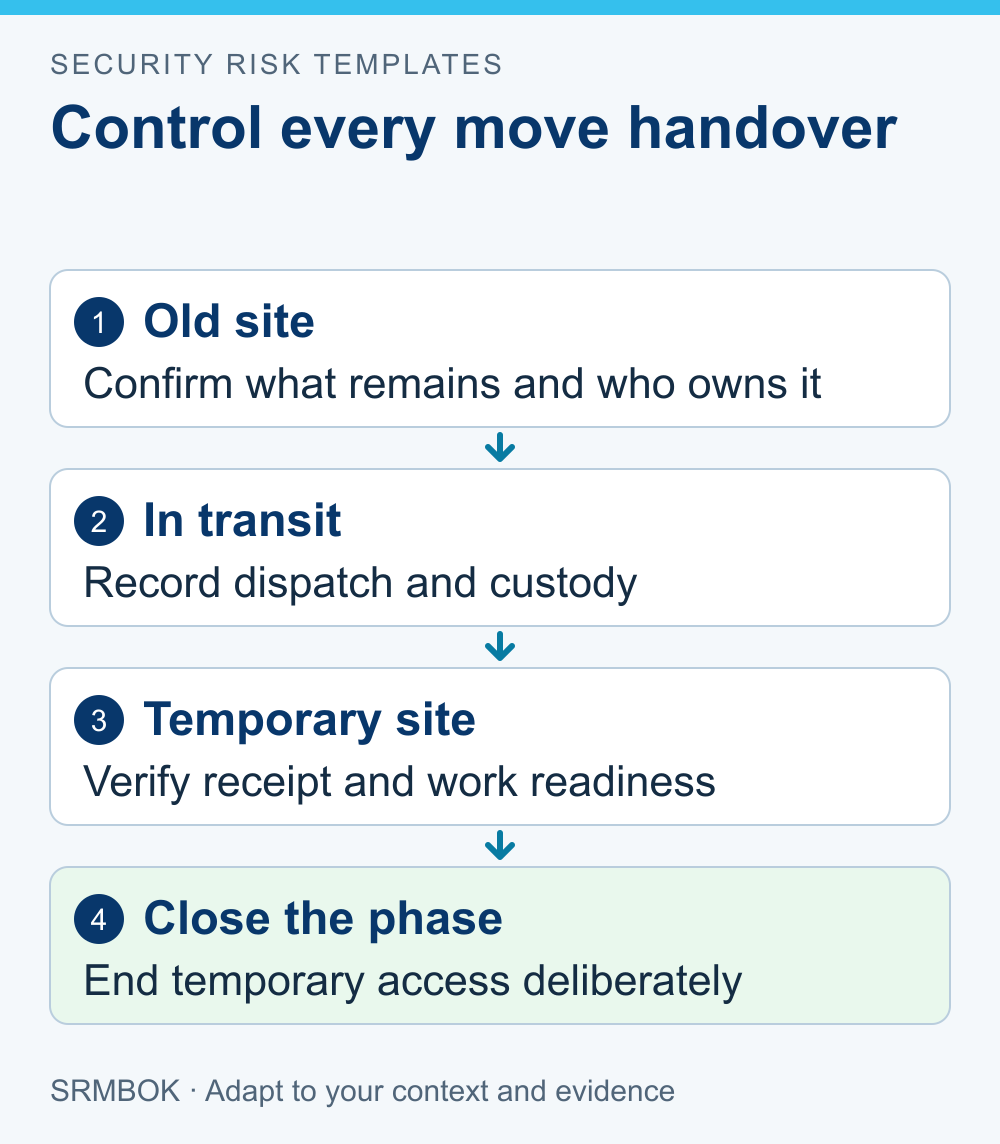
Divide the move into operating phases
List the conditions the business will pass through: preparation, packing, collection, transport, temporary occupation, final installation and old-site closure. Add dates and accountable roles, recognising that phases may overlap.
For each phase, record where people will work, which assets remain and who controls access. A site marked “closed” on the project plan may still contain staff, records or a communications service required elsewhere.
Name the decision-maker who can approve a phase change. Moving furniture into a room does not establish that it is ready for sensitive work. Readiness should reflect the controls needed for the work that will actually occur there.
Keep the plan short enough for the move coordinator and duty staff to use. Put sensitive inventories and access details in controlled attachments rather than a widely circulated timetable.
Establish the temporary workplace boundary
Confirm which areas your organisation may use and which are shared. Define visitor reception, equipment storage, private conversations and the handling of information where others may be present.
Check the proposed operation against the space. Australian business.gov.au guidance on premises includes temporary and co-working spaces and recommends defining needs before choosing them. A short occupancy does not remove the need to decide whether the space supports the intended activity.
If a necessary activity cannot be adequately controlled there, consider another approved location or a different working method. Do not treat a makeshift barrier as proof that a public space has become suitable for confidential work.
Identify who provides building security and what your team must provide itself. Temporary tenants may have different entitlements and support arrangements from permanent occupants.
Control the transfer of assets and records
Use a manifest proportionate to the items being moved. Identify the responsible sender, authorised recipient and handover evidence. Separate high-consequence items where they need different handling, rather than placing everything under one generic box count.
Agree how discrepancies are reported. The receiving check should identify a missing container and provide a known route for checking dispatch and transport records. Staff should not have to reconstruct custody several days later from memory.
Coordinate digital and physical changes. A device may arrive while its approved network connection or access configuration is unfinished. Keep it under appropriate custody until the responsible team confirms it is ready for use.
Do not circulate sensitive container contents, schedules or access credentials more widely than required. Movers need clear handling instructions; they do not necessarily need the full security assessment.
Worked example: a two-stage relocation
A fictional consulting team moves into a temporary office while its permanent fit-out is completed. Some records remain at the old premises for collection by an approved service provider.
| Phase | Main decision | Evidence required before proceeding |
|---|---|---|
| Temporary office opens | Which work can start in the shared space? | Manager confirms the relevant access, information-handling and support arrangements |
| Equipment collection | Who takes custody from the old-site team? | Dispatch record identifies items, recipient and discrepancies |
| Temporary-site receipt | Has the expected equipment arrived and been assigned? | Receiving check and named custodian |
| Old-site closure | Are any assets, records or active services still present? | Final inspection and reconciled removal or transfer record |
| Permanent office opens | Can temporary permissions and workarounds end? | Readiness decision and verified removal of temporary arrangements |
The project tracks open items by phase. It does not close the old site merely because most people have left, or end temporary protection because the new furniture has arrived.
Manage access without creating permanent leftovers
Give movers and contractors the permissions required for their role and period of work. Coordinate with the building manager and the organisation responsible for their supervision.
Record who can approve changes when the schedule slips. A delayed move should trigger an explicit extension or replacement arrangement, not indefinite access because nobody knows whether the job is finished.
Reconcile keys, badges, accounts and shared access arrangements after each phase. Some changes belong to facilities, others to IT or the landlord. The move coordinator needs completion evidence from each responsible party.
Keep emergency and assistance routes clear for staff working in unfamiliar premises. Confirm they know whom to contact and how the site's emergency arrangements apply to their area.
Test the plan against an ordinary delay
Before the move, walk through a scenario in which the vehicle is late or the temporary office is unavailable. Ask where the assets remain, who can approve an alternative and which work must pause.
This is a planning exercise, not a requirement to rehearse every possible disruption. Choose an uncertainty that could materially change custody or expose staff and information.
After the first transfer, review the actual handovers. Correct unclear labelling, receiving responsibility or contact gaps before the next load. Small operational changes can be more useful than rewriting the whole move plan.
Keep a final closure check for temporary arrangements. Record what ended, what became permanent and who accepted any remaining limitations.
Define the move's temporary boundaries in the assessment scope and assign each phase's responsibilities in the security plan.
Your next action
Draw the move as a sequence of locations and handovers. Mark every point where responsibility changes, then resolve the first unsupported assumption about custody or readiness.
The paid SRMBOK Security Plan Templates provide editable planning and treatment examples. Adapt the relevant responsibilities and activity sections into a short relocation plan, with clear phase decisions and a deliberate end to temporary controls.