
Write security guard instructions that connect each duty to a clear purpose, decision authority and escalation route. Start with the situations they actually face at your site, then check whether a trained replacement could follow the instructions without relying on unwritten knowledge.
A long document can still leave an officer uncertain about whether to admit a late contractor or whom to call when equipment fails. Useful post instructions answer those decisions directly and remain accessible during the shift.
This article helps clients and security supervisors prepare site-specific instructions together. It does not define legal powers or replace required licensing, training, emergency procedures or the employer's responsibilities.
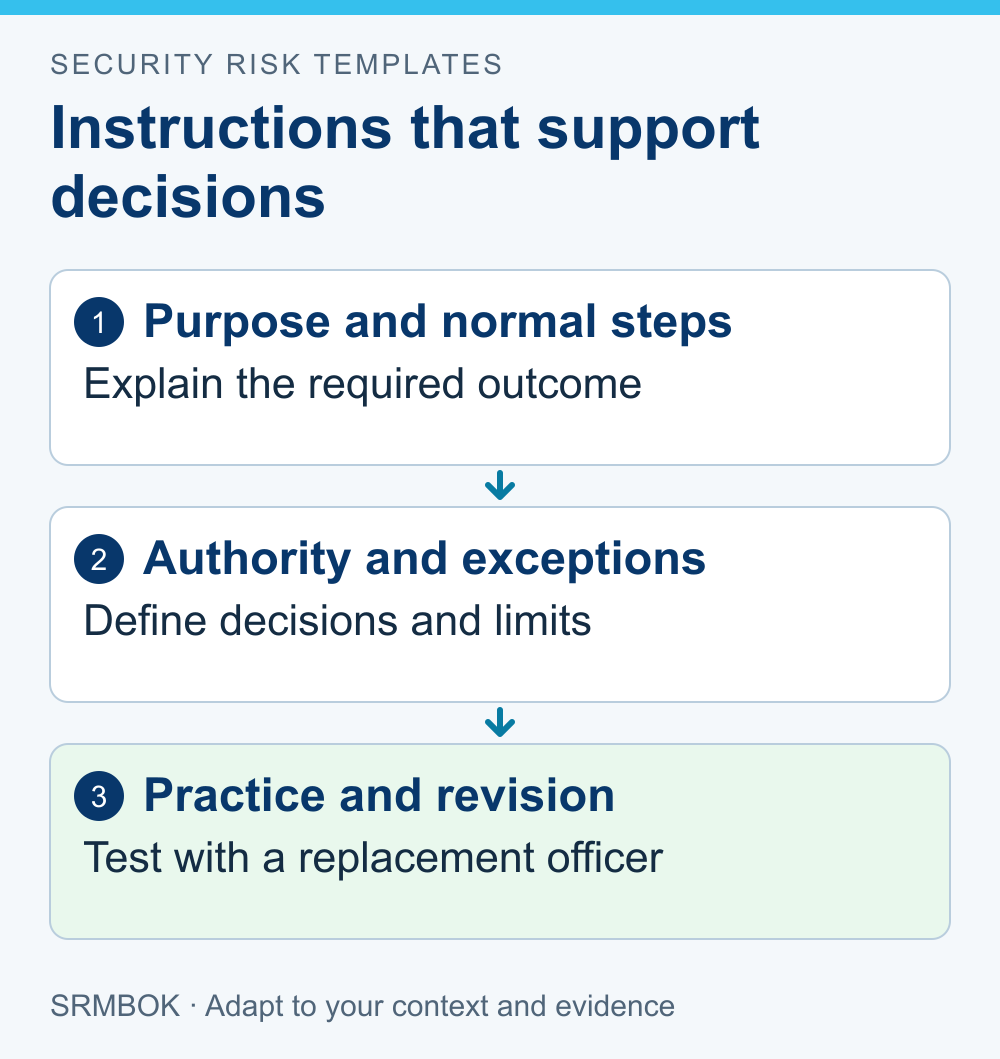
Explain the control purpose
For each duty, state what it is meant to achieve. “Monitor reception” is an activity. “Allow visitors beyond reception only after an authorised host accepts responsibility” describes an outcome against which an instruction can be tested.
The purpose helps officers recognise a situation the steps do not cover. It should not become an invitation to improvise outside their authority. Pair it with the limit: which decisions the officer may make and which must be referred.
UK ProtectUK personnel-training guidance emphasises clear roles, operating procedures, lines of command, training and rehearsal. Apply those general principles to your site's duties; local legal and licensing requirements need their own verification.
Check that the agreed service actually includes the duty. A client cannot solve a staffing gap simply by adding another paragraph to post orders. Discuss resources and contractual scope with the provider.
Write the normal decision sequence
Use short steps in the order the officer needs them. Identify the trigger, checks, permitted action, record and completion condition.
For a contractor arrival, that might mean locating the approved job, contacting the sponsor, confirming the agreed destination and applying the site's access arrangement. Link to the current authorisation record instead of copying a list that will soon become stale.
Keep forms and contact details consistent with the instructions. A procedure directing someone to call a role that is not staffed after hours is incomplete, however clearly it is written.
Avoid language such as “deal with as appropriate” for a consequential decision. Explain the permitted options and the condition for escalation. Where judgement is necessary, identify what information should inform it.
Define limits and exceptions
Describe situations in which the officer should stop the ordinary process: missing approval, unavailable sponsor, conflicting instructions, equipment failure or a safety concern.
Specify a fallback that the officer can carry out within their role. This might be maintaining the ordinary access boundary while seeking a decision, rather than granting an exception to avoid inconvenience.
Instructions cannot create powers of search, detention or force. Have the provider and relevant qualified adviser check legal boundaries and the site's approved response policies. Keep the practical instruction aligned with those boundaries.
Make emergency arrangements easy to find and consistent with the site's plan. Do not bury immediate safety actions inside an administrative checklist or require routine approval before using the appropriate emergency route.
Worked example: an unlisted maintenance visit
At a fictional office, a technician arrives after the approved booking time. The guard has a contact number but no authority to approve an unlisted job. The client and provider agree this sample instruction structure.
| Part of instruction | Example content |
|---|---|
| Purpose | Only authorised maintenance visitors enter the defined work area |
| Initial check | Compare the visit with the current approved work record |
| Missing or changed approval | Contact the nominated site decision-maker through the established contact route |
| Authority limit | The officer may apply the approved access process; they may not authorise new work |
| If the decision-maker is unavailable | Use the documented fallback and keep access within the existing permission |
| Record and handover | Record the decision, approving role and any unresolved issue for the next shift |
The detailed instruction would contain the site's actual contact route and safe waiting arrangements in a controlled document. Those details should not be published in a general article or public tender attachment.
Make the instructions usable on shift
Separate immediate decision aids from background explanation. A short checklist can point to a fuller procedure when an officer needs detail. Both should carry a version or reference that allows staff to recognise the current instruction.
Check practical access. If the instructions are online, what happens when the network is unavailable? If printed, who removes superseded copies? Decide how approved urgent changes reach every affected shift.
Use language the workforce can understand. Explain local abbreviations, avoid contradictory terms for the same area and provide suitable accessible formats where needed.
Ask officers to identify tasks that cannot be completed together. If attending one duty leaves a required position unattended, resolve the conflict in the operating plan. “Do both” is not an instruction that can be followed.
Test before approving
Have an officer who did not write the document work through a clearly labelled scenario. Ask them to explain the decision, locate the authorisation source and identify the escalation route.
Observe where they pause or rely on memory. A successful answer from the site's most experienced supervisor does not establish that a newly assigned, appropriately trained officer can use the instruction.
Revise the text and supporting arrangements together. If the exercise exposes an unavailable manager, the correction includes the management rota or fallback authority, not only a clearer telephone list.
Record who approves the instructions, who withdraws superseded copies and how competence is confirmed. Keep acknowledgement separate from demonstrated understanding: a signature proves receipt more readily than it proves the ability to perform the duty.
Guard instructions should implement the relevant security plan under the authority established in the security risk policy.
Your next action
Choose one duty that generates repeated questions. Rewrite it as purpose, trigger, permitted decision, exception, record and handover, then test it with a replacement officer and the supervisor.
The paid SRMBOK Procedure Template provides an editable structure for purpose, scope, steps, responsibilities and document control. Use it to turn an agreed operational decision into maintainable instructions, with the provider verifying that the role, training and authority support the work.