
Start a security lighting assessment by defining what people and cameras need to see, then inspect those tasks under the conditions in which the lighting must work. Adding brighter fittings without checking the view can leave the important detail obscured by glare, shadow or poor contrast.
This is a briefing and review process for security and facilities managers. A competent lighting designer and the relevant electrical specialists should specify and implement technical changes. Emergency lighting, hazardous locations and other regulated applications need their own applicable requirements.
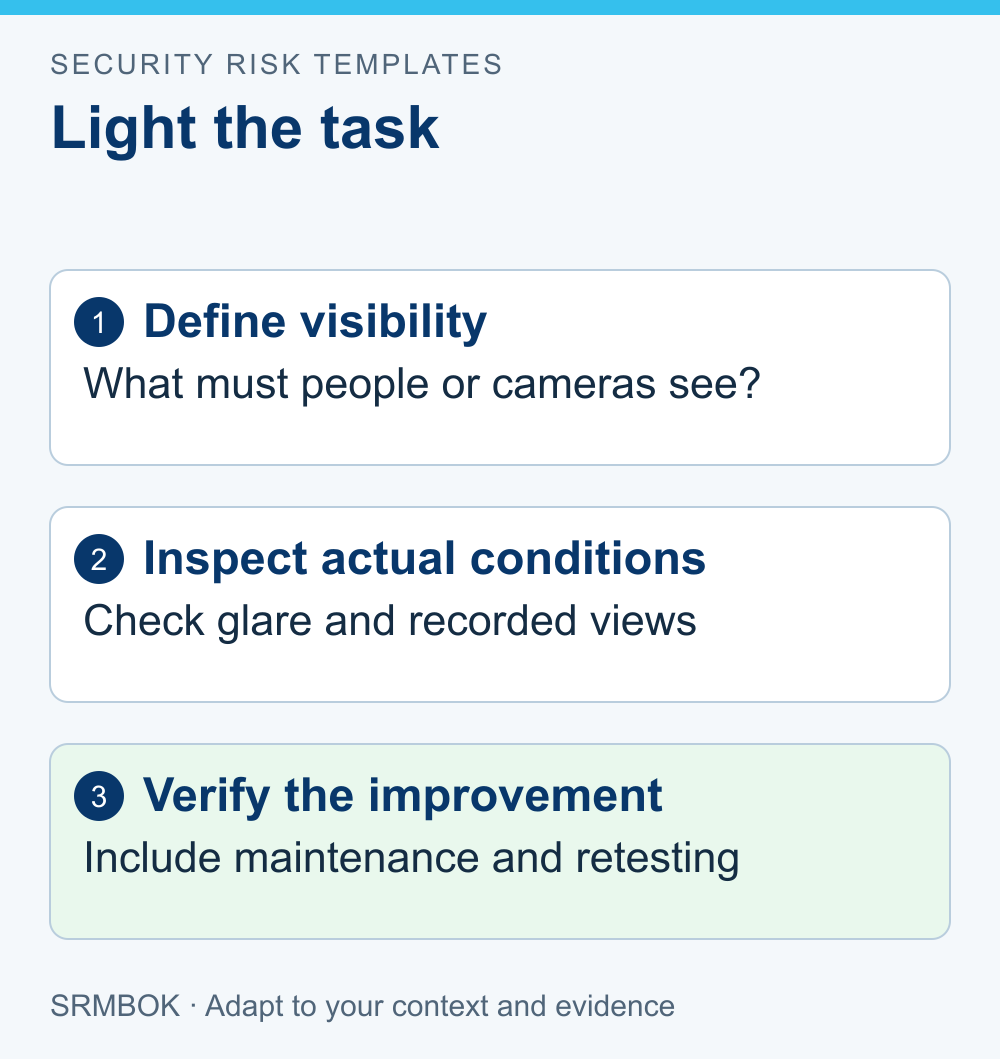
Name the task before choosing a fitting
Different tasks need different results. Staff may need to recognise a person approaching reception, a camera may need to record a particular activity, and a responder may need to move safely through an area. “Light the car park” is too broad to distinguish those needs.
Write the task, observer or camera, relevant area and operating conditions. State whether the task concerns normal use, a security response or both. This helps the designer understand why light is needed and where performance matters.
NPSA's Security Lighting guidance, dated February 2015, explains the relationship between lighting, human observation and CCTV. Its general principles are useful here. Have specialists check current technical standards and local requirements rather than treating an older guidance document's tables as a current universal specification.
Inspect the scene from the user's position
Arrange a safe inspection with facilities staff under relevant night-time conditions. Look from the positions where people must perform the task, not only from directly beneath a fitting. Keep the inspection within authorised areas and normal safe-working arrangements.
Record obstructions, bright sources in the line of sight and abrupt changes between lit and unlit areas. Ask staff which tasks are difficult, then verify the circumstances rather than accepting every preference for more light as a design requirement.
View the relevant camera recording as well as the scene itself. A human observer and a camera can respond differently to the same lighting. Where the requirement concerns recorded evidence, assess the saved image under the tested conditions.
Distinguish a defect from a design problem
A failed or dirty fitting may need maintenance. A repeated problem despite working fittings may need changes to position, direction, shielding, control or the overall lighting design. Establish which problem you have before buying replacements.
Check whether the surroundings changed. New signs, foliage, structures or parked equipment can affect a view that was acceptable at commissioning. A seasonal change can also alter conditions. Record the change and ask the appropriate specialist how it affects the required task.
Do not use a phone photograph as a substitute for a competent lighting assessment. It may help document a location or complaint, but automatic exposure can produce an image that differs from what a person or security camera experiences.
Give the designer a useful problem statement
The following fictional example concerns the entrance and receiving area of an ordinary office. It does not prescribe illumination levels or fixture positions.
| Required task | Observed difficulty | Question for the designer and installer |
|---|---|---|
| Reception staff can see an approaching authorised visitor. | A bright fitting appears behind the person's face from reception's viewpoint. | How can the lighting support the required view without creating objectionable glare? |
| The existing camera records activity at the receiving point. | Part of the saved view loses useful detail after dark. | Which lighting and camera conditions cause the loss, and how will the corrected result be demonstrated? |
| Staff use the agreed path safely. | Maintenance has left some fittings out of service. | What repair and verification are required, and what interim arrangements are appropriate? |
| Neighbouring premises are not unnecessarily affected. | A complaint identifies light spilling beyond the intended area. | Can the task be achieved with better control of spill and operating times? |
The completed brief connects the complaint to a task and a verification question. It gives the specialist room to propose a suitable design without forcing an arbitrary choice of equipment.
Review interactions and constraints
Coordinate lighting with cameras, landscape maintenance, building operations and legitimate users. Ask whether proposed changes affect glare for drivers or pedestrians, neighbouring properties, environmental considerations or the operation of other controls.
Check how the lighting is controlled. A timer that does not match operating hours, a faulty sensor or an undocumented manual override can undermine an otherwise suitable installation. The responsible operator should know the intended mode and how to report a fault.
Avoid specifying permanent maximum brightness merely because it is easy to describe. The appropriate arrangement depends on the task, assessed security need and local constraints. Also avoid assuming that lighting by itself prevents crime or removes the need for detection, response and other protection.
Agree how the result will be accepted
Before work begins, define the tasks to be demonstrated, relevant test conditions, competent participants and the evidence required. Include any applicable measurements and standards identified by the designer. Do not invent a numerical threshold after the installation is complete.
For a camera-related requirement, include a check of the recorded output under relevant conditions. For a staff task, include the appropriate user viewpoint and safe operating conditions. Record any limitations such as weather or an operating situation that could not be represented at the time.
If the proposed change requires work on electrical equipment or affects safety systems, keep it within the authorised specialist process. A security inspection is not permission for staff to reposition live fittings or change wiring.
Maintain the performance you accepted
Assign responsibility for inspections, cleaning, fault reporting and review after changes to the scene. The interval should reflect the installation, environment, manufacturer guidance and applicable requirements. A generic annual check may not address a fast-changing work area.
Retain the accepted design and commissioning evidence. They help distinguish deterioration from a new requirement. If a new task is introduced, assess it explicitly rather than assuming the old lighting arrangement serves it.
Define the lighting question within the assessment scope, then record improvements and verification in an accountable treatment schedule.
Your next action is to select one recurring visibility complaint and write the task that cannot be performed reliably. Inspect that task with facilities and the relevant specialist before choosing a replacement fitting.
The paid SRMBOK Guide to Physical Security Specifications helps place lighting and related measures within an overall physical-security brief. Use it to connect the required protection to the specialist specification, commissioning and ongoing responsibilities for your site.