
Security system acceptance testing should provide evidence that the installed system meets the agreed requirements under the conditions in which you will use it, together with the information and training needed to operate and maintain it. An installed device and a successful demonstration of one feature are only part of that handover.
This guidance is for security and facilities managers commissioning ordinary building-security measures. Technical design, electrical work, life-safety interfaces and contractual disputes need the relevant specialists. Define acceptance early enough for suppliers to price and plan the work properly.
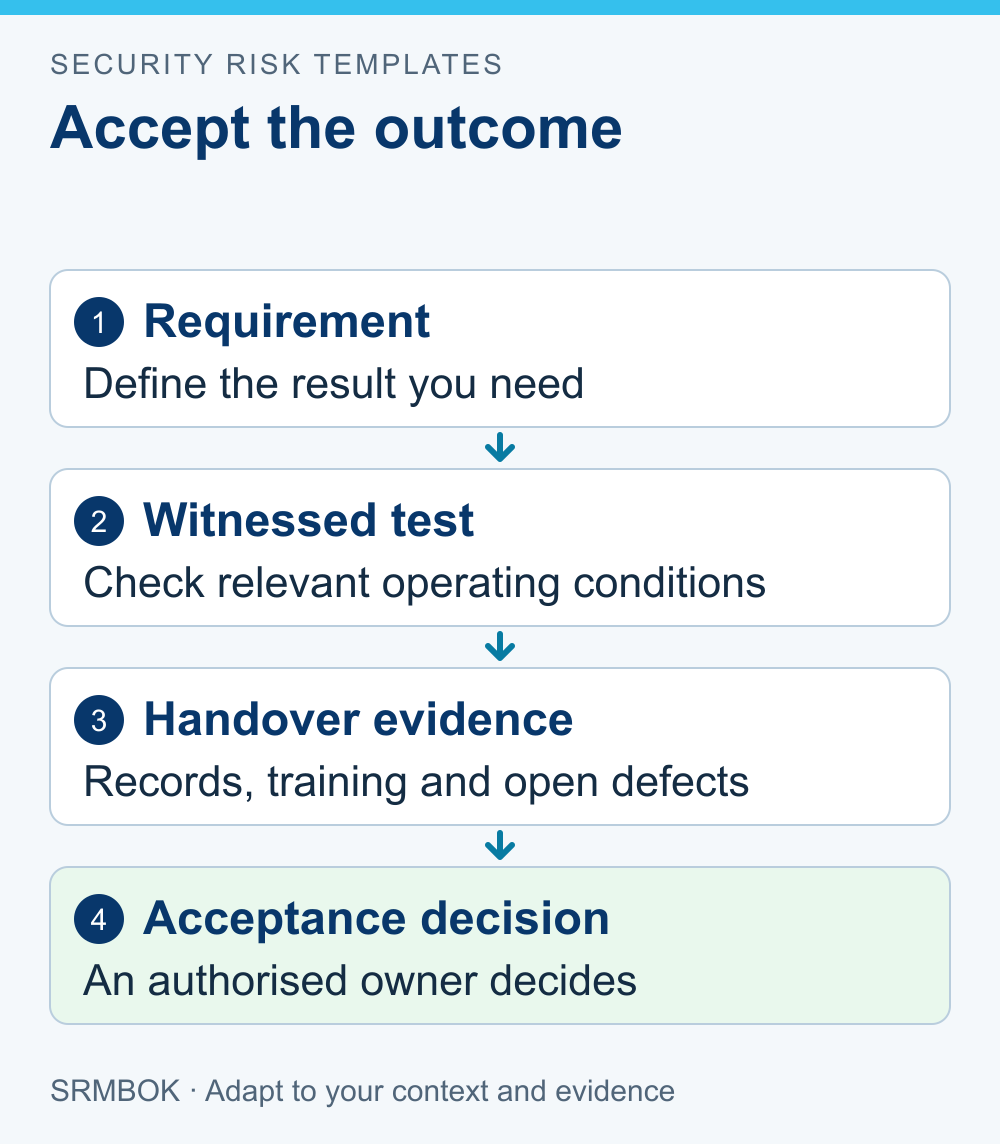
Describe the operational result first
Start with the risk and the work the measure must support. For example, you may need reception to confirm an authorised visitor before allowing access to a staff-only area. That is a clearer requirement than asking a supplier for “a modern visitor system”.
Describe normal use, foreseeable exceptions and dependencies. Include operating hours, who will use the measure, relevant environmental conditions and the systems it must work with. Do not publish real-site details in an unrestricted procurement document if they would reveal vulnerabilities.
The UK's National Protective Security Authority guidance on access-control systems places risk assessment and operational requirements before installation. Use that principle to connect the proposed equipment to a required outcome. It is guidance, not a certificate that your project meets local obligations.
Convert each important requirement into an acceptance check
If a requirement cannot be checked, clarify it before installation. “Easy to use” might mean an authorised operator can complete specified routine tasks using the supplied instructions. “Reliable notification” needs a defined destination, escalation arrangement and performance criterion appropriate to the site's needs.
Agree who will perform the check, who will witness it and what record will be kept. For critical interfaces, a supplier's assertion may need confirmation from another system owner. Avoid accepting a responsibility gap because each contractor says their own component passed.
Do not invent thresholds at the final demonstration. The installer should know the acceptance criteria before committing to the design. If the requirement changes, document the change and its effect on price, scope and testing through the project's normal process.
Use a handover matrix
The following fictional example concerns a replacement access-control arrangement at an ordinary office. It illustrates acceptance records without specifying real access routes or technical configurations.
| Requirement | Evidence to request | Acceptance decision |
|---|---|---|
| Only approved roles receive the agreed access. | Approved permission schedule and a witnessed, authorised test using test credentials. | Confirm the schedule and observed behaviour match; resolve unexplained exceptions. |
| An authorised operator can remove a test credential. | Operator demonstration and the resulting change record. | Verify the removal reaches the relevant system components and is recorded. |
| The arrangement interfaces correctly with other building systems. | Coordinated commissioning record from the responsible specialists. | Refer unresolved life-safety or technical issues to their owners; do not improvise a bypass. |
| Staff can perform routine work. | Training attendance plus a demonstration of agreed operator tasks. | Confirm the people who will operate it can use the instructions and escalation route. |
| The business can maintain the installation. | Asset list, configuration records, maintenance instructions and support contacts. | Confirm records are usable, controlled and held by the responsible business owner. |
Keep the matrix focused on material requirements. A large collection of supplier brochures does not replace a clear link between the requirement, the result and the person who accepted it.
Test the interfaces as well as the parts
A control can appear satisfactory in isolation and fail when connected to the rest of the operation. Check how permissions, alerts, records and operator actions move between components. Include the people who own those interfaces.
The same NPSA guidance discusses commissioning against the specification and testing integrated systems together. Apply that idea within an agreed commissioning plan, using competent specialists for the system and environment involved.
Tests that could affect emergency exits, safety systems, live operations or other tenants need specific coordination. Document stop conditions and restoration checks. A rushed final demonstration is a poor time to discover that nobody has authority to interrupt a supporting service.
Check that you can operate it after the installer leaves
Ask the people who will run the installation to demonstrate the tasks they actually need to perform. This may include adding an approved user, reviewing an event, reporting a fault or restoring a routine configuration through the authorised process.
Verify access to the current instructions and support route. Store sensitive administration information through the organisation's approved credential-management process. Do not place passwords in an ordinary handover report or distribute them with broad project correspondence.
Identify the owner of ongoing maintenance, software support and configuration changes. Clarify which activities are included in the support arrangement and which require additional work. The acceptance record should not assume a service exists simply because the equipment supports it.
Record defects and limitations precisely
Separate an unfinished requirement, a failed test and an agreed limitation. Each requires a different decision. “Minor issues remain” is inadequate if the remaining issue affects the main security function.
For each unresolved item, record its consequence, owner, corrective action, target date and retest. If a competent authorised decision maker permits temporary use, document the conditions and interim measures. A temporary arrangement needs a review date and a clear route to resolution.
Payment and contractual acceptance may have different meanings under the agreement. Use the project's contract-management process to handle those decisions. This checklist should inform that process, not be treated as legal advice about withholding payment or rejecting work.
Keep a baseline for later assurance
Retain the accepted requirements, test results and configuration records in a controlled location. They give a later assessor something more useful than “it worked when installed”. Record subsequent changes against that baseline so old test evidence is not mistaken for proof of the current arrangement.
Connect the acceptance evidence with the security plan and keep unfinished work visible in the treatment plan.
Your next action is to select the three most important operational requirements in the project and ask how each will be demonstrated at handover. Resolve missing tests and owners before the installation reaches its final day.
The paid SRMBOK Guide to Physical Security Specifications helps structure requirements for physical protection, access, locks, alarms and related measures. Use its guidance to prepare a brief appropriate to your risks, then have the relevant specialists develop and verify the detailed specification.