
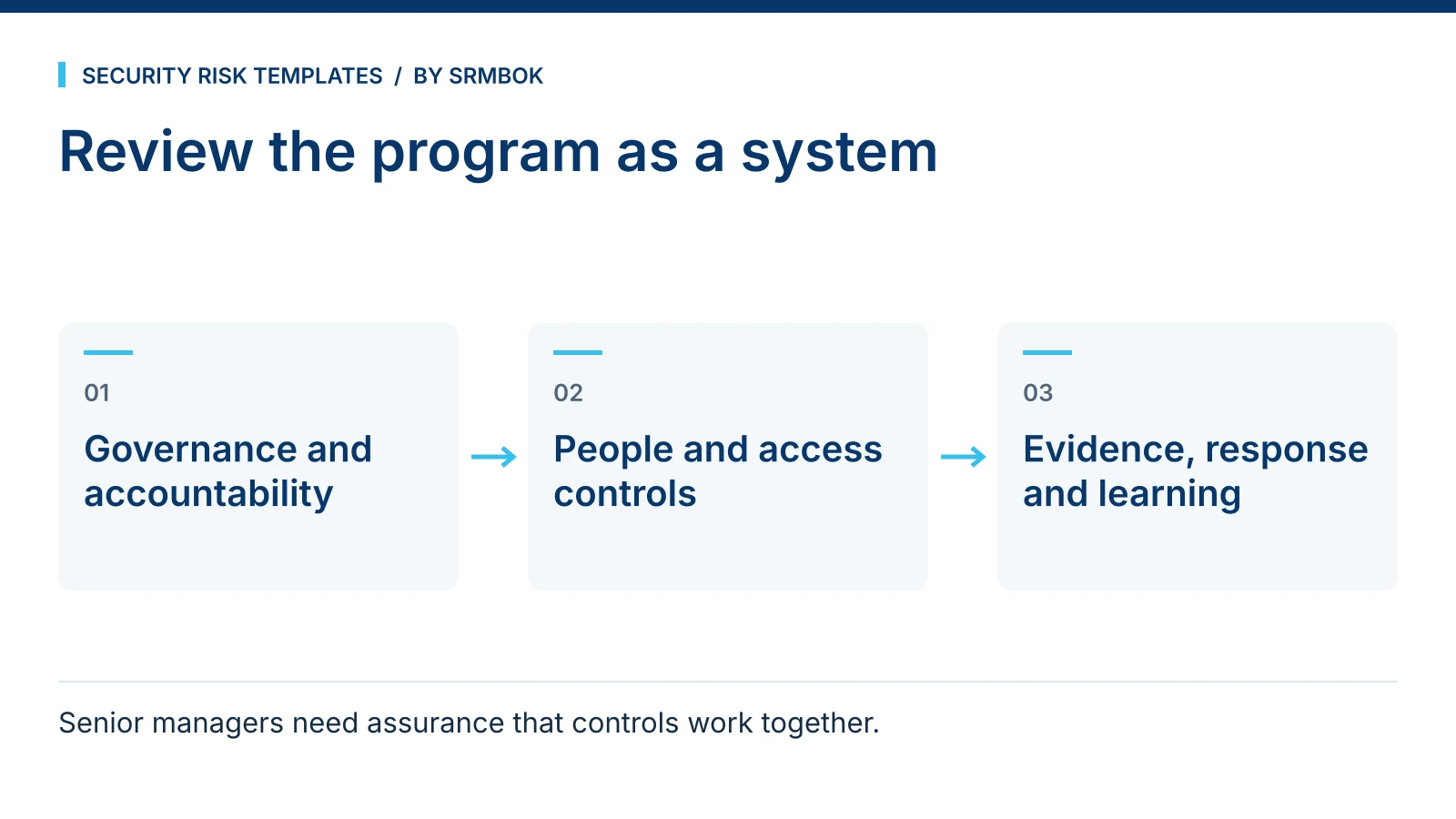
If insider threat has been delegated to a specialist team, you still need evidence that responsibilities and controls connect across the organisation. A management self-assessment can identify questions to investigate before you accept that the program is working.
Why this belongs with senior managers, not just security
That's not a criticism of security teams. It reflects where the actual authority sits: a security manager can flag that access is excessive, but only a senior manager can direct that a business unit give up access it's used to having, and it's that second step where most insider threat programs stall.
An insider threat program depends on decisions only senior managers can make: what access is genuinely necessary for a role, whether a concerning behaviour report gets acted on or quietly dropped, whether budget goes to background vetting renewal or to something more visible. A security team can design the controls. It cannot make an executive act on a report about a well-liked, high-performing staff member, and that is precisely the situation where insider risk most often goes unmanaged.
There's also a governance reason. If an insider incident occurs and causes serious harm, the question afterwards is rarely "did the security team have a policy." It's "did senior management know the controls were inadequate, and if so, why weren't they fixed." A checklist senior managers actually complete themselves closes that gap, because it forces the question to be asked at the level where the answer has consequences.
What effective insider threat management actually covers
A program with real coverage — as distinct from one that exists on paper — needs to address more than access control. It spans personnel security (screening at entry and at role change, not just at hiring), behavioural indicators (a process for reports to actually reach someone with authority to act), access governance (permissions that match current role, reviewed on a cycle, not accumulated indefinitely), and culture (whether staff believe reporting a colleague's concerning behaviour will be taken seriously or will damage them).
The evaluation question for a senior manager isn't "do we have a policy for this." It's "if I tested this control today, would it hold." Those are different questions, and a program can pass the first while failing the second completely.
Worked example
A fictional mid-size engineering firm asks its senior leadership to self-assess three areas before a planned expansion into a new government contract.
| Area | Documented position | What testing found |
|---|---|---|
| Access reviews | Quarterly access review policy exists | Last completed review was fourteen months ago; no one had followed up the miss |
| Reporting channel | Anonymous concern line advertised on the intranet | Two staff interviewed didn't know it existed; no reports logged in two years |
| Offboarding | IT ticket triggers access removal on termination | Average delay between termination and access removal found to be several days, not same-day |
Every one of these areas had a documented control. None of them, on testing, was performing as the documentation implied. This is the gap a senior manager's self-assessment is meant to surface before a contract, an auditor, or an incident does it for them.
Building your own insider threat self-assessment checklist
You don't need a large program to start, and you don't need to wait for a formal insider threat function to exist before asking the questions that matter. A workable senior-manager self-assessment covers, at minimum:
- Can staff report a concern about a colleague's behaviour confidentially, and do they actually know the channel exists?
- When was access last reviewed against each person's current role, rather than the role they were hired into?
- How long does it take, in practice, for access to be removed after someone leaves or changes role — not what the policy says, but what actually happens?
- Is vetting renewed on a cycle appropriate to the sensitivity of the role, or only ever completed once at hiring?
- Does anyone own the response when a concerning report is made, with the authority to act on it?
- Has each control claimed in the program actually been tested recently, or is its existence being taken on faith?
- Do staff in sensitive roles understand what would constitute misuse of their access, in concrete terms relevant to their job?
- Is there a defined escalation path for a concern about a senior or well-regarded staff member specifically, given that this is where reports are most likely to be quietly dropped?
- Are contractors and third-party staff with system or facility access covered by the same standard as employees, or treated as out of scope?
- When did senior management last see evidence — not a policy document, but evidence — that these controls are functioning?
Answered honestly by the people who can act on the results, these ten questions surface more real exposure than a much longer document that nobody at decision-making level actually reads.
Reporting this to the board
Insider threat sits awkwardly in governance reporting because it doesn't produce the kind of metric that fits neatly into a dashboard. A count of background checks completed says nothing about whether check 6 above — whether controls have actually been tested — would pass. Boards and senior executive committees are better served by a short narrative answer to each of the ten questions, with an honest rating of confidence attached, than by a compliance percentage that implies more certainty than the underlying evidence supports. If a senior manager can't currently answer question 10 with actual evidence, that gap is itself the most useful thing to report upward, because it's the one a board can act on by asking for testing to be commissioned.
Common mistakes
- Treating insider threat as an IT problem. Access logs matter, but the controls that most often fail are behavioural and procedural, not technical.
- Confirming a control exists without testing whether it functions. The gap between the two is where most real exposure sits.
- No genuinely confidential reporting channel, or one that exists on the intranet but that staff don't trust to protect them.
- Vetting treated as a one-off hiring gate rather than something renewed as role sensitivity or personal circumstances change.
- Offboarding access removal tied to an administrative process with no urgency, leaving departed staff with live access for days.
Take the checklist to your leadership team
You can't manage what you haven't honestly tested. SRMBOK's free Insider Threat Management Evaluation Tool gives senior managers a ten-item checklist to work through alongside the SRMBOK control effectiveness framework, customisable to your sector, so the gaps above surface in a self-assessment rather than an incident. For getting the underlying policy to a length your managers will actually read, see Why Your Risk Policy Should Fit on One Page. If your insider exposure extends into contracted labour or vendor staff, see Secure Supply Chain Policy Template (Free), and for personnel risk that travels with your staff, see Business Travel Safety Plan Template (Free).